



April 29, 2026
The Cat’s Cradle, or How to Play a Tongue
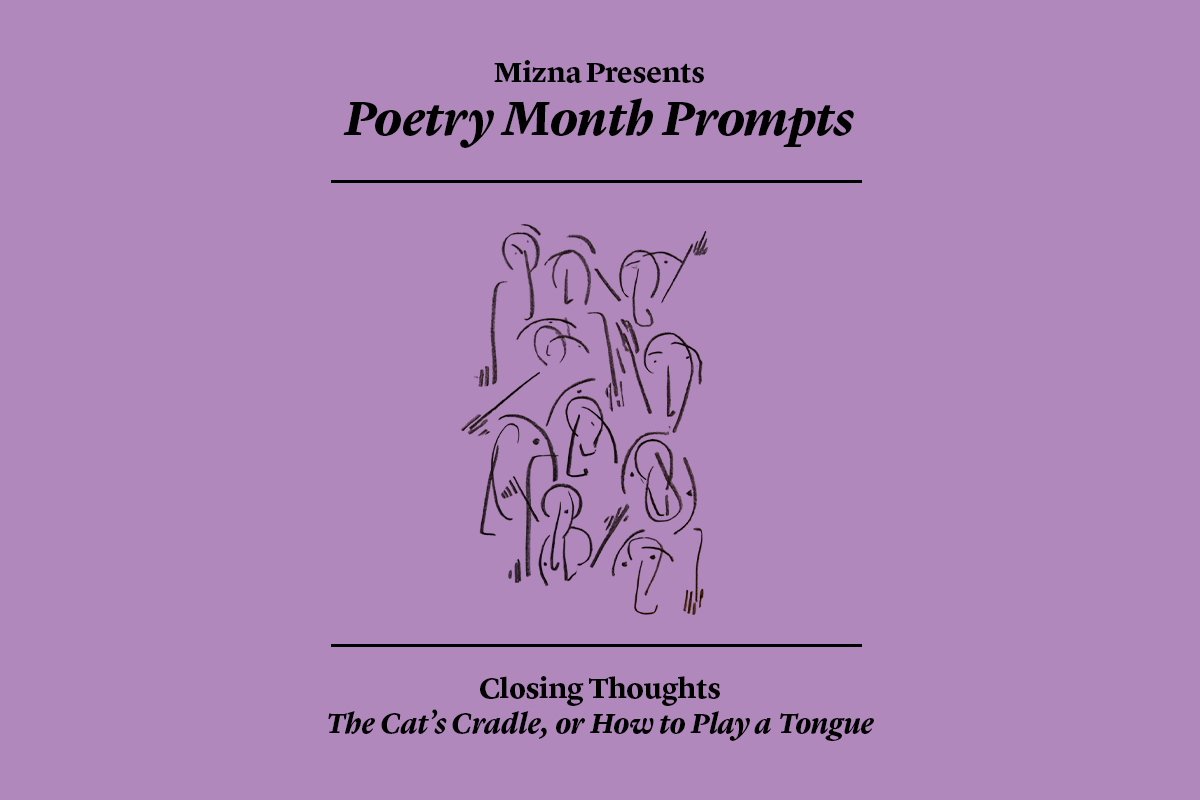
To mark the end of National Poetry Month, column editor Layla Faraj offers closing thoughts on the why and how of the editorial project. Reflecting on Mizna’s history of experimentation, disobedience, and playfulness—and during National Poetry Month and Arab American Heritage month—this Faraj’s project presented ten archival works and thirty original prompts exploring language and form in our community. Read the archival works and Poetry Month prompts here.
Setup: tie a piece of string into a loop.
I have always been interested in how our tongues conjure words: the gnaw, spit, lick, suck, and teeth required to get there. I am even more interested in how the tongue forks, trisects, or quarters itself up to make way for multiple languages. Is the mother tongue the space before the forking paths, or is it the path always taken? Is the colonizers’ language the dark expanse of wasted potential between the split, or is it the path most resented? How to make peace with the war in our mouths? How to remove the stink of mourning breath off of an English word?
Starting position: player 1 loops the string around both hands, twists it, and uses their middle fingers to pull the string through, creating the initial “cat’s cradle” shape (an X-shape).
I first wanted to explore this ongoing collection of works published by Mizna because of its potential to serve the reader of the journal I once was: a teenage girl living in an Arabic home, surviving an English world. Mizna was the Yes and of my early writing years. Yes English and Arabic. Yes Syrian and living in America. It was that Layla, sitting in her room with a bilingual reader in hand, who brought me here. I remember feeling most drawn to the blank sea of white between the two pulsing bodies of text—that clean and hopeful space begging for a messy connection. I searched for the invisible thread tucked away somewhere in that emptiness. Was there anyone else who longed to hold that thread in their hands?
Gameplay: player 2 uses their thumbs and index fingers to grab the X-shapes, pulling them through to form a new shape, such as “candles”.
It wasn’t until I read Mizna that I saw the threads pulled out and played with: a cat’s cradle with Arabic as one player, and English as the other. I had only ever encountered works of the “Western canon” in my education, and works of what I’ll describe as the “Arab-household canon”—those poems tucked into conversation and songs; Jibran Khalil Jibran in Fairouz’s voice; Ahmad Shawki in Umm Kalthoum’s; Mahmoud Darwish at the dinner table, bread still warm, my mother reciting, احن الى خبز أمي . When I grew old enough to have credit card access I bought my first copy of Mizna and placed it in my family magazine holder, discovering a set of works that combined those two worlds, coming together to form new shapes.
Progression: the string is passed back and forth, transitioning through various shapes like “diamonds,” “fish in a dish,” and “cat’s cradle” again.
Questions of language, it turned out, weren’t just swimming in my head. There was a whole community of writers with two internal players twisting, knotting, passing, and transforming threads. Enter: the kesra poem, the English ghazal, The Arabic form, and so many others. This column placed those works into conversation with one another, adding players together and seeing what new shapes they could create. I myself played with the knots and tried to untie them, and I wanted others to try and untie their own knots too. It felt only natural then, to curate the folio during National Poetry Month, where the poems could serve as a guide for other writers, searching for a way to make sense of their own messy threads. I wanted to awaken our linguistic players who might be lying dormant. I wanted to say, take your tongues and let them speak over, fight, relent against, or question one another. Find your threads and begin to play.
Goal: to continue the sequence of shapes without causing the string to become tangled.
It can feel nearly impossible to arrive at an answer to these nagging questions, to avoid things getting tangled. In fact, it probably is. But the writers I have had the honor and pleasure of curating do something worth noting: they keep playing. And perhaps even more exciting, they all arrive at different conclusions. No two are the same in form nor in content; no two can be undone the same way, and no two can be replicated once undone. I imagine that this column could be run every year and each year it would come to different conclusions. This year, I leave you with this: you can be understood by many, or no one at all. You can beg or you can berate. You can fold in or you can excise. The search matters more than the answer; you have to believe that one day it can all be untangled.

Layla Faraj is a Syrian-American writer, translator, and editor who received her B.A. in English Literature from Barnard College. Her own work has appeared in LitHub, ArabLit Quarterly, The New York Times, Even/Odd Studios, and elsewhere. In addition to her work with Mizna, she is currently translating a Gazan diary with HarperCollins.
Related
The Bringers of Violence
Mizna 22.1 Foreword: On SWANA Literature + Art

“Black Lives Matter” by Anis Chouchene

RAWIfest 2023