

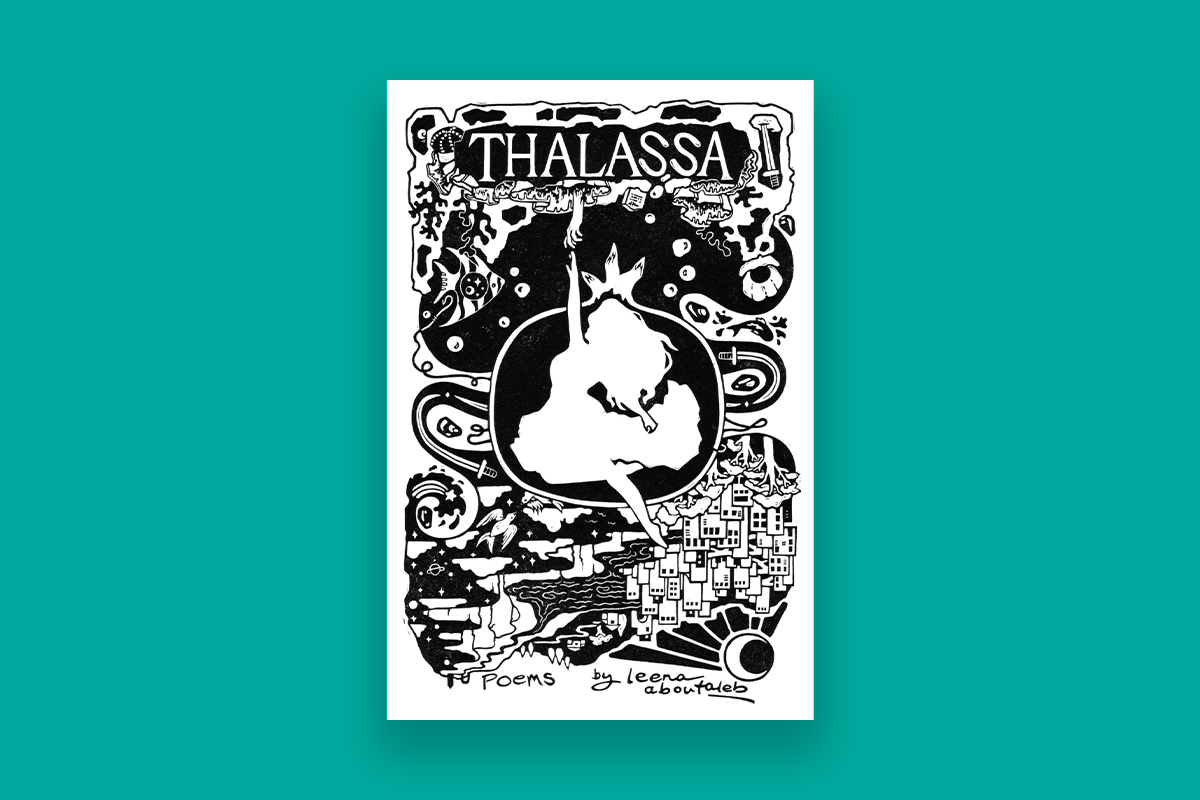


July 7, 2026
Excerpt from THALASSA – Three Poems
Today, Mizna celebrates the launch of habibna leena aboutaleb’s poetry debut, THALASSA, out now with Game Over Books. This is one of the most gutting, moving collections of poetry I’ve read in recent memory. In part, an elegy for a brother beloved beyond the point articulable in language; in part, an auto-mythographic reckoning with many worlds of Palestinian grief; this collection of mostly prose poems embody different shapes of breathlessness, of holding and never letting go, all gestured toward the central stake: memory. Unsurprising as this is for a long-time Mizna contributor like aboutaleb, whose work was central in solidifying the editorial vision for issues like Myth & Memory. Here, I am reminded of Etel Adnan writing, “Memory is all that I am,” in Night. There is something deeply relational, deeply life-affirming, about how aboutaleb’s speaker remembers her loved ones: a graveyard confession affirming, “every time I return to your ending, I find myself at the beginning of time,” or the small intimacy of an “I love you” preceding a “Kan ya makan,” or a poem that opens “I love the temporary. I have to go.” only to end “I am a fragment splintered along the riverbed of my ancestors and their lovers.” Of aboutaleb’s book, Fargo Tbakhi writes: “from inside this state of misery—Palestinian misery, sisterly misery, the misery of being alive in countries addicted to death—THALASSA runs desperately, unceasingly, towards love.” This was a slow, difficult read for me, because this is a book that returned me to the devastating, light-like fact of time; a book that breathes, as it grieves and loves, in time. In a world that lifts its arms and discards entire timelines of Palestinian being and potentiality, here is a lyric density that demands love as a form of attention, that looks unflinchingly into the most abject and necrotic of spaces and, in mourning giants like Refaat Alareer (allah yerhamo), writes: “It is not God I have grievance with; it is humanity.” Here is a grief poetics that is unafraid to hold up a mirror to its audience, in the beating heart of empire, and ask: can you bear it? Are you ready to do what love requires of us? “Love will reinvent you,” writes aboutaleb, “I am made of all the people who love me. I know exactly who I am.”
—George Abraham, Editor-at-Large
Love will reinvent you. I am made from all the people who love me. I know exactly who I am. Why do you still believe we are made out of images and not hearts? Are we all martyrs? My brother will take seven. Only God can dissolve me. Only God can judge me.
—leena aboutaleb
elegy (i); the grave
with lines from Diana Khoi Nguyen’s Ghost Of
I wake in the morning, buried. Fell asleep to your corpse, body long gone. Akh, what have you done habeebi? Syrian wails stealing Mama’s throat. How selfless a mother’s love. I have spent a decade nightmaring your grave wa I will spend the rest of my life dreaming of a brother eternally twenty-five. Tell me how dates taste there, how sweet your soil, how warm the cloth. Do you feel the coffee I make us, the tea, the bateekh, what about the salt on my skin? Never meant to die that night, habeebi, I know. There is a dagger in my throat until I die for you—if your brother dies is killed kills himself is alive you will see your brother. I see you, habeebi, for months. The closest since we were children with shrapnel. You begin to own the shadows. You become mazes wa corridors. I wake up in a mess of tears. Is it cold underneath? Is death warm? Please, turn, look at me, face me. Tell me you are okay. I want to see our eyes one last time. Look at what you have done. Let me die with you, please, let me see our eyes once more, please, let me see your face once more. I wake in our old home. You are with our dead, laughing, cigarette lesa fil eedak wa you ask me to laugh with you, how can I ever say no? We are both dead. I wake up in your grave on my luckiest days. You died and became celestial. Time is your hands, our fates threads you witness—I want to die you told Baba the morning of—fortune teller inta, did jinn whisper, did you laugh? If your death was not gentle, I will kill the Angels with my hands. I swear by my heart, on my eyes. Did you smile when I put soil on your grave? I fought my way past the men for you. I refused to leave you. I held you blue for hours. I kissed your eyelashes. Please, look at me. I am begging for one more second. I want to see our eyes one more time. Please. Look at me. Tell me how I am to live and die now. How am I made to wake up in death. Tell me how can I love without craving my face open to show them what you left behind—a desperate sister—Yousef, tell me what you have done, please—I want to see you with our eyes, Yousef, look, you were alive once and I am dead now Yousef I am glad you are dead Yousef I will laugh with you forever Yousef I will stay in this grave with you until time ends Yousef please don’t be lonely Yousef I am glad you are dead I am dead I stay alive and you are dead I eat the flowers how Mama trained us—fedayeen—I find the sea to you, Yousef, ya Yousef, habeeb albi Yousef, I am happy you are
Mythos
after Sappho
I shall love weapons. Note our beautiful times and beautiful land. Tie together a gentle crown of anise. Let the woven violets lose and regain their petals. Let the garlands rest on the softness of my throat. Let the motion of light frame my portrait. Let me lose myself in my longing. I am on the world again, seeped in Holy, my Land making. Sweet almond oil, fresh tides of jasmines, rosemary water, crushed hibiscus. The dazzle of dawn, my father gathers a lamb. The bride is made of miracles and sacrifices, as aching and hidden as time’s cycle. I am no one’s beloved. My light stretches the sea, rinsing its salt from banks. You, all teeth and beautiful cheekbones, my drowsy reflection, the morning ache and nightly ritual. A fawn trembling in grief. Let the moon hang herself for you. Our memories exiled, leaking away. I am broken in longing. A grievous wish. You stole me the first night I slept in the new land, so close to the pilgrimage. Bridegroom, the veil of purity against the evening light. The moon cries, wishful Andromeda hidden behind a laurel tree and sweet flowering cloves. You pick an apple, unknown to us besides nativity. The mountains are your shepard. Unable to reach. Blest, blessed, my beautiful groom. My form stepping from the fog. In the night, Astarte returns to renew me into your wish, your sapling, your mythweaver.
Persephone’s Sword
Dance with me, your hand on my hip. Listen for the beggars. Call for mercy. Do you have a shekel to spare? I lost my gold in Amman and wept for months. Where have you touched me? I closed my eyes and the sky fell. Glory. Transparency. Lie of a small oppression. Photograph of grief: my father curled towards the window, bereft of his son .يا ضناي I would give the world to you. In Frankfurt Airport, I bought a 30 minute shower and cried the entire way through. There is always a before and after. I no longer remember who I was before your death. I collect photographs to remember what I looked like once. I am amazed every time that I find myself beautiful in the midst of it all. July. October. Have you grieved enough? Sometimes I imagine Cairo now, how different it is with no one left for me to love inside it. Are we drawing up new names for the seas and its prophecies? There’s a river gleaming, golden mists, glided stones crushed on the tongue of waves. To be human is to despair, wretched in devastation. To be human is to ride a train to Alex, collapse on the seabed and find eternity in our love. Look, the world has ended. Do you see it too? That doesn’t mean there isn’t something still worth living for. The grotesque horrifies me, others find solace in it. Why make lust from a feverish human lost in limbo between species? Love will reinvent you. I am made from all the people who love me. I know exactly who I am. Why do you still believe we are made out of images and not hearts? Are we all martyrs? My brother will take seven. Only God can dissolve me. Only God can judge me. Go back. There is still time. Why are you so ready to transcend humanity? There are no flowers on the moon. You know I love the sea. I love being human. I love this earth. I love my grief. I love my desire. I am not meant for this. I am not meant to flee from the horrors of my humanity. The wind is calling. Persephone, our language a secret. Our bodies, held sweet. I’ll see you soon. The afterlife is home as much as the sea and the land. My sword, my gentle sword. You are a part of me still.
Note: these poems are from THALASSA (2026), which was published by Game Over Books. It is reprinted here with permission of the author and publisher.

leena aboutaleb is an Egyptian and Palestinian writer who asks you to commit to the Palestinian liberation struggle. She is the author of THALASSA (Game Over Books, 2026). Her pamphlet, Expeditions of Projection, was released in 2023 (VIBE). Her film, ‘Oracle,’ co-produced with Youssef ElNahas debuted in Venice, 2025. She is a Brooklyn Poets fellow, a Kundiman fellow and Tin House scholar. Read her work at www.leenaboutaleb.onl.
Related
The Bringers of Violence
Mizna Film Series 2023: Resistant Images- Restoring, Recovering and Reimagining Palestinian Archival Film
Mizna x AAWW: Announcing I WANT SKY
CALL FOR FILMS: 8th Twin Cities Arab Film Festival