



August 4, 2026
30 More SWANA Books to Read in 2026
2026 continues to be an exciting year for SWANA literature, with many stunning debuts, new releases and translations from longtime favorites, and experiments in new genres. I’m particularly excited by the excellent slate of nonfiction and poetry being published in the second half of the year, as well as the many brilliant works in translation I’ve read so far. These stories and poems are political, challenging, thoughtful, mystical, speculative, and full of love—for community, for culture, and for the futures they envision. Here are 30 more new SWANA books to read in 2026; some I’ve read all of, all I’ve read some of, and all offer something truly new and special to the wonderful world of books.


NON-FICTION
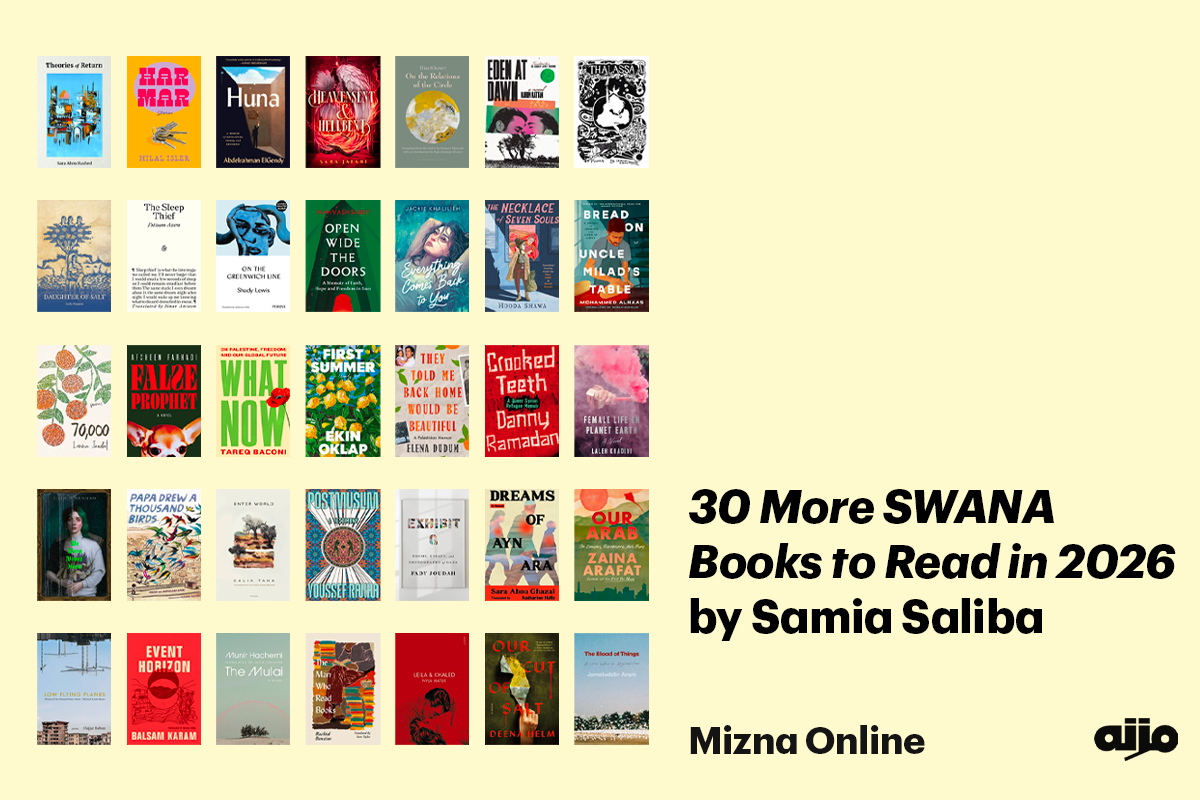
Crooked Teeth: A Queer Syrian Refugee Memoir by Danny Ramadan (Soft Skull, August 18)
This tender memoir explores the author’s overlapping identities and the ways they are too easily misread, misunderstood, and positioned against each other. Moving from his difficult and beautiful childhood in Damascus to his present life as a writer in Canada, interrupted by many violences, Ramadan’s writing is clear and direct but never without the vivid detail of a truly lived-in life.
Open Wide the Doors: A Memoir of Faith, Hope, and Freedom in Iran by Mahvash Sabet, trans. Bahiyyih Nakhjavani & Azita Mottahedeh (Oneworld Publications, August 18)
Sabet is an Iranian poet and activist who has been repeatedly imprisoned and targeted as a leader of the Baháʼí community. This memoir recounts the beginning of her longest incarceration, from 2008 to 2017, in vivid, visceral prose. It’s a powerful prison memoir, propulsive despite the stagnancy of life imposed by carceral systems. Sabet was rearrested in 2022 and remains in prison despite her deteriorating health.
Huna: A Memoir of Revolution, Prison, and Becoming by Abdelrahman ElGendy (Hogarth, September 1)
One of my personal most anticipated books of 2026, Huna is a harrowing lyrical memoir of ElGendy’s years in prison after being arrested with his father by the Egyptian military at a protest when he was only seventeen years old. The beautiful writing in this book captures the physical horrors of incarceration and the possibilities of resistance through love, writing, family—blood and otherwise—from within the prison’s walls.
Our Arab: On Longing, Belonging, and Hope by Zaina Arafat (Little Brown, September 8)
Following up on her incredible debut novel You Exist Too Much, Arafat makes her non-fiction debut in this ruminating essay collection on diaspora. These essays explore the current role of the Palestinian diaspora writer during genocide, moments of political possibility and the potential for Palestinian acceptance in America that may no longer exist, and the choices we make to find belonging, however troubled, wherever we may land.


The Blood of Things: A Love Letter to Afghanistan by Jamaluddin Aram (McClelland & Stewart, September 15)
Aram’s essay collection is poetic, rich, and gorgeous, even as it captures the harrowing traces of war and displacement. From intimate portraits of the deep social memories you lose when you are forced to leave the country of your birth, to sharp criticism of contemporary Afghan literature and its treatment of Hazaras, this expansive collection may be the non-fiction book I’m most excited to see find its readership this year.
Postmuslim: A Testimony by Youssef Rakha (Graywolf, September 15)
I really enjoyed Rakha’s first English novel The Dissenters last year, and Postmuslim is an intellectually rigorous, beautifully written, and often delightfully funny follow up to some of that book’s political questions, in the form of an essay collection. If you’re interested in questions of imperialism, faith, and identity, or if you’re a fan of 90s rock music, this book should definitely be on your radar.
They Told Me Back Home Would Be Beautiful by Elena Dudum (Atria/One Signal Publishers, October 27)
I saw Dudum read an essay virtually a few years ago and was struck by her electric prose. I was immediately thrilled when I learned her debut memoir would be published this year. This book is a moving rumination on how Dudum came to understand what it means to be Palestinian throughout her life—in the eyes of the world, in the eyes of her family, and within herself.
What Now: On Palestine, Freedom and Our Global Future by Tareq Baconi (Washington Square Press, November 3)
Following up from his incredible memoir from last year, Fire in Every Direction, Baconi is back with an impressive collection of political writing which attempts to lay out a path into the future from the unfathomable despair of the ongoing genocide in Gaza. Speaking first and foremost to his fellow Palestinians, Baconi interrogates with clear eyes and vital reflection what it will take to bring about Palestine’s liberation.


POETRY
Theories of Return by Sara Abou Rashed (Diode, April 16)
Though I’m cheating a little since this came out in April, this stunning debut collection was too good to pass up (and not yet announced when I published my last installment). Abou Rashed’s gorgeous imagery is precise and devastating. Through the simple truths of a familial history marked by multiple exiles, her poems speak honestly, inviting us to feel the weight of the world.
Daughter of Salt by Leila Farjami (Trio House Press, July 1)
Farjami’s debut collection is dream-like, populated with images and conjurings of the sea, of ghosts, of lineage. In the midst of her beautiful dreamy phrases, though, there is always a profound violence—of history, of war, of gender. The book’s most frequent apparitions are the speaker and her mother, always intertwined across spaces, across hardships, trying to care for each other.
70,000 by Lenna Jawdat (Central Avenue Poetry, July 7)
It’s exciting to get to see visual and experimental poetry given the space to shine in a debut poetry collection like this. Amidst, within, and between her words, Jawdat writes by hand the numbers 1-70,000 to catalog all the books stolen from Palestinians during the Nakba. 70,000 is an insightful patchwork of numbers, shapes, archives, prose, poetry, memory, and that which is lost.
THALASSA, by leena aboutaleb (Game Over Books, July 7)
This debut collection is unique in its form. It is rich with narrative, somewhere between prose, poetry, and drama, following its speaker on a journey into the underworld as she mourns the death of her brother. aboutaleb has written a profoundly moving collection that blends genres as much as it blends our world and the next, one which invites the reader to share in the motions of grief and remembrance.
Low Flying Planes by Hajjar Baban (Milkweed Editions, August 25)
Yet another incredible debut, Baban’s first full length collection is a stunning provocation of language. Tracing the shared and divergent experiences of colonialism that shape her Kurdish and Afghan heritage, Baban writes of surveillance, of warfare and genocide, of the rocks thrown in resistance, and of the language we are all missing in describing these histories. Her poems take shape through and within a language of absence.
Exhibit G: Poems, Essays, and Photographs of Gaza by Fady Joudah (Milkweed Editions, September 22)
Though most easily categorized as a book of poetry, this collection is more of a hybrid work, combining original poems by Joudah, translations of poems by Rawan Hussien and Nima Hasan, photographs from Gaza by those working with the Gaza Soup Kitchen, and lyric essays by Joudah. This collective witnessing and preservation of memory amidst genocide is vital reading, as full of life as it is devastating.
Enter World by Dalia Taha, trans. Sara Elkamel (Graywolf, November 3)
From a writer already prolific in Arabic, Enter World is Taha’s first work translated into English. In her beautifully honest, direct language, Taha catalogues the images and details of life under occupation, the persistence and destruction: children, hills, weapons factories, casualties of war, apartheid, memory, poetry, the sea, beauty. Each striking poem creates a world of its own, while together they deconstruct the cruelties of the world in which they are made.


FICTION
Event Horizon by Balsam Karam, trans. Saskia Vogel (Feminist Press, March 31)
Another missed title from earlier in the year that’s so exciting I had to include it! It’s a feminist speculative tale about a young revolutionary from a community of women and girls banished to a place they call the Outskirts who build a new society in exile. In a nonlinear narrative, this book follows Milde as she grows, resists the state, is incarcerated and tortured, and, eventually, launched into a black hole, her final exile.
False Prophet by Afsheen Farhadi (Melville House, July 7)
Farhadi’s debut novel follows an actor who, reeling from his mother’s death, gets himself into a sticky situation when he lies about his mother’s involvement in the Jonestown cult during her youth in Guyana. When his agent enlists him to write a memoir about this history to bolster his career, he sinks further and further into the lie… It’s a breezy read and a fun, unique story!
Har Mar: Stories by Hilal Isler (Curbstone Books, July 15)
For short story lovers, this collection is bright and strange, following a broad range of characters between Turkey and the US, each of them navigating the rough edges of their lives in some profound way. Some of them are tied up in complex, intimate labor relations, while others face the unsettling and uncertain world of romance. An exciting debut collection!
On the Greenwich Line by Shady Lewis, trans. Katharine Halls (Peirene Press, August 4)
This dry, witty novel—about a disillusioned London housing officer who is tasked with planning a funeral for a twenty-year-old Syrian refugee he’s never met—actually made me laugh out loud over and over. Lewis makes the horrible stuff of neoliberal austerity, bureaucracy, and anti-refugee policy the butt of the joke, crafting an emotionally stunning portrait of the vital ways people show up for each other against it all.
The Mulai by Munir Hachemi, trans. Julia Sanches (Coach House Books, August 11)
The Mulai is a thrilling follow up to Hachemi’s excellent debut, Living Things. Told through the ethnographic snippets of a researcher from Earth, this strange and speculative novel explores the post-apocalyptic space society of the Mulai, a people who have transformed their practices, language, and religion since being cut off from Earth more than a century earlier. In any genre, Hachemi’s writing is always playfully philosophical, dark, and hopeful all at once.


Leila & Khaled by Nyla Matuk (House of Anansi, August 11)
On the surface this is a story about an intense unexpected romance between a Palestinian-Canadian film professor and a younger Palestinian man serving as her delegation’s tour guide in Palestine, but at its core this book is an intellectual rumination on land, history, displacement and belonging. It’s a wonderful debut driven by the allure of home, in all its shapes,
Dreams of Ayn Ara by Sara Abou Ghazal, trans. Katharine Halls (Feminist Press, August 18)
Another of my most anticipated, this lively, brutal, funny novel tells the story of a Palestinian family in exile over decades, from Shatila camp to the streets of Stockholm. Moving with ease back and forth across time and perspective, between family members and from first to third person, this book captures life and place in vivid details, as if piecing together oral histories and ephemera to conjure a likeness of the world.
First Summer by Ekin Oklap (S&S/Summit Books, August 18)
This debut novel tells the story of two teenage girls who find friendship with each other one summer through their shared loneliness. The story is cut through with excerpts of a space story the girls share a love for. They still hold onto their childlike wonder, but their growing friendship opens up into a more adult kind of love. It’s a tender, queer story and a quick, enjoyable read.
Our Cut of Salt by Deena Helm (Tor Nightfire, September 22)
An eerie family saga, this book follows three generations of Palestinian women whose lives have been irreversibly unsettled by the Nakba as they grapple with the haunting of their family home in Haifa from which they were displaced in 1948. If you enjoyed Anbara Salam’s The Salvage, you’re sure to get invested in this gothic speculative renarration of Palestinian history and exile.
The Sleep Thief by Ibtisam Azem, trans. Sinan Antoon (And Other Stories, September 22)
From the author who gave us the incomparable Book of Disappearance, this sharp novella is a fast, captivating read. In brief, almost short story-like vignettes, it follows Gharib Haifawi, a Palestinian living in the Zionist state, through his life as he grows up, finds and loses love, experiences the violence of Zionist prison, interfaces with his colonizers, and tries in different ways to resist. Azem’s words and tales are as brilliant and vital as ever.


Female Life on Planet Earth by Laleh Khadivi (Ecco, September 22)
I was immediately stunned by Khadivi’s meditative writing in this book. It follows a woman whose mother has recently died and who learns of her mother’s secret, militant past life that upends her understanding of the woman she loved. It’s a book as funny as it is reflective, a tale of grief, feminism, inheritance, and the pieces of our parents we’ll never really know.
Eden at Dawn by Karim Kattan, trans. Jeffrey Zuckerman (Restless Books, September 22)
Eden at Dawn is a dreamlike, magical, almost biblical tale of two Palestinian men falling in love in Jerusalem in the midst of occupation and war. As the khamsin winds bring dust to every crevice of Palestine one summer, a celestial narrator observes the two men, Isaac and Gabriel, as they grow up, change, encounter each other, and embark on a journey together. A singular and beautifully rendered story.
Bread on Uncle Milad’s Table by Mohammed Husayn Alnaas, trans. Sawad Hussain (HarperVia, October 6)
Winner of the 2022 International Prize for Arabic Fiction, this novel unfolds in the oral storytelling tradition, as our narrator Milad crisscrosses his life to an unknown listener. From his childhood learning to bake bread in his father’s bakery, to family drama and expectations, to the changing social and political landscape of Libya, to the crushing weight of society’s imposed expectations of masculinity, Milad’s stories are rich and real.
The Man Who Read Books by Rachid Benzine, trans. Sam Taylor (Cardinal, November 10)
This meditative short novel, grounded in the tradition of oral storytelling, follows a young French photographer who is dispatched to Gaza in 2014 where he encounters an elder Palestinian bookseller who begins to dictate his life’s tale to the photographer. Profound despite (or because of) its brevity, this novel probes the powers and limits of memory, storytelling, and literature amidst destruction.
On the Relations of the Circle by Elias Khoury, trans. Yasmeen Hanoosh (Archipelago, December 1)
What a blessing to still get new Khoury books to read even after he’s gone. Though this is actually his very first novel, it has never before been published in English! This novel unfolds like the fragmented memories of childhood, tracing the orphan Mansour through his encounters with his world and surroundings, mystical and material. A gorgeous and poetic tale and a perfect end to a brilliant year of books.


Young Adult
I’ll conclude, as usual, with a nod to some forthcoming SWANA Young Adult titles. Here are five exciting titles that show the huge range of YA, from gothic to romance to fantasy to work in translation to memoir.
We Were Never Here by Sophia Hannan (Simon & Schuster Books for Young Readers, July 28)
Everything Comes Back to You by Jackie Khalilieh (Tundra, August 4)
Heavensent & Hellbent by Sara Jafari (Delacorte, August 11)
The Necklace of Seven Souls by Hooda Shawa, trans. Nour Jaljuli & Sawad Hussain, ils. Nada Esmaeel (Yonder, September 1)
Papa Drew A Thousand Birds: A Memoir by Maren & Ahmadjan Amini, ils. Marianne Martens (Levine Querido, November 3)
Samia Saliba is a writer from Washington state and a PhD candidate in American Studies & Ethnicity. She is the author of the chapbook conspiracy theories (Game Over Books, 2025), and her poems have appeared in Split This Rock, Apogee, AAWW, Mizna, and elsewhere. Find her at samiasaliba.com.
Related
The Bringers of Violence
Gaza 2 Khartoum

Mizna 22.1 Virtual Launch
Mizna at AWP 2023