



August 20, 2026
Two Poems from Nima Hasan
trans. Huda Fakhreddine
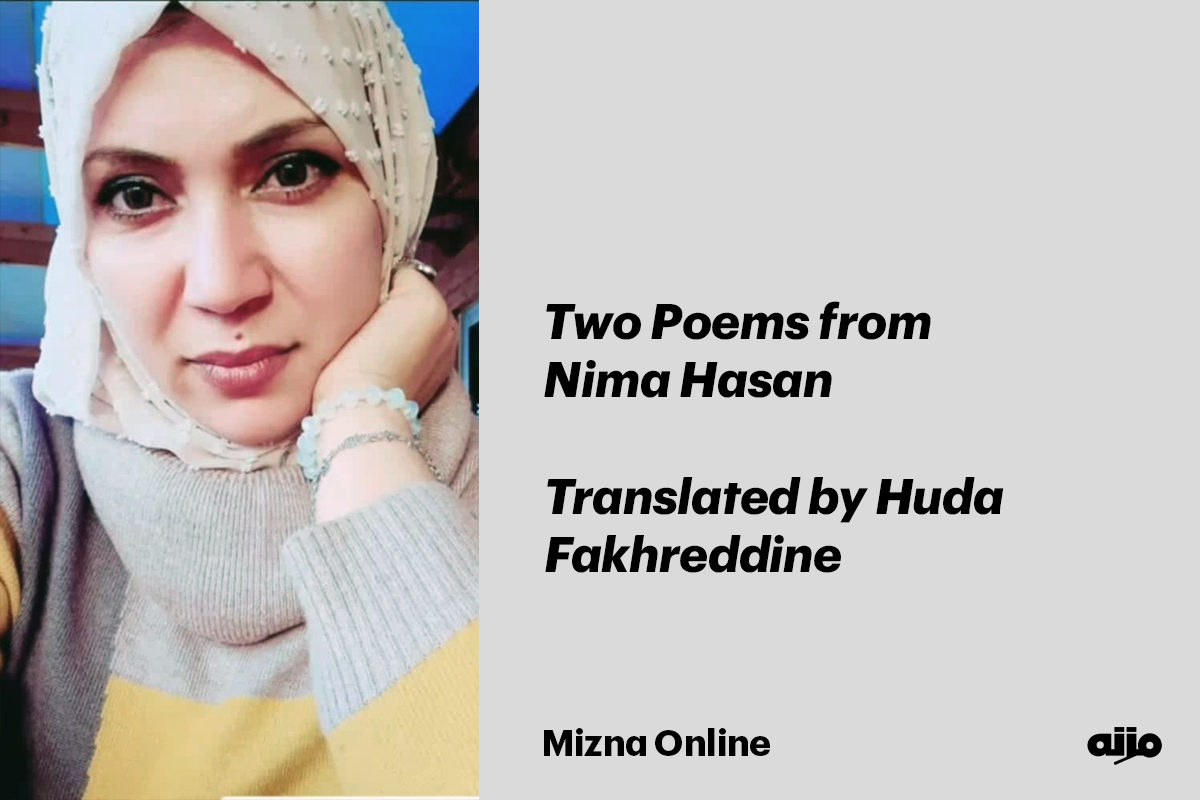
“Perhaps these poems will help keep my children alive,” Nima Hasan texted me once, leaving me with nothing to say. She is a poet and a single mother of seven surviving a genocide in Gaza. She continues to write poetry on the front lines of life and death and remains able to summon the playful, witty, and defiant energy of love in words. Her voice is unmistakable. You know it is Nima, whether the poem is short or long, complete or unfinished, posted on a bad day or less than bad one.
The frankness of her statement, stripped of metaphors to lessen the blow, left me unarmed. This is poetry for survival as literally as that. It is a strategy or a hope that belongs to the most potent and invincible tradition of Palestinian resistance. In the face of unspeakable horrors that have been inflicted on the Palestinian for the past 80 years, the Palestinian’s invincible weapon thus far has been language, the insistence of living and loving in language. The louder and the clearer the Palestinian voice is, the smaller and more transient the atrocities of the settler, the occupier, the genocider, and the hypocrite appear to be. Because when a people, in times of calamity, entrust language with justice, they count on memory and imagination to defeat time again and again; they count on a victory in time.
The Other that Nima speaks to, flirts with, or taunts in her poems is a lover, a friend, or the memory of a self and city before horror. It is also someone on the other side of language, on the other end of a poem. And can you imagine the hope and strength this requires? To be a poet in Gaza, a mother of seven, who still reaches outward through language to strike back at a brutal, depraved world in a sentence: a string of words arranged to provoke, to aggravate, to unsettle, or simply to allow the world’s complicit silence to ring louder in our ears. Her simple and precise language captures the silences that force us to begin to imagine the states of mind and interior worlds with which she faces the daily monsters of genocide, from the most mundane to the unimaginable realities of life in a tent. Still, her poems resist turning into documents or inventories of suffering. They insist on being poems: intimate, interior, and true to the complexity of a mind confronting what should be impossible to comprehend.
Follow her. Allow yourself to be in the presence of her language. She is still here, still writing, and still thinks that you are worth speaking to.
If this work spoke to you, please consider reading more about Nima’s story and donating to her GoFundMe campaign to find safe passage out of Gaza.
—Huda Fakhreddine, translator
A brick is missing from my side.
Dancing with me will make you a clown.
And soon, all of you will fall
into me.
—Nima Hasan (trans. Huda Fakhreddine)
You
There is no other form.
Just you and the idea of you repeated.
Your perfume bottle empty.
Your place in hell already assigned.
Nothing frightens you anymore.
Is the peak of this earth
within you?
Climb up, then.
Nothing stops.
Try to hold me.
A brick is missing from my side.
Dancing with me will make you a clown.
And soon, all of you will fall
into me.
Hold yourself tight.
The step that separates you from me
is also me.
No one abandons themselves without
getting to know themselves first,
even if a little.
No certainty in the light or the dark.
Strike the path with your foot
before you stumble
and befall me.
I do not want to survive you.
أنت
لا يوجد شكل آخر
أنت نفسك فكرة معادة
زجاجة عطرك فارغة
مكانك في الجحيم متفق عليه
لا شيء يخيفك بعد الآن
أين تقع قمة الأرض
داخلك
اصعد
لا شيء يتوقف
حاول أن تمسكني
في خاصرتي لبنة ناقصة
الرقص معي سيجعلك مجرد بهلوان
سيسقط كلك الآن داخلي
تمسك بنفسك
الخطوة التي تفصلك عني
هي أنا
لا أحد يغادر ذاته دون سابق معرفة
لا يقين للضوء أو العتمة
اضرب الطريق بقدمك
قبل أن تتعثر
أو تحدث لي
لا أريد أن أنجو منك
* * *
An Embrace
I gather a bouquet of flowers
to cradle this grief,
or give it color, at least.
There are no sidewalks
where I can pick a flower
worthy of a homeland
that sings passionately
behind your ear.
I try to count the seasons,
while your arms, growing green,
flourish into a secret garden,
and I am its fence.
You, me,
and a handkerchief
mothers hide away
for a cold night,
we all know that
an embrace can bring
the dead back to life
in moments of darkness
when evening tucks away
a solitary tent.
عناق
تحتضن هذا الحزن
أو تجعله ملونا
لا أرصفة على الطريق
أنتقي منها
زهرة تليق بوطن
يغني خلف أذنك بشغف
أحاول عد المواسم
وذراعاك المائلتان للخضرة
تكبران بترف
في حديقة سرية
أنا السور هناك
أنت
وأنا
ومنديل
خبأته الأمهات
لليلة باردة
نعرف
أن العناق يحيي الموتى
في لحظات العتمة
حين يغلق المساء
باب خيمة وحيدة
Nima Hasan, a mother and single caretaker of seven children, is a writer, poet, and social worker from Rafah. Her published works in Arabic include the novels Where the Flames Danced and It Was Not a Death and the book Letters from a Perpetrator. Her poetry has been published and translated widely in print and online publications. She was awarded the Samira al-Khalil Prize in 2024 and a selection of her writings during the genocide were published bilingually, in Arabic and French translation by Souad Labbize, titled Be Gaza (Les Lisières, January 2025). Ḥattā lā yatrukanī al-dawʾ (So the Light Won’t Leave Me), a collection of Nima Hasan’s poems written in the second year of the genocidal war on Gaza, was published by AlNasher Publishing in Ramallah, Palestine with an introduction by Rania Jawad, assistant professor of English Literature at Birzeit University.
Huda J. Fakhreddine is a writer, translator, and associate professor of Arabic literature at the University of Pennsylvania. She is the author of Metapoesis in the Arabic Tradition (Brill, 2015) and The Arabic Prose Poem: Poetic Theory and Practice (Edinburgh University Press, 2021), and her latest translation is Ruins and Other Poems (World Poetry Books, 2025). Her current book project, Our Oracle Ruin: Reading the Arabic Poetic Tradition in the Time of Genocide, is forthcoming from the University of California Press.
Related
The Bringers of Violence
Three Poems

Anti-Biography
Hell Is Empty and All the Devils Are in Gaza and Other Reflections