



September 18, 2026
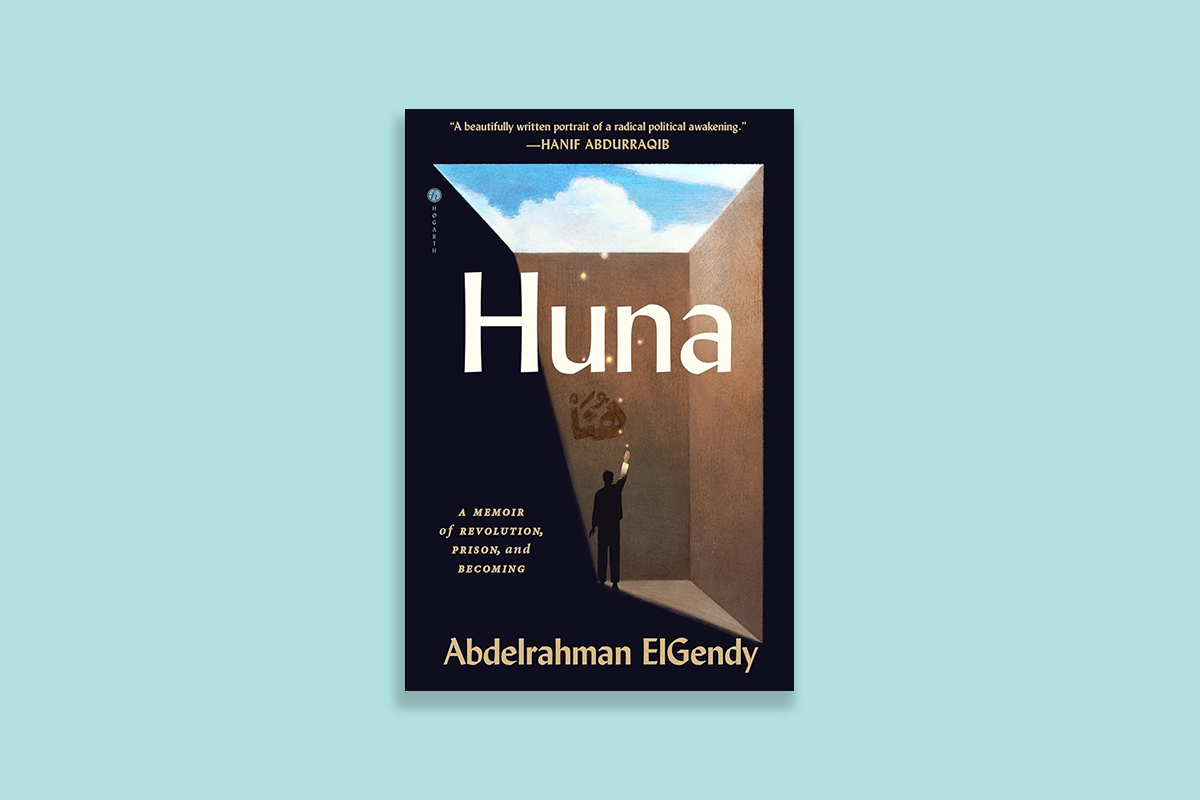
Litterateur as Saboteur: Review of HUNA by Abdelrahman ElGendy
There are no words capable of describing the feeling I had—after spending months of my life immersed in Abdelrahman ElGendy’s Huna, the book itself becoming a comrade, a textual accomplice in my life, as I mourn the physical distance from my dear comrade and accomplice Gendy himself, who has written about having to flee the US—seeing news that Huna was longlisted for the National Book Award in Nonfiction. No award could ever be capable of capturing the feeling of weeping with ElGendy’s recounting of the prison ‘anbara; of having to physically put this book down several times for weeks at a time, because this story was not a metaphor; of returning and re-returning to Huna, within the many hunas of my living and resisting, texting excerpts to comrades, students, colleagues, and poets nearly nonstop over the past several weeks. There is no image that comes to my mind besides a circle: a Morrison at the end of Sula circle, a Layli Long Soldier in the dead center of Whereas circle, a Lena Khalaf Tuffaha saying “repetition is a nakba” circle. The brilliance in this memoir is not merely in its final chapter “Circles”—one of the most remarkable and memorable book ending I have read in any book of the past several decades—but the material facticity of this book’s huna simply never ending. Even the way the visual arc of the Arabic calligraphic section headings—beginning with an airiness, moving towards a brutal density through the book’s long middle in prison, and circling back towards another imagination of airiness at the end—tells a story of circles and closures, of borders and making space to move despite their violent compactifications. What is at stake in this book could never be reduced to as hollow and failed a concept as witness understood in a neoliberal legalistic sense; what is at stake is with-ness in the depths of an impossible despair, with-ness despite the Arms that super-saturate our lives outside-in, with-ness not as a circle of held hands but as a tunnel, as a wormhole that we have always already been digging.
If poetry, as Solmaz Sharif discussed in her 2017 Between the Covers interview with David Naimon, might teach us something about reading a relationship to power and modeling an otherwise to normative relations therein, then what ElGendy has done here is lovingly intervene in a genre infected with the empathy of executioners. I remember sitting in a crowded Palestine Writes room with ElGendy, listening to Khalida Jarrar talk about how the generations of Palestinian political prisoners held hostage in the Zionist entity’s prisons have gotten im/possibly creative, forming radical reading groups in even the most abject of conditions. From Walid Daqqa to Marcellus Khalifah Williams (allah yerhamhom), from Samih Al-Qasim to George Jackson, from Nasser Abu Srour to Wissam Rafeedie, from the anti-Black genocidal American settler entity founded on enslavement to the genocidal Zionist settler entity founded on British colonial rule, I am reminded of the ways our most brilliant radical intellectuals, the leaders and north stars of our thinking, have been abducted and held hostage. This is the tradition in which I place habibi ElGendy’s exceptional work, as I read Nour Eldin Hussein’s brilliant review that meditates on power and the genre of Arabic prison literature. From Palestine and Iran to Turtle Island, where our Minnesota Prison Writing Workshop comrades are doing essential work, from radical SWANA lineages to long lines of Black radical literature and intellectualism, may we never forget anyone held hostage in any state or settler entity’s cages. May we write and act in deep material solidarity with our kin on the inside, instead of writing with gazes and witnessing tarnished by the material regimes of our executioners. May we bear the weight of these circles of rage and despair: “Each cycle: a witness inscribed. A diameter stretched. A center shifted. A new ache born. A kiss at every threshold, a never-ending homecoming.” Sawfa nabqa huna.
—George Abraham, Editor-at-Large
Power: overt power, trigger-happy, armed to the teeth; awesome, omnipotent power that needs only utter a word to move worlds; disciplinary power that is the container and you—the liquid; inscrutable power, its machinations enigmatic and its movements sudden and its logic anything but; power insecure and in crisis, neurotic, anxious power afraid of the dark, of its own shadow, spooked by its own reflection, paranoid, insomniac power checking the locks for the umpteenth time; cynical power, cruel, needlessly cruel, narcissistic, nihilistic power that believes in nothing but itself; capricious, whimsical, funny power, silly, childish, moody, arbitrary, power just because; power as Arms, hands seizing bodies, pinning face to asphalt, whipping and lashing and shoving and pulling and fixing in place; power as fantasy, as pleasure, as ideology internalized and commonsensical that wants what you want—scraps of choice cuts thrown to obedient dogs; power to establish; power to abolish; power to separate; power to enjoin; power to proclaim; power to efface; power to categorize and make orderly; power that says to hell with all the rest of it; power to maim; power to kill; power to free.
If there is anything Abdelrahman ElGendy’s latest book Huna: A Memoir of Revolution, Prison, and Becoming is not about, it is not about power.
* * *
The reputation of the Arab prison precedes it—certainly in name (Sednaya, Abu Ghraib, Tazmamart, Tora), certainly in image (Mazen Hammada’s silent tears as he recalls his torture at the hands of the Assad regime, the bound and blindfolded teenage boy who rushes to answer Bashar Al-Assad when asked مين ربك؟ who is your God?, frail and thin Layla Soueif on hunger strike to free her son Alaa), and most certainly in letters.
As sprawling as the institution itself, the corpus of Arab prison literature, أدب السجون, encompasses decades, spans countries, and relates one regime to its forebears and cousins and children. As the Pan-Arabist or Ba’athist or monarchist or militarist or wannabe neoliberal state, beset on all sides by enemies real and imagined, converges on the same means—mass incarceration of dissidents, forced disappearance of political rivals, torture—to achieve nominally disparate ends, the literature of the Arab prison greets us as a kind of negative image of the Arab state, a byproduct of the process of its reproduction, its shadow or refuse. In this way, the literature of the Arab prison traces the fault lines in the hegemony of local power: A given destabilizing circumstance—revolution, sectarian conflict, economic crisis, an armed coup d’etat, war—surges and motivates the imperative to quarantine and eradicate rival political agents; in response, the literature flows. Thus Tahar Ben Jelloun’s This Blinding Absence of Light (Penguin, 2006; first published 2001) traces Morocco’s Years of Lead, just as Fadhil Al-Azzawi’s Cell Block Five (The American University in Cairo Press, 2013; first published 1969) traces the afterlives of the 1958 Iraqi Free Officers’ revolution and subsequent 1963 Ba’ath coup.
This is a unique historical position for a literature to occupy. Whereas we might commonly expect power to appear in a text in the form of a firm but invisible hand—embedded in a discourse in the Foucauldian sense, or shaping representations in the Saidian sense, or lurking as symbols of prestige in the Bourdieuian sense—here is a genre marked by direct confrontation, distinguished by its intimate proximity to necropolitical power at its starkest, shorn of pomp and facade. Power makes no overtures about what it is; it makes no attempt at plausible deniability; it bares itself and all its teeth.
Accordingly, it is often the case that this aspect of raw, coercive power is, at first glance, the overriding preoccupation in the literature of the Arab prison. The genre, interested as it is in understanding and recording the state of exception created within the prison and the behavior of unfettered power in such spaces, is notoriously disturbing and challenging to read, trafficking in depictions of fantastic physical and psychological violence and some of the most abject human conditions. This corpus frequently waxes philosophical, pondering the metaphysical origins of such profound degradation and the implications of the aforementioned on the moral character of humankind. Often, carceral space, the condition of incarceration, and the incarcerated subject are taken as synecdoches of nominally free society and meticulously inspected to reveal the true face of a status quo that must resort to inhumanity in order to reproduce itself. Sometimes, as is the case in Sonallah Ibrahim’s influential That Smell (New Directions Publishing 2013; first published 1966), the prison and its wardens do not explicitly feature at all, pervading instead as an ominous, nauseating omnipresence.
Yet this is only half the story. This seeming reflexive passivity of Arab prison literature is a sleight of hand. As incarcerated subjects, the authors of the genre are or become staunch, radical, and active political agents: Walid Daqqa was a freedom fighter of the First Intifada; Ahmed Fouad Negm penned a poem hailing the assassination of Anwar Sadat in whose prisons he languished. Insofar as they are victimized by power, they are also its archnemeses—active threats. As writers, then, they are not so much litterateurs as saboteurs. The composition of an incarcerated literature is less an aesthetic pursuit than an explicitly political one. They deign not only to observe power, but to plot against it, subvert it, usurp it, resist it—if not to enact an agenda then at least to save their own skin. Arab prison literature observes power so as to better do battle with it, to learn its weaknesses and scope out its limits. What can ultimate power not do? Where can it not go? What can it not seize? What can it not be?
Egyptian writer, activist, revolutionary, and former political prisoner Abdelrahman ElGendy’s latest book Huna is about everything power can never be.
* * *
For the powers in control of the Egyptian state throughout the early 2010s, the task at hand was nothing less than counterrevolution. Popular uprisings had decapitated the regime in 2011; for the first time in modern Egyptian history, the military and various security apparatuses were forced to compete against civilian political forces for control of the state and its institutions. Socioculturally, Egypt was in a state of flux: Social norms and hierarchies previously fundamental to buttressing and legitimating the ancien regime were in question and up for debate. In 2012, the Muslim Brotherhood’s Mohammed Morsi beat out Ahmed Shafik in the country’s first democratic elections, the deposed Mubarak’s first prime minister. By 2013, the program was simple and the imperative obvious. Maged Mandour explains it as follows:
The summer of 2013 witnessed one of the worst cases of state-led violence in Egyptian history. This violence ushered in a period of intense repression that is yet to abate at the time of writing. The massacres of that summer not only ended any hope of the continuation of Egypt’s brief democratic experiment, but also laid down the basis for a deep social polarization, essential for the military to cement its hold on power. Indeed, without mass state violence, the military’s ability to completely sideline the civilian political forces, from the Islamist to the liberal and leftist currents, would have been extremely difficult.1
This is the fault line ElGendy traces in Huna: the resurgence of an embarrassed master sovereign hellbent on eradicating all trace of its humiliation and ensuring nothing resembling January 25th, 2011 can ever be permitted from occurring again. To that end, blood is compulsory.
On October 6th, 2013, Abdelrahman ElGendy was driving through a protest with his father when he was dragged out of the car by the nascent regime’s thugs and assaulted. He was accused of being part of or cooperating with the Brotherhood and, on that basis, imprisoned on trumped-up terrorism charges and sentenced to serve fifteen years. He was seventeen years old at the time—legally a minor, which the regime conveniently forgot. He served six of those fifteen years; in 2019, the regime conveniently remembered he was arrested as a minor and ordered his release.
In prison, ElGendy is one of many. At the time of his arrest, he is one of many. The prison cells he calls home overflow with detainees stacked atop one another, literally stacked atop ElGendy himself. His story, likewise, is one of many. Since 2013, forced disappearances, arbitrary detentions, and unfair sham trials have been principal tools in the regime’s kit for repressing dissent. Though the true number is unknown, something like 60,000 political prisoners languish in Egyptian prisons.
ElGendy’s story is an encounter with a grotesque sublime. It tracks a boy’s gradual realization of the sheer scale of a machine as vast as the Egyptian state; it tracks his reckoning with its capabilities, with his absolute insignificance to such a machine as it subsumes and bandies him about from cell to cell and prison to prison, as it dangles the prospect of freedom before him and yanks it away, as it disregards his basic humanity.
ElGendy’s story is one of profound loss. It is a chronicle of the loss of personhood as the regime supplants and superimposes his identity with its own categories. It chronicles the loss of agency, tracking how carceral spaces and the condition of incarceration force the imprisoned subject to cede sovereignty, how prison annexes that fresh ground, how it seeps into the mind and claims the body as its own. In one particularly haunting scene, ElGendy stands before a doorknob, paralyzed:
The doorknob glared back at me, a relic from a past life. My hand tensed by my side, unauthorized. Then the door flung open, revealing the guard, who grabbed my uniform and yanked me away.
Through the night, I contemplated those two seconds of paralysis before the door, the forbidden knob.
Two seconds.
They had my hands, too.2
ElGendy’s story is a study in the different faces of power—he calls them the Arms. It is a typology of the Arms, an almanac of its moods and habits. At turns the Arms are surprisingly whimsical and funny and benevolent, at other turns the Arms are unsurprisingly incompetent and lazy and irresponsible. And the Arms are cruel—certainly cruel: “The Arms rampaged through the cell, cut down the ropes we’d used to hang our bags from the lone window strip across the wall, destroyed our food supply, piled our sleeping blankets in the middle, and, for the epic finale, drenched it all with our stash of cooking oil.”
But ElGendy’s story is at its most beautiful and affecting as an ode to hereness.
Hereness is everywhere in Huna. It underlies the structure of the book; it returns again and again as its most persistent refrain. It is on the graffiti’d walls of the prison where former inmates have left their mark and among whom ElGendy carves his own name. It is in the comrades he meets behind bars, in the steadfastness of ElGendy’s implacable father, in ElGendy’s (successful!) pursuit of mechanical engineering. Huna cites the long tradition of incarcerated writing, incorporating it into its very structure—there is hereness in that as well. ElGendy finds hereness between his thighs where he’s learned to smuggle contraband past the guards, and in the holes and apertures of the prison where glimpses of the outside trickle in. Hereness is in smiling for the mugshot camera. Hereness is inside the prison itself, turning the null space into a source of meaning unto itself. Hereness is pure being; it is what remains when the Arms have seized everything else. Perhaps this is the ultimate lesson of Huna: Let the Arms take and take all it wants—hereness will always be beyond its grasp.
Yet hereness is an ambivalent victory. Huna shows us that power is fallible, yes—it has its limitations, it can be tricked, there are gaps in which one can sequester away and hide out. It is possible to detach from all worldliness, and win—“I had to kill enough of myself, but just enough,” as ElGendy puts it, “I tucked the last remnants of softness inside, tending to them like embers in the wind.”—but it can only be a victory of the Self. Hereness is a technique of survival, not an ethic of justice. ElGendy asks, “What chaos decided which of us, mere flickers of light in the tunnel, burned on, and which blinked out?” On that topic, hereness cannot venture an answer.
So Huna concludes on something of a stalemate: ElGendy is free—as are his jailers; he has eluded Arms in Egypt, but there are Arms the world over. It is not a stalemate ElGendy finds acceptable. His friends are still down there—somewhere “Beyond the sea, the mountains, the borders, the desert. Past the Tora ramparts, the fences, the mesh, the bars. Past that second row of mesh where my face had pressed against steel diamonds every night for three years.” As dogged power dons new faces, hereness can only be the beginning:
Perhaps what I mean to say is this: There is a certain futility in seeking an arrival when you carry your ghourba in your bones. Perhaps it is about seeking out fellow exiles, those ‘like us,’ yearning together toward an untenable homecoming, a light in the tunnel instead. This communal pursuit, within the ghourba of the Huna, becomes, itself, a kind of home… The body despite the Arms. The writings on prison walls.
- Maged Mandour, Egypt under Al-Sisi: A Nation on the Edge (I.B Tauris, 2023), 17. ↩︎
- Abdelrahman ElGendy, HUNA (Hogarth, 2026), 152. ↩︎

Nour Eldin Hussein is an Egyptian essayist, poet, researcher, editor, and translator. His writing can be found in Mizna, Tawahan, World Literature Today, POSTPOSTPOST, re•mediate, and on his personal substack @lightedroom. He is managing editor of the SWANA literary journal Mizna. He is fascinated by crowds and the new human silhouette.

Abdelrahman ElGendy is a writer and translator from Cairo, and the author of Huna: A Memoir of Revolution, Prison and Becoming.A winner of the Samir Kassir Press Freedom Award, ElGendy holds an MFA in Nonfiction Writing from the University of Pittsburgh, and his work appears in publications including The Washington Post, The Nation, The Baffler, and The Los Angeles Review of Books. His poetry and prose translations from Arabic appear in Ploughshares, Poetry Northwest, Literary Hub, Words Without Borders, and elsewhere. ElGendy’s work has received awards or fellowships from the Elizabeth George Foundation, the de Groot Foundation, the Steinbeck Fellowship, Virginia Center for Creative Arts, and the Arab American National Museum.
Related
The Bringers of Violence
Arab Film Fest 2019 Juried + Audience Awards

“I Bequeath Life to You, for We Die without Life Knowing Us”—Nima Hasan Writing from the Ends of the Homeland

Press Release: Mizna is Recognized as Regional Cultural Treasure