



September 25, 2026
In Commemoration of Mizna’s Twentieth Twin Cities Arab Film Fest
This text is originally published in the special-issue zine, “To Tell Stories Is To Survive: 20 Years of SWANA Film“, commemorating the twentieth Mizna Twin Cities Arab Film Fest. In the words of Mizna film curator Michelle Baroody,
In this zine, we reflect on twenty editions of pushing boundaries and cultivating a space in Minnesota for SWANA makers, near and far, to present their work to a ready audience. This milestone is occuring in a dark time, as we are approaching a fourth year of genocide, as a repressive state is disappearing our neighbors, as the post-9/11 racism of 2003 is still with us, and we mark it with a promise to continue this work as long as we are able. Thank you for contributing, for reading, and for being a part of what makes Mizna’s Arab Film Festival always feel like a homecoming.
—Nour Eldin Hussein, Managing Editor
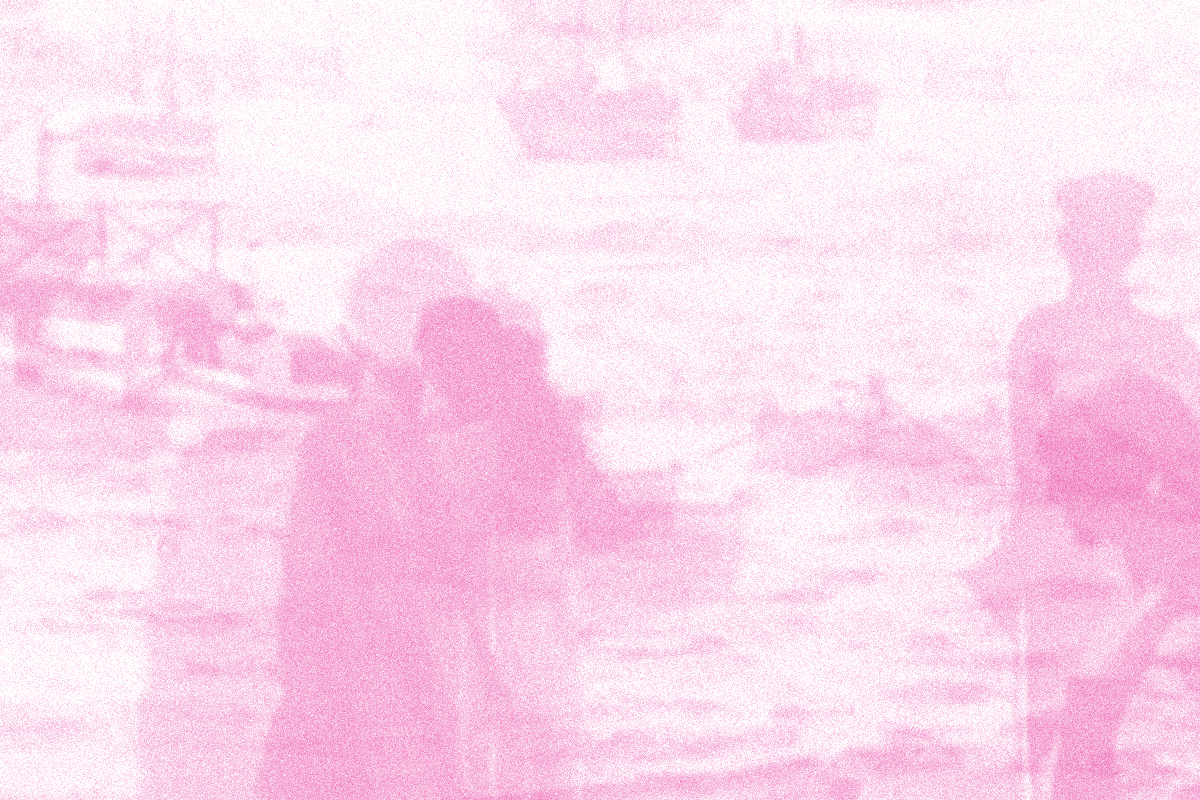
In Ismyrna, Etel Adnan and I reflect on the intertwined histories of our families. Etel speaks of her mother, a Greek woman born in Smyrna, today’s Izmir, and of her father, a Syrian officer in the Ottoman army. I share the story of my Greek grandfather Thomas, who, together with his family, was forced to leave the same city in 1922.
The film asks what is transmitted. How do we live with the grief and nostalgia inherited from our parents without becoming imprisoned by them? How do we give form to an imaginary without images, a city we never knew, yet one that inhabits us through stories, silences, and absences?
Imaginary is never opposed to reality. It is the place where facts, fiction, memory, transmission, absence, and identity intertwine. It allows lost places to continue existing, not as monuments to the past but as living presences that shape who we become. One of the film’s question is how to live outside nostalgia in what Etel called an eternal present, where the past is acknowledged without preventing us from inhabiting the present.
It is also about asking who has written history, who has produced its images, and who has been denied the possibility of imagining otherwise.
Hannah Arendt opens Between Past and Future with a sentence by René Char that has always resonated deeply with us: “Our inheritance was left to us by no testament.” We inherit fragments rather than certainties, interrupted histories rather than complete narratives. We find ourselves, as Arendt describes it, in the gap between past and future, where meaning can no longer simply be transmitted but must constantly be reinvented.
This condition is profoundly familiar to us. Coming from Lebanon, we have learned that permanence is an illusion. Wars, political violence, displacement, and repeated crises continually interrupt lives in a region marked by instability, discontinuities where the unexpected constantly reshapes places and destinies. Yet perhaps this condition is no longer exceptional. We all live in a time of uncertainty, impending catastrophes, conflicts, economic crises, and collapsing certainties. The fragility we once believed belonged only to certain geographies has become a shared condition.
It is precisely within this breach that our work begins.

Using and reappropriating archives, but also stories kept secret as we like to define them, transforming and reactivating them as materials through which history can be reopened and new meanings can emerge. It allows us to build bridges between temporalities, inhabiting the present while acknowledging what has disappeared.
Human beings, cities, institutions, and even works of art are exposed to loss, destruction, and disappearance. This led us to question history, representations, heritage, permanence, and the role of museums and institutions as spaces. Rather than considering fragility an exception, we have come to understand it as a defining condition that transforms both artworks and the viewer’s relationship to them.
Colonial histories have occupied not only territories but also narratives and images. They have determined whose stories become History and whose remain invisible. Making films and artworks is therefore about creating spaces where uncertainty, contradiction and opacity can exist, where other voices and other temporalities may emerge. To imagine is already to reclaim a form of freedom. Transmission therefore becomes a resistance to dispersion.
This is what Mizna makes possible. Not simply the circulation of films, but the circulation of imaginaries. By bringing together artists, audiences, and stories that are too often marginalized, Mizna creates a space where the personal and the collective meet and where new ways of imagining become possible. Every screening becomes an encounter where stories are transformed, reactivated in the present.
Showing Memory Box and Ismyrna, exchanging ideas with the team and with audiences, we felt that we were engaged not only in an artistic territory but also a political and profoundly human one, built on empathy and sharing.
Cinema cannot repair history. But it can give forms, incarnate, unsettle the ways history has been written. It can reveal, make visible what has been erased while leaving room for what remains invisible.
To tell stories, then, to share them, is not only to remember. It is to survive. It is to resist dispersion. And it is to keep open the possibility of imagining another possible future in all those uncertainties.

Filmmakers and artists, Joana Hadjithomas and Khalil Joreige question the fabrication of images and representations, the construction of imaginaries, and the writing of history. Their works create thematic and formal links between photography, video, performance, installation, sculpture, and cinema, being documentary or fiction film. Together, they have directed numerous films that have been shown and multi awarded in the most important international film festivals as Cannes film festival, Berlinale, Locarno or Toronto before having theatrical releases in many countries. Their films include Memory Box (2021); ISMYRNA (2016); The Lebanese Rocket Society: The Strange Tale of The Lebanese Space Race (2012), Khiam 2000-2007 (2008); Je Veux Voir (I Want To See) (2008), A Perfect Day (2005), The Lost Film (2003); and Around the Pink House (1999). The artists are known for their long-term research based on personal or political documents, with particular interests in the traces of the invisible and the absent, histories kept secret such as latencies of wars, a forgotten space project from the 1960s, the strange consequences of Internet scams and spams or the geological and archaeological undergrounds of cities. Among their major artworks, also are Circle of Confusion (1997), Lasting Images (2003), The Lebanese Rocket Society (2011), SCAMS (2014), and Unconformities (2017), centering on archeological and geological sediments and remains, what we leave behind. It showcased at the Centre Georges Pompidou (Paris) and was awarded the prestigious Marcel Duchamp Prize.
Related
The Bringers of Violence

Mizna at RAWIfest
Mizna 22.1 Virtual Launch
Mizna: The Palestine Issue