



November 25, 2026
HEAVEN LOOKS LIKE US: A Cento
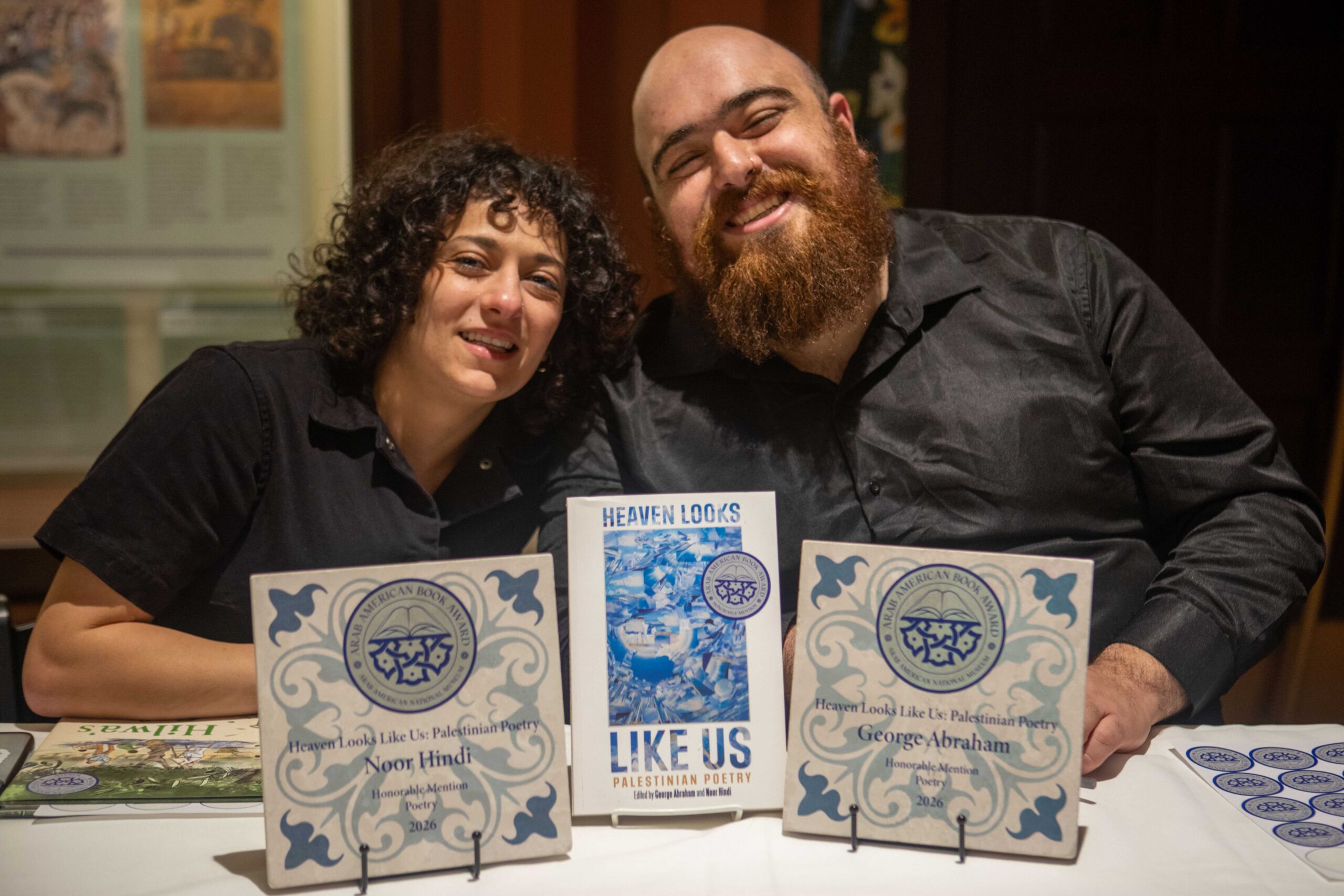
HEAVEN LOOKS LIKE US (Haymarket Books, 2025) is an anthology of Palestinian poetry edited by George Abraham and Noor Hindi that was recently awarded a 2026 Arab American Book Award from the Arab American National Museum. We struggled, generatively, with questions of: how to accept a book award in a time of genocide and how to honor a collective that produced a book like this. Our answer came in the form of a cento—a poem comprised of lines taken from all of the anthology’s poets, which we presented at the book awards alongside the acceptance speech that follows. Purchase HEAVEN LOOKS LIKE US here.
“Ashlaa’ connect the past and the present, the living and the dead, the shredded and still intact bodies of the settler colony. To invoke ashlaa’ is to rupture the colonial dialectics of history. Ashlaa’ represent the struggle for psycho-affective survival and agency amidst the agonies of relentless attack. Centering ashlaa’ in an analysis of the genocidal violence toward Palestinians in Gaza is not only about refusing ontological non-being and deprivation of wholeness suffered by the colonized, but about naming and reclaiming ashlaa’ to problematize the Israeli state’s racial, geo-political, and aesthetic investment in violence. Ashlaa’ is a concept that comes from the words of Palestinians in Gaza, and can be read as both a sign of extreme violence and terror, as well as a refusal of such genocidal dehumanization. To speak of ashlaa’ is a liberatory act of reunification (lamm shamil, lammlamehl) mobilized by Palestinians in Gaza, like Lena, Rami, Haneen, and Bisan who insistently re-assemble ashlaa’ as Palestine. They propose a liberated and revolutionary livability, a political effort to rebuild new spaces of love in a struggle for a dignified and humane life.”
HEAVEN LOOKS LIKE US
A Cento
If I have to live, I choose you.
You: everyone I’ve ever mourned.
You who have been made homeless
As oblivion furls between your ribs.
Your bodies root me into the singing earth,
Our countries, across all borders, taking your names for anthem.
I can’t write a poem without dropping a name.
I annotated the earth’s erosion,
Attempting to find this poem’s pivot:
Desert blooming through phosphorous gas,
A forest fire that occupied all the air.
The trees have been entered into a war
Of bone-breakers, of a thousand longings.
The poem slips out of my hand,
A closet of incomplete sentences,
And a world we want to begin begins:
My hope is that you will come flying to me
On your tireless wings.
Somewhere, deep inside me, I know I’ll die
The same way:
Standing in a bright wind,
A sun race, maybe, then, a return
Maybe wingspan, elsewhere.
To stretch our aching arms,
Fly home toward Jerusalem.
Al Quds, Al Quds, how could I forget you?
Who can separate the bird from the possibility of wings?
A gash of movement,
A spring of flight—
I loved you, my love,
Without evidence, motive, or demand.
Your smile that bargains with the devil,
And lightens loads for dreams,
As though you aren’t stepping on grass
But on the gasps of the dead.
Though I no longer have a swarm to fly with,
Nor wildflowers who understand my tongue,
It was you who held my hand as I was dying.
I want to bleed you.
I want to stain you.
I want to shout you,
but it hurts to say your name.
Take me to you, mother of tender,
For I have never been I
And you have never been you,
And yet we are never we only.
With you I will share the patchwork.
Burn charcoal, smoke argileh.
We’ve seen it all before.
Measurement is its own form of witness.
We cannot be exorcized
But we can be excavated,
At the hilltop crusader colonial experiment,
To obsolete an ancient homonym.
We won’t forgive each other for the future.
I wished for you a better life.
The cost was my life.
You were worth it.
* * *
Upon this earth what’s worth living for?
The invader’s fear of memories?
The tyrant’s fear of song?
The beginning of love the beginning of
The beginning—
My apologies for the inverted syntax.
Only soil frees from grammatical tenses.
Love remains a kind of present tense.
Without it, there is nothing sweet to speak of.
We fell in love in a city that will never love us back,
The windows blown out in every store along the street.
The only land I’ve ever known tried to swallow my people whole.
That grief is their most vicious weapon,
Our most familiar friend.
Why did you leave the horse alone?
Horses, still the light is fatal.
I am not a proud beast.
I cried as if I were half of the world
And bid no one farewell,
Not even to flesh—
Not even to self—
You can tell, hayk hatha,
How peace is the war they won.
It’s not enough to be dead. God plucked me
Like a string & sheared the melody
Where once a butterfly didn’t ask permission.
They don’t have the memory of the earth that births.
Even in another life, they would choose
Each other to be their executioners.
There’s nothing about the sin of denying your own body—
Like it doesn’t carry you through this world?
Like it isn’t the one thing with you all your days?
We believe ourselves nations.
If only words buried swords,
The land we’re on would turn
Scalding, for who would betray each fresh hell
That ushered their entrance?
The dead who live in me, you killed.
The dead who live in you, I did not kill.
You will not be consoled,
Soldier, you will not,
Not even the alphabet desires you here.
There will be no funeral for
You who ordered my throat to be cut.
Know that you’ve written my immortality.
Because this english tongue owes me a language,
From the narrow window of my small cell
I can see your big cell!
Rein in your kids, get ’em inside, you drifter.
Bint il-kalb. You look fucking stupid in your Bedouin
Getup, Aladdin-ass bitch,
Color the languish I insist to dismantle.
You, murderer,
Who remembers you?
* * *
The fence does not hold.
Water surged from a world broke open.
The sea is coming to take it back.
Returning in the present tense.
I am been returning.
From far and wide, arise
The water of me.
A rock isn’t thrown until it is thrown.
Because the water could without notice
Soar like history above the empty page,
History is like magic: It happens when you aren’t
Looking, leaves you gaping at the outcome.
Colony, a chalk outline.
FLAGS WILL BE BURNT.
THE SUN HAS SET ON THE BRITISH EMPIRE!
ON THE AMERICAN EMPIRE!
ON THE EMPIRE OF POSSIBILITYEATERS!
Every empire is a return of the dead.
I don’t want a world where we are Almost Beautiful.
We demand a world with many worlds in it.
A world of the anthill.
A world of your mouth.
A world of our word.
Our love, my darling, is a love that feeds ants.
You tremble now,
So take what there is of your blood,
Find the path of least resistance over the cliffs.
The mountain is made of kindling.
* * *
Everyone says it is about land,
But I believe it is about time.
22 years in, 5 days out.
Everything is still as it was
Since we had gone out to war.
I was silent and nothing came of it.
I called out, but nothing came of it.
The only eternity I understand is this one:
In Palestine, a stone is a poem.
A poem has nothing to lose.
A poem is a space to rehearse for the future.
In poetry, a child would find a bite
To remember what I spent my entire life forgetting.
When a memory turns on another memory, which of your voices is mine?
The ancestors tell me that we have not failed them:
But must our death be a poem?
Trauma theory for the televised era?
Some days, poems are scrawled on pieces of cardboard
And carried on our shoulders at the protest like martyrs.
INSIDE THE POEM WE FOUND A TUNNEL.
INSIDE THE TUNNEL WE FOUND OURSELVES.
* * *
Resistance sometimes looks like constraint.
Our whispers, advising us to be patient.
To say nothing. To never have to say nothing.
And this, this too, is Palestinian.
I did not arrive on this earth just to perform
A watered down version of someone I’m supposed to be.
Love, I’m learning, is an act of mercy.
It might have been worse than the I don’t love you.
I remember hands, anticipating my fall
Where our hearts
Are doves are thunder in deluge
Are crying violet oceans in bloom.
You—in this way—live.
You were first created out of love,
So carry nothing but love
To those who are trembling.
When the sky is on fire, hold us.
Dig a well, deep as memory,
For a trace to endure as a trace.
Where now is the word for such intimacy?
Will you touch me in this violence? & STILL
NEVER LEAVE THE HANDS THAT MAKE ME
Back shatilla back ramleh back jenin back il khalil back il quds;
Every street, Every kiss, Every image, Every eye,
Not theatre the Palestine, not otherwise it,
Every tear, [alight] Every yamma, [alight] Every yaba, [alight] Every name,
I WAS THERE! I WAS THERE I WAS ALWAYS
Every name, Every name, Every name, Every name, Every
Everything we’ve ever held. Every
Everything we’ve ever let go.
All of this is yours.
All of you, come in.
2026 Arab American Book Award Acceptance Speech
Thank you to the Arab American Book Awards for this recognition. We’re thrilled to be here and so grateful for everyone who’s made room for HEAVEN LOOKS LIKE US!
We want to first begin by saying this honor belongs first and foremost to our contributors, especially those who were martyred before they could hold this book in their hands. This moment belongs to them first, and we want to carry their words into this room alongside the unbearable absence of the people we’ve lost: Refaat Alareer, Heba Abu Nada, and the unknowable thousands of Palestinians whose lives were stolen from us, who we continue to honor.
It also belongs to our community whose grief, queerness, survival, joy, and love gave this anthology its life. As we stand here today, we are more than one thousand days into a genocide that has rendered entire neighborhoods into ash, turned hospitals into mass graves, and made the very act of naming this reality, of calling it a genocide, a punishable offense in many of the literary, academic, and artistic spaces we inhabit.
To accept this recognition is to also remember the conditions under which this book came into being, and the people whose words reached us despite those conditions. When we started this project in 2020, we wanted to create a place for Palestinians to convene on the page when borders inevitably fail us. Somewhere we could speak to one another across generations, languages, and geographies. Somewhere our voices could gather without having to ask for permission from the systems that keep us apart.
Throughout the process, we centered community above all else. We opened submissions to Palestinian poets regardless of experience or publication history. We worked collaboratively with contributors to honor the emotional and political force of their poems. We made space for contradictions, for voices long excluded, and for work that breaks form, breaks genre, and sometimes breaks language altogether.
We couldn’t have imagined that a genocide would unfold in Gaza before the book was even released and that some of the poets we were working with would be martyred, that others in Palestine would be unreachable, sending us GPS coordinates instead of mailing addresses, and that we would have to abandon not just plans for contributor contracts, but sometimes even the basic act of getting copies of the book into their hands.
What began as an act of literary care became, by necessity, an act of mourning and testimony. Every poem in this anthology now carries not only artistic intention but the unbearable weight of absence, survival, and the urgency of memory. And still, these pages hold so much life. They hold our humor, our desires, our anger, our tenderness. They hold Palestinian imagination and its inevitable future. This book is an act of love, an act of protest, and a place of gathering. We hope that everyone who reads it carries that gathering beyond the page: into their relationships, their communities, and their commitments to Palestinian liberation.
Thank you to everyone who advised us, who helped translate poems, who labored tirelessly with us throughout this book’s process, especially Lena Khalaf Tuffaha, Rasha Abdulhadi, Naomi Shihab Nye, Fady Joudah, Huda Fakhreddine, Maya Marshall, the good folks at Mizna, RAWI, Palfest, Palestine Writes, Haymarket, and many more. Thank you to our contributors for trusting us with your words, and to our community for helping us carry them. This honor belongs to all of you. May we keep making room for one another. And may we live to gather freely, one day, in Palestine.
This poem contains lines by the following Palestinian poets in the following order: Noor Hindi, Ashraf Fayadh, Aiya Sakr, Yusuf Ezideen Salah, Jen Siraganian, Dina Abdulhadi, Samah Fadil, Tariq Alarabi, Annemarie Jacir, leena aboutaleb, Ghayath Almadhoun, Hanan Hindi, Fady Joudah, Mosab Abu Toha, Suja Sawafta, Micaela Kaibni Raen, Zaina Alsous, Zeina Azzam, Lamise Noor Shawahin, Mourid Barghouti, Naomi Shihab Nye, Maya Abu Al-Hayyat, Deema Shehabi, Dalia Taha, Mustafa Abu Snineh, George Abraham, Nadeen Alalami, Hala Akkawi, Mira Mattar, Shereen Naser, Tarik Dobbs, Anonymous, Jad Youssef Doumani, Issam Zineh, Islam Al Khatib, Layla Azmi Goushey, Ahmad Diab, Hala Alyan, Nadia Said, Rewa Zeinati, Mohammed El-Kurd, Lina AlSharif, Carolina Ebeid, Tariq Luthun, Aziza Okab, Angie Mazakis, Mohammed Khader, Samer Budair, Mahmoud Darwish, Olivia Elias, Zaina Alsous, Yahya Ashour, Refaat Alareer, Rasha Abdulhadi, Emily Khilfeh, Sara Abou Rashed, Eman Ghanayem, Rema Ghassan Shbaita, Mandy Shunnarah, Issam Zineh, Rimona Afana, Micaela Sahhar, Fady Joudah, Ahlam Bsharat, Mourid Barghouti, Jad Youssef Doumani, Fadia Antabli, Ahmed Almallah, Samih Al-Qasim, Sheikha Hlewa, Summer Awad, Maen Hammad, Najwan Darwish, Lena Khalaf Tuffaha, Dina Abdulhadi, Jaye Nasir, Hajer Mirwali, Dareen Tatour, Priscilla Wathington, Hasib Hourani, Jessica Abughattas, Naomi Shihab Nye, Lisa Suhair Majaj, Sara M Saleh, Yahya Hassan, Fargo Nissim Tbakhi, Fady Joudah, Sara M Saleh, Veera Sulaiman, Farah Barqawi, Ashraf Fayadh, Priscilla Wathington, Asmaa Azaizeh, Zena Agha, Laila Shikaki, Ghassan Zaqtan, Ibrahim Nasrallah, Jaye Nasir, Mejdulene Bernard Shomali, Omar Zahzah, Fargo Nissim Tbakhi, Dareen Tatour, Heba Hayek, Nathalie Handal, Yasmeen El-Hasan, Kaleem Hawa, Lena Khalaf Tuffaha, Fargo Nissim Tbakhi, Sarona Abuaker, Maya Abu Al-Hayyat, Hind Shoufani, Jaye Nasir, Janine Mogannam, A.D. Lauren-Abunassar, Micaela Sahhar, Yousif M Qasmiyeh, Suheir Hammad, Bassam Jamil, Heba Abu Nada, Jehan Bseiso, Sharif ElMusa, Yousif M Qasmiyeh, Lenna Jawdat, leena aboutaleb, Summer Farah, Suheir Hammad, Samer Abu Hawwash, Carolina Ebeid, George Abraham, Summer Farah, Samer Abu Hawwash, Noor Hindi, and Heba Abu Nada. Some of these works were available to us in English with thanks to translators Huda Fakhreddine, Zeina Hashem Beck, Fady Joudah, Lena Khalaf Tuffaha, Sarah ElKamel, Jordan Barger, Kareem James Abu-Zeid, Bazeed, Catherine Cobham, Thiri Daoud, Katharine Halls, Mona Kareem, Nazih Kassis, Nicole Mankinen, Jeffrey Sacks, Yasmine Seale, and Mona Zaki.

George Abraham (they/هو) is a Palestinian American poet, essayist, critic, performance artist. A two-time Arab American Book Awardee, they are the author of When the Arab Apocalypse Comes to America (Haymarket, 2027) and Birthright (Button Poetry, 2020). A Mizna editor, they are co-editor of Homosexual Intifada (Interlink Books, 2026) and HEAVEN LOOKS LIKE US: Palestinian Poetry (Haymarket, 2025) which was long-listed for the Palestine Book Award. They are a graduate of Northwestern’s Litowitz MFA+MA program, and teach at Amherst College as a Writer-in-Residence.

Noor Hindi (she/her/hers) is calling on you to join the global fight for the survival and liberation of Palestinians and all oppressed people. Anywhere and everywhere you are, you can disrupt, advocate, speak out and refuse in small and big ways. Revolution until freedom. Hindi is a Palestinian American poet. Her debut collection of poems, Dear God. Dear Bones. Dear Yellow (Haymarket Books 2022), was an honorable mention for the Arab American Book Award. She is the co-editor of HEAVEN LOOKS LIKE US: Palestinian Poetry (Haymarket Books, 2025). Follow her on Instagram @NoorKHindi.
Related
The Bringers of Violence

CALL FOR ART: Let There Be Spaces in Your Togetherness
Sunbird
How Is Your Devastation Today?