



August 14, 2026
A Diasporic Requiem: Watching Ayatollah Seyyed Ali Khamenei’s Funeral in America
Here, Sima Shakhsari lays bare their response as they witnessed Ayatollah Seyyed Ali Khamnei’s funeral this July and follows their vivid memories of being on the streets of Tehran thirty-seven years ago, at the funeral of Ayatollah Ruhollah Khomeini with their mother. Shakhsari reflects on their family legacy of resistance and critique and the example their parents set, being engaged with their community and their country and feeling compelled to challenge both their government and also the destructive effects of US and other Western imperialism. Shakhsari left Iran for the US in August 1989, shortly after Khomeini’s funeral, and has built a principled, meaningful, and truly busy life as a scholar and tireless activist for Palestine, for Iran, for animal liberation, for queer community, for truth and liberation. For me, and likely many others who are lucky to be in Shakhsari’s loving and magnetic orbit, this piece of writing gives context to the remarkable way they move through the world. To wit and in their mother’s footsteps, Shakhsari is spearheading a Let Iran Live Fundraiser on August 20 in Minneapolis.
—Lana Salah Barkawi, Executive + Artistic Director
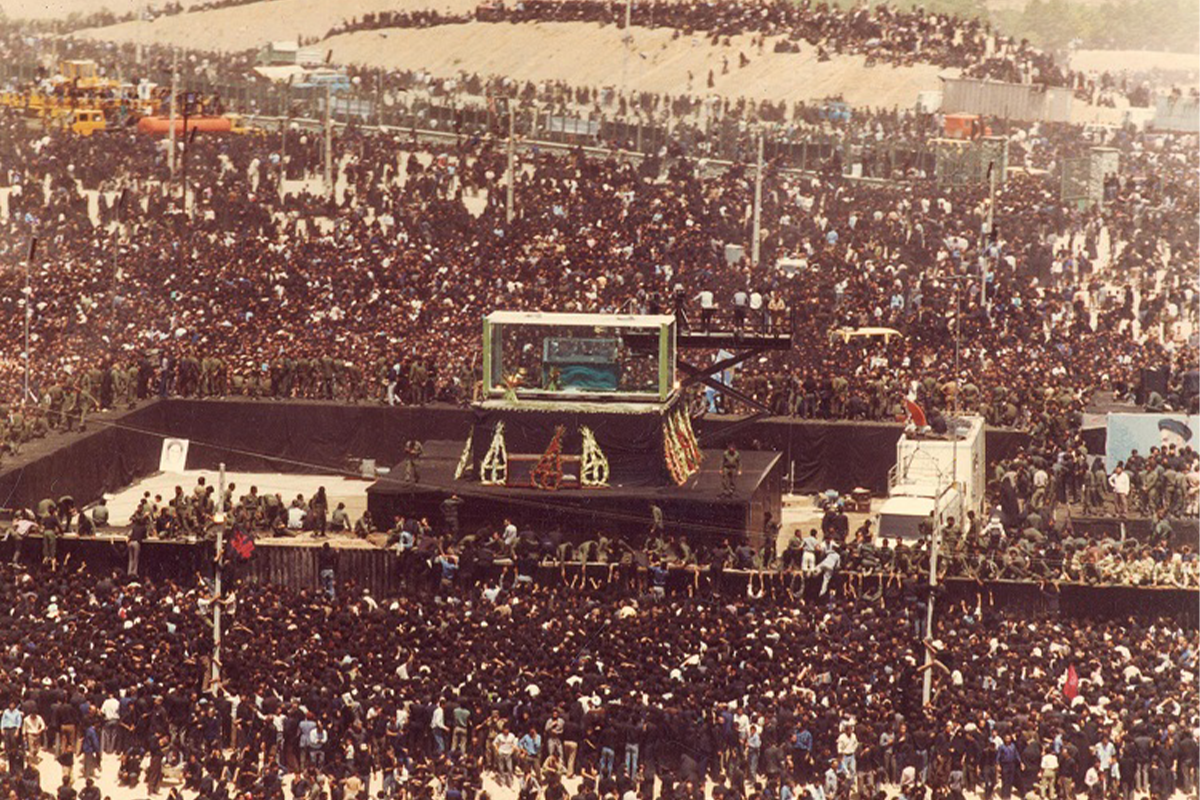
In the summer of 1989, my mother and I drove to participate in Ayatollah Khomeini’s public funeral. His body was displayed in a refrigerated glass case sitting atop an elevated platform in what was then a vast empty lot, which later became the Imam Khomeini Mosalla Mosque. The heat of that summer day was intense, and the sheer size of the crowd was astonishing.
—Sima Shakhsari
A Diasporic Requiem: Watching Ayatollah Seyyed Ali Khamenei’s Funeral in America
For me, Seyyed Ali Khamenei’s funeral was an archaeologist’s brush, revealing treasures and traumas, unearthing bittersweet remnants of my past, and offering a renewed sense of belonging and a deeper insight into the present. Watching people of all ages make their way by shuttle buses and on foot excavated sensory memories of another funeral thirty-seven years ago, that of the first leader of the Iranian Revolution, Ayatollah Ruhollah Khomeini. I smell the rose water splash from the long-necked golaab-paash and feel beads of sweat trickle down my forehead in sweltering heat. Thousands of miles away and almost four decades later, I vividly remember the sensation of nothingness, being among the sea of black-clad mourners heading toward the resting place of Ayatollah Ruhollah Khomeini. Somehow the simulated haptic connection across the screen revived the affective intensities of belonging to a revolution that has endured for the past forty-seven years.
That revived memory shimmered and then came into focus, illuminating what the mainstream media and the monarchist diaspora loathes to depict: more than twelve million Iranians flooded the sunbaked streets of Tehran to mourn the martyrdom of Seyyed Ali Khamenei. The tale that the Iranian state, often depicted as uniformly repressive and referred to by the US politicians and the Iranian opposition groups in diaspora as the “regime,” mobilized the crowd, enticing them with mere Sundis juice boxes, crumbles under the weight of the sheer number of people. Their undeniable reality shatters the dreams of those who believe regime change will come from the outside. Even those who did not agree with Khamenei found themselves at his funeral—his murder was an affront to Iran’s sovereignty, a stark reminder of the nation’s unity in the face of external incursion.
In the summer of 1989, my mother and I drove to participate in Ayatollah Khomeini’s public funeral. His body was displayed in a refrigerated glass case sitting atop an elevated platform in what was then a vast empty lot, which later became the Imam Khomeini Mosalla Mosque. The heat of that summer day was intense, and the sheer size of the crowd was astonishing. We visited the funeral not necessarily out of admiration for Khomeini, but because it represented a pivotal moment in Iranian history. You could say our initial motivation was curiosity.
As my mother and I stood there, I was taken aback to find that we both shed tears. Here I was, a twenty-year-old Marxist who had been forced to halt my political activism during a brutal eight-year war (1980–88), mourning the death of a man I believed was responsible for the mass execution of leftist activists in 1988. Known as daheye shast, or the sixties decade according to the Iranian solar calendar, the1980s was among the darkest periods in the history of post-revolutionary Iran. It was characterized by the strains of war, US-backed plots for regime change, the violent actions of the Mujahedin-e Khalq (MEK, an Islamic socialist organization that transformed into a militant cult-like group), and mass execution of dissidents. As a young person, I witnessed it all.
The newly established state faced threats to its existence—both external and internal regime-change plots—and responded with hypersecuritization and repression. To take two critical events: In April 1980, after the Iranian students captured the US embassy (which they called “laanehyeh jasoosi” or the “spy nest”) and retrieved the CIA documents that the embassy staff had managed to shred before the student takeover, the US military initiated a covert operation to attack Tehran and rescue the hostages. Operation Eagle Claw failed when a severe sandstorm grounded the helicopters, killing eight US soldiers in Iran’s Great Salt Desert. In July 1980, a US-backed coup attempt involving former prime minister Bakhtiar and military officers was thwarted by the revolutionary government. As a result, more than five hundred dissenting armed forces members who participated in a plot to bomb critical locations, including Tehran’s airport and Ayatollah Khomeini’s residence, were arrested and many were executed.
Meanwhile, soon after the revolution, the MEK changed its direction under Masoud Rajavi’s leadership and morphed into a cult-like terrorist group, planting bombs in civilian areas and government buildings and killing ordinary Iranians and high-ranking officials. This included an attack on June 27, 1981, at the Abuzar Mosque in Tehran, when a bomb hidden inside a tape recorder placed in front of soon-to-be-president Seyyed Ali Khamenei detonated. Khamenei’s right arm was severely damaged and permanently paralyzed. A day later, on June 28, 1981 (my thirteenth birthday), a bomb detonated at the Islamic Republic Party headquarters in Tehran, claiming the lives of seventy-two high-ranking Iranian officials. The MEK violence continued intermittently throughout the 1980s, concomitant with the devastating Iran–Iraq war—a war in which the MEK allied with Iraq against Iran. Witnessing human remains strewn across the pavement after MEK bomb explosions and observing buildings reduced to rubble by Iraqi bombs and missiles—this was part of my everyday reality growing up in Tehran.
In 1988, near the conclusion of the Iran–Iraq war, seven thousand MEK militants launched an offensive called Operation Forough Javidaan, or Eternal Light. The MEK entered multiple Iranian Kurdish cities along the Iran–Iraq border, aiming to overthrow the Islamic Republic. The Iranian military, supported by Kurdish groups, successfully defeated MEK militants in a counteroffensive operation known as Operation Mersaad. It comes as no surprise, then, that during the war and shortly after the establishment of the Islamic Republic of Iran, a climate of heightened security alongside a witch-hunt against dissenters took shape.
In response to MEK’s Operation Forough Javidaan, Ayatollah Khomeini issued a fatwa, labeling MEK members as mohaareb, meaning “enemies of Islam” or “enemy combatants” and deserving of death. However, the blanket order to execute MEK’s armed forces was applied not only to those fighting alongside Iraqi forces against Iran, but also to MEK members who had been imprisoned in Iran for several years and had served most of their sentences. It is believed that between eighteen hundred and three thousand political prisoners, including many not actually affiliated with MEK (mostly communists) who had served a significant portion of their sentences, were executed in ad hoc revolutionary courts in 1988. Ayatollah Montazeri, the deputy to the supreme leader at the time, protested this decision and was subsequently removed from his position and placed under house arrest for defending the MEK.
Montazeri later revealed that during the final two years of Ayatollah Khomeini’s life, all decisions were made by his son Ahmad Khomeini and other officials, but they were presented as orders from the supreme leader himself. Montazeri also claimed that the execution fatwa and the response to his protest letter were written in Ahmad Khomeini’s handwriting, not that of Ayatollah Khomeini. According to Montazeri, Ayatollah Khomeini had been misled into believing that all prisoners were combatants captured in the counteroffensive after Operation Forough Javidaan. Apparently, Ayatollah Seyyed Ali Khamenei, who was serving as president at that time, was not informed about these letters and had expressed his opposition to the executions upon learning about them from Montazeri. The events of 1988 sparked fear and anger among many, reshaping Khomeini’s image into that of a cruel figure in the perception of a segment of the Iranian population who held him responsible for the executions, including me. However, it remains unclear whether he was truly the one in charge of issuing the order.
While I could not explain my own tears at the sight of Khomeini’s deceased body, I was surprised that my mother also cried. A decade before this funeral, she had brought the ten-year-old me to Behesht-e Zahra to bear witness to the martyrdom of young protesters who had lost their lives at the hands of the Shah’s soldiers. Each day, hundreds of lifeless bodies were carried on shoulders through Tehran’s Behesht-e Zahra cemetery, which, over the years, expanded to resemble a small city in southern Tehran, filled with the martyrs of the revolution and war. At that age, I couldn’t grasp why my tearful mother murmured, “I wish your mothers would die and not see you like this.” She deeply empathized with the mothers of the martyrs who fell to the Shah’s soldiers, just as she later wept for the mothers of leftist activists who were killed by the post-revolutionary state in the 1980s.
During the Cultural Revolution (1980–1983), armed paramilitary forces of the Islamic Republic violently attacked university campuses, targeting Marxist students, particularly the Peeshgaam (the translation of which is “vanguard”). My mother, fearing for her children’s safety, locked the doors to prevent us from joining the protests. But her heart was with the students, and she courageously smuggled warm food and cigarettes in a basket concealed beneath her veil to the students at Tehran University, who were besieged and under attack. To pass through the paramilitary Basij checkpoints, she adopted a motherly demeanor toward the young Basijis and told them she lived nearby. Later, it was these same student activists who were among the so-called mohaareb who had wrongly been subject to the fatwa issued after Operation Forough Javidaan and were executed on the brink of their release from prison. And yet my mother cried at Khomeini’s funeral.
After reciting a Fatiha for Khomeini and gazing at the glass coffin, my mother gently shook her head, sighed, and said to me, “He died too. I wish your father were alive to witness this moment.” This paradox didn’t come as a shock to me. My mother’s desire was not about celebrating Khomeini’s death. There was nothing to celebrate. Decades later, I’ve come to believe that her tears symbolized a profound, pent-up sense of loss: the loss of a dream that had gone awry, the loss of young lives taken too soon, the loss of her husband with whom she longed to share such significant moments in history, and even the loss of Khomeini himself. Her wish encapsulated the complex emotions she felt toward Khomeini—a man who, in her eyes, represented both piety and brutality; a figure she both respected for his command of mysticism and Islam and held accountable for the deaths of countless young dissidents.
My mother’s wish was also linked to my dad’s complicated feelings toward Ayatollah Khomeini. My father, a hardworking man, had only recently died in a freak accident, just months before Khomeini’s funeral. During the revolution, before the Shah left Iran, my father would bring home Khomeini’s recorded sermons on cassette tapes, listening to them intently after work. In contrast, my mother was initially loyal to the Shah and would scold my dad for introducing Khomeini’s tapes into our home (She lost that loyalty after the Shah’s massacre of protesters during the revolution). At that time, my mother’s brother had close ties to Savak, the Shah’s notoriously brutal intelligence agency that had been trained by the CIA, and she feared he would find out about the tapes. He had once threatened to report my sister and me, both schoolchildren at the time, to Savak for being communists, which to him was disrespectful to the a’laahazrat, a royal honorific that monarchists (such as my uncle) used and continue to use to convey fealty to the Shah.
This uncle, who mocked my mother for praying and becoming religious around the time I was born (a self-adopted religiosity that was unusual among her siblings in her areligious family), and whose satellite dishes in his engineering office were confiscated by the revolutionary committee shortly after the revolution, cursed Khomeini with the coarsest language in the first decade after the revolution. Ironically, after Khomeini’s death and shifts in the post-revolutionary politics, he conveniently became a devout Muslim and developed connections to some elements in the intelligence apparatus of the post-revolutionary state. In the words of Obayd Zakani, the fourteenth-century poet and satirist of religious hypocrisy, “The cat has turned pious, Oh Muslims! He now catches five mice at a time!” Amusingly, in 1993, when I lived in San Francisco and was outed to this uncle by another family member against my wishes, my uncle eagerly told my mother about my queerness, claiming he could easily locate the “lesbian cult” that had brainwashed me.
In any case, it didn’t take long after the revolution for my parents to relinquish their loyalties to both the king and the supreme leader. During the early 1980s, with three Marxist children—one a young adult, another a teenager, and the youngest (me) a tween—they were preoccupied with protecting their children against persecution. Their worries later shifted to making ends meet during a devastating war and the threat of bombs, particularly after my brother was deployed as a medical intern on the frontline.
At the height of the raids to arrest dissidents, my sister Mojgan and I were upset that my father was planning to get rid of our family’s books and newspapers, including The Communist Manifesto and Das Kapital, Kar and Chalangar, along with novels and short stories by communist writers like Ali Ashraf Darwishian, Maxim Gorky, and Samad Behrangi. In a bid to preserve the books, we reached a compromise: instead of making a trip to burn them on the outskirts of Tehran, we persuaded our parents to bury them, believing we could retrieve them in a few years when the house searches by the Komiteh (Revolutionary Committee) would cease. My father removed several square tiles in the basement, dug a large hole, and concealed the books and papers in plastic bags. Mojgan and I stood there and cried quietly, as if mourning a loved one’s death. Years later, our parents decided to convert the basement into a bomb shelter to escape Saddam’s frequent missiles after the house across from us was hit. My father lifted the tiles to retrieve the books so that the construction workers wouldn’t discover them. Sadly, all the books and papers had turned to dust.
In the early 1980s, my mother constantly feared that they would come after her children. Her concerns were not without merit. During her final year of high school, my sister Mojgan, five years my senior, was expelled from Khaarazmi school along with her peers because of her political activism as a Peeshgaam, a young follower of the Marxist organization Saazmaan-e Cherik-haaye Fadaayi-e Khalq-e Iran, Aksariyat (Organization of Iranian People’s Fedai Guerrillas, Majority). For many years, she was too afraid to obtain her high school diploma. It took her more than a decade to finally visit the Ministry of Education and get her diploma, allowing her to pursue higher education. By that time, the war had ended, her children were in school, and the reform movement—bolstered by tremendous support from women and students—had reshaped her political beliefs to more practical strategies for change.
In the end, it wasn’t the Islamic Republic that claimed Mojgan’s life; it was the US sanctions that severely restricted access to chemotherapy medications for Iranians. In 2010, the Stuxnet virus incapacitated Iranian computers linked to nuclear technology, disrupting Mojgan’s radiotherapy treatment. She was therefore forced to seek treatment at a hospital with an outdated, noncomputerized machine, resulting in severe damage to her lungs. Mojgan succumbed to breast cancer in 2015, after five years of bravely fighting the illness while actively serving on Iran’s Children’s Council of Books and translating novels and publications focused on environmental justice.
Having been politicized by Mojgan during the early years of the revolution, I also received a negative “red mark” on my school record for being a Peeshgaam. My journey into political activism began in fifth grade, during the peak of the revolution and the waning days of the monarchy and Pahlavi’s regime. I helped construct barricades with sandbags, attended protests whenever I could sneak out, and organized a strike to persuade my classmates to boycott class in response to the dismissal of our Marxist teacher by the pro-Shah school principal. In sixth grade, shortly after the revolution, I witnessed the same teacher, a university student and art major whose campus shared an alley with my school, being chased by an armed Basiji man. She had often given me free political posters that she and her comrades had designed, and I had a big crush on her. Running from the Basiji man was the last time I saw her. Throughout that year, I was often summoned to the principal’s office as a consequence of my activism. I received an expulsion warning for leading protests and refusing to attend class when Marxist university students were being attacked during the Cultural Revolution.
In the seventh grade, I was sent home for challenging the “religious knowledge” teacher by bringing Dialectical Materialism to class to refute her arguments. Fortunately, my monarchist uncle’s wife served as the principal’s assistant at my school. She intervened and managed to overturn the expulsion provided I refrained from discussing such topics at school again. In the same year, when the Komiteh (Islamic Revolutionary Committee) stopped my mother’s car for a checkpoint search, a young Basiji man with a machine gun slung over his shoulder insisted that I exit the car, convinced that he recognized me as someone who had been selling newspapers at Vali Asr Square. My mother pleaded with him to let me stay in the car. She addressed him as “my son” and explained that I was merely a tall kid who appeared older than I was, insisting he must have mistaken me for someone else. I was fortunate that my mother’s charm prevailed; little did she know my backpack was filled with Kar papers and spray paint that day. My life could have been very different had he searched my backpack.
What ultimately curtailed my Marxist activism as a teenager was the persecution of dissidents and my disillusionment with some of the leaders of Marxist organizations on one hand, and the realities of living during a war and worrying about my mother’s heart issues on the other. My mom was constantly worried about Komiteh coming after Mojgan and me. During the war, she often ended up in the emergency room for heart pain, worrying that my older brother would be killed in the war when he was deployed to the front line as a medical intern. Living with the realities of war and mass executions of dissidents, I had no choice but to give up my teenage activism. Yet, the anger stayed with me. I blamed Ayatollah Khomeini for the deaths of young Iranians, regardless of whether they occurred at the hands of the state or in the war. Even though I strongly opposed the MEK and their violent attacks on innocent civilians, the execution of young prisoners who had not participated in Operation Forough Javidan or other violent acts terrified me and broke my heart. Even if the execution decisions were not solely made by Ayatollah Khomeini, and even though the war was imposed upon us by US-backed Iraq, he represented the head of the state and became the target of my frustrations.
At his funeral, I grappled with the enigma of my tears. They were woven from strands of conflicting emotions—a profound respect for a man who fearlessly challenged the Pahlavi dictatorship, US imperialism, and Israel, enduring years of exile. I couldn’t help but feel empathy for the old man who had fallen silent in his twilight years, emerging only to acknowledge his devout followers with his infamous hand wave, as he greeted them in his modest residence in Jamaran. Yet, alongside this respect and empathy was a sense of relief, as the person I deemed responsible for countless executions was finally gone.
Years later, I can understand better my confused emotions and ambivalence that day. Khomeini had been a steady moderating force amid clashing factions, a man of formidable bearing who embraced a life of modesty. A well-versed scholar in philosophical mysticism and irfan, he possessed an intellectual depth that escaped my youthful understanding. In my teenage years, I had mocked him, playfully twisting revolutionary songs—my favorite being “Khomeini ey imam, reedee beh een ghiyaam” (Khomeini, oh Imam, you shitted in this revolution”). It wasn’t until years later, as a doctoral student at Stanford University, that I listened to his sermons and explored his scholarly contributions for my research. While I did not agree with him on many things, I came to appreciate his knowledge and saw him beyond my blind hatred, understandable as it was. I had held him solely accountable for the turmoil in post-revolutionary Iran as a reaction to his perceived towering authority.
His reluctance to express emotions and display vulnerability, likely a defense mechanism to seem invulnerable to his numerous adversaries—most notably the US empire—may have significantly influenced his portrayal as both cruel and charismatic. Epitomizing his enigmatic nature was the renowned reply he gave during the flight back to Iran after years of exile in France, when a reporter asked him what he felt about his return. He responded simply, “Nothing.” He was both revered by millions of followers and reviled by those unable to see past the agony of executions. Caught between idolization and demonization, the complexity of his principles and beliefs was often oversimplified into exaggerated caricatures. Celebrated as a superhuman or condemned as a monster, the polarized portrayals of Ayatollah Khomeini hindered both constructive criticism and recognition of his staunch anti-imperialist and anti-Zionist stance, as well as his significant role in the regional resistance against US-Israeli domination.
Attending the funeral also revealed to me that millions of Iranians admired and respected him deeply. It was a humbling experience to be part of the vast crowd that gathered to honor a man who boldly labeled the US as the “great Satan” and famously declared, “America cannot do a damn thing!” People were willing to walk for hours under the scorching sun to accompany his jinazeh, his deceased body, to Behesht-e Zahra, his final resting place. In the end, Khomeini in his glass coffin was transported by helicopter, as the roads became impassable with ten million people crowding the route.
Given my mother’s knee pain, we assessed the long distance from northern Tehran to Behesht-e Zahra, which would have taken hours on foot, and we decided to drive instead. While we were navigating a congested street, three women wearing chadors asked if they could ride with us. They hopped in and began discussing “Agha’s” virtues. I found it fascinating that these ordinary women held such affection for Khomeini, whom they remembered as a kind and saintly leader. After two hours, we were only a few blocks from where we started. My mother and I chose to turn back and head home, apologizing to the women who continued their journey on foot. That day, I witnessed that for millions of Iranians, for those three women, for me and my mother, Khomeini represented resistance, humility, and strength. His death managed to unite people despite the resentments and heartaches that had resulted after eight years of war and divisions; divisions that had, in turn, overshadowed the spirit of unity experienced during the 1979 revolution.
Thirty-seven years later, as I watched Seyyed Ali Khamenei’s funeral through my computer, I saw a resonance in the deep solidarity among millions of Iranians on the streets in Iran. It was both an expression of grief and a strong stance against the US empire. Ayatollah Khamenei’s funeral served as a reminder that while the revolution may have shifted direction, its dedication to resistance remains unwavering. Khamenei’s funeral drew an even larger crowd than Ayatollah Khomeini’s had, particularly because he was martyred by US-Israeli forces alongside his family on the same day that 168 schoolchildren were murdered by the US-Israeli regime.
Much like his predecessor, Ayatollah Seyyed Ali Khamenei was either revered by his supporters or despised by the monarchists and other opposition groups and individuals who have succumbed to US-Israeli propaganda and falsehoods. The reality is that, despite the authority of the Velaayat-e Faqih, or Guardianship of the Islamic Jurist, various decisions are made by different levels of government within the Islamic Republic of Iran. Holding one individual accountable for all the shortcomings is a myopic perspective on the state of politics in Iran.
To me, the remarkable turnout of people in 2026 demonstrates that—even with multiple righteous grievances—the economic devastation caused by US-imposed sanctions, the exploitative actions of the resulting sanctions-profiteering mafia, as well as the repression and collective punishment in reaction to ongoing regime-change efforts by the US, MEK, monarchists, and Israel, the majority of the Iranian populace remains steadfast in their demand for independence from US imperialism and outside influence. The presence of millions at Ayatollah Khamenei’s funeral is an indication that the revolution is resilient and clear-eyed. After enduring three wars, decades of harsh sanctions, both internal and external proxy schemes, and pressures to yield to the neoliberal agenda and the demands of global capitalism over the past forty-seven years, Iranians have displayed extraordinary strength and determination.
The courageous people of Iran have made it clear that they will unify anytime the US-Israeli war machine threatens their land and its people. They have demonstrated that it is they—rather than any member of the Iranian diaspora, and certainly not the US and Israeli regimes—who will determine Iran’s future. Just as the Iranian state must learn from its past mistakes, those critical of the state who oppose US imperialism and Israeli occupation must reevaluate their strategies and be vigilant about appropriations of their struggles by the US-Israeli propaganda regimes. This is a humbling moment for all of us to learn from the strength and resilience of millions of Iranians in Iran whose steadfast commitment to the spirit of the Iranian revolution, despite the corruption of sanction-profiteers and financial mafias, will endure beyond any one individual leader. This is also an opportunity to move past the hatred fueled by propaganda and distorted images that reduce the complexities of a multilayered state to a singular, unified entity often referred to as “the regime,” which we have learned to either condemn or revere. If loss can teach us anything, it is to sit with our fears, our anger, and our grief, to learn from and stand in solidarity with the people of Palestine, and to redirect our energies toward resisting the empire’s relentless and insatiable appetite for the region’s resources.
I do not intend to romanticize post-revolutionary Iran or diminish the struggles faced by ordinary Iranians, particularly the working class, ethnic minorities in impoverished regions, women, and other marginalized groups within Iranian society. While displaying an applaudable resistance to the empire and the Zionist regime’s aggressions, domestically, the Iranian state has made numerous mistakes, the repercussions of which are borne by those same individuals who continue to rally in public spaces and stand on bridges to resist the US-Israeli war. The Iranians who traveled to Ayatollah Khamenei’s funeral across various borders and cities have sent a message to the world that regardless of internal conflicts, they will not allow any foreign aggressor to violate Iran’s national integrity. This is a vital opportunity for the Iranian state to avoid repeating past mistakes, be it the collective punishment of protesters or neoliberal policies that widen the wealth gap and embolden the economic mafia.
* * *
I won’t lie. I cried when the US-Israeli regime killed Seyyed Ali Khamenei and terrorized millions of Iranians with bombs. I am fully aware that articulating this statement will provide ammunition for monarchists and those who view the world in absolutes, leading them to label me as a so-called regime sympathizer or even a “regime lackey.” As someone who has not returned to Iran in thirty-seven years, however, I do not owe an explanation about why I cried when Seyyed Ali Khamenei was killed, especially to those who travel to Iran every year to receive their government subsidies or get cheap cosmetic surgeries, and who return to perform “anti-regime” revolutionaries in North America or Europe. I know very well why I, and many people who did not agree with many views Seyyed Ali Khamenei held, cried on that day. Crying out of anger and frustration is a completely natural response when your agency is stripped away, leaving you feeling utterly powerless. That is precisely how I felt as I witnessed a genocidal state and a corrupt empire self-righteously execute the leader of a place I hold dear—someone who stood firmly against imperialism. What lies ahead? What will become of the ninety-two million Iranians who are at risk of being bombed by two of the world’s most formidable militaries? Why do the United States and Israel feel entitled to interfere in Iran’s matters? These were the questions that tormented my mind as I wept on February 28, 2026. The sight of monarchists in diaspora celebrating in the streets while 168 schoolchildren were brutally massacred in Minab only deepened my anguish.
That day, I remembered my mother’s words at Ayatollah Khomeini’s funeral and wondered what she might have said if she were alive. I did not wish for my mom or Mojgan to be alive to witness Khamenei’s murder by the US and Israel. I did not wish for them to suffer the consequences of another war in their lifetime. Instead, I worried about my nieces and nephew, Mojgan’s children, who were born during the Iran-Iraq war and are now living through another war. On the first day of war, and before she lost access to the Internet, my niece, a medical doctor who witnessed numerous injured or killed civilians brought to her hospital, left a message to let me know that our family was OK. In her message, she also talked about the hidden victims of war: cancer patients who willingly stopped their treatment and left the hospital to evacuate Tehran with their families. Her voice trembled as she uttered these words: “No matter what you think of Khamenei, the US had no right to kill him.” I understood her tears. The feeling of powerlessness, when the US and Israel attacked Iran and killed Ayatollah Khamenei in the name of freeing Iranians, while robbing ninety-two million Iranians of their agency, was, and remains, utterly infuriating. I believe this feeling explains why cancer patients chose to discontinue their treatment and leave the hospital, fully aware of the risks involved. They opted to take control of their own lives and death, rather than surrendering to the US-Israeli bombs. And this is why thousands of Iranians make human chains on bridges and on the ports, from Ahwaz and Bandar Abbas to Sirik and Charbahar. The Iranian people are aware that they could be killed by the US-Israeli bombs as they form human chains to protect Iran’s infrastructure. But they, and not the US-Israeli aggressors make the decision to risk their lives for Iran.
Our tears of helplessness in the early days of war have turned into a sea of resistance. Whether it is on Iran’s soil and the sea, or thousands of miles away, the resilient spirits of the Iranian people shall not yield to the US-Israeli aggressors to decide their fate. This is the spirit that Iranians have inherited from Imam Hussien, the Shia martyr and the Prophet’s grandson, revered by most Iranians, including Marxists such as Khosrow Golsorkhi—a poet and journalist who was killed by the Pahlavi regime. Like Imam Hussien and his sister Hazrat-e Zainab, Iranians turn our tears of grief into fists and proclaim firmly, هيهات منا الذلة.

Sima Shakhsari is a professor at the University of Minnesota and a member of the UMN Educators for Justice in Palestine.
Header image sourced from http://en.imam-khomeini.ir/en/n26128/Over_10_million_people_attended_Imam_Khomeini
Related
The Bringers of Violence
Celebrating Abundance: Queer + Trans Voices Virtual Reading
What is experimental work, anyways? Foreword to Mizna 22.2: The Experimental Issue
Mizna Film Series