



October 7, 2026
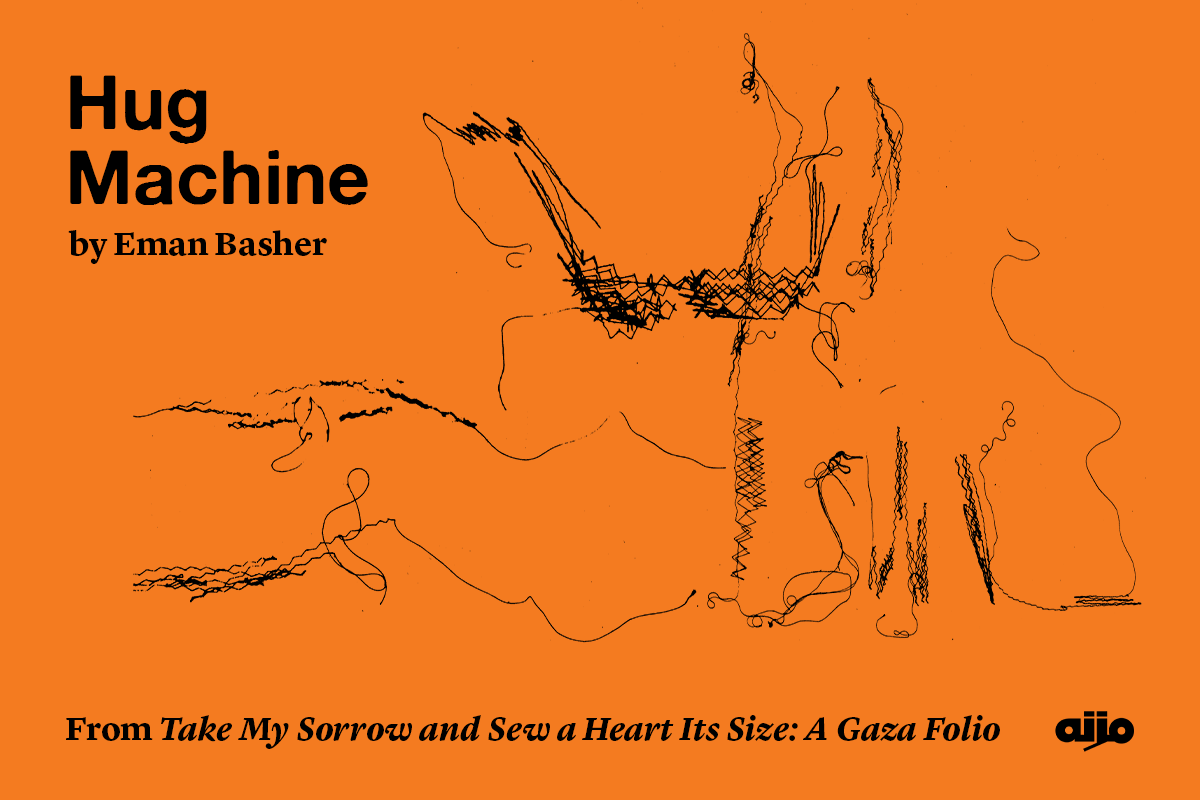
Marking Three Years of Genocide in Gaza: Hug Machine
Three years of genocide in Gaza. One thousand and ninety-five days. Just as on the first days of the killing, language fails to express what it means for incomprehensible death and destruction to proceed unabated and with no clear end in sight. Three years of political failure, as the mechanisms supposedly designed to put a stop to genocide instead ease its path. Three years of ethical failure, as the inertia of business-as-usual renders Palestinian death, mass-imprisonment, displacement, and grief as background noise.
Against the failure of politics, ethics, and language, love triumphs. Love endures; the trace of love remains. It is a creative force; intractable. In remembrance of the third anniversary of October 7, Mizna presents Eman Basher’s tribute to the Gazan scholar, writer, activist, and, to many, personal mentor, Dr. Refaat Alareer, who was killed by Israel in the first few months of the Zionist genocide in Gaza. This essay is published as part of Take My Sorrow and Sew Me a Heart Its Size, a bilingual anthology of Gazan writing guest-edited by author and Mizna fellow Yahya Ashour. Available for pre-order soon.
—Nour Eldin H., Managing Editor
In my first writing session with Dr. Refaat, I sat there, staring at the blank page. I wrote nothing.
—Eman Basher
I never liked poetry. It never spoke to me, never moved me with its rhythm or hidden meanings. Now, I find myself forced to like it because it has become part of your legacy, part of what’s left of you. I hate the word legacy too. It feels too grand, too final, as if it erases all the small everyday things that made you who you were. Poetry was something you loved.
Now, there will always be someone sending me your poem, “Let It Be a Tale,” pushing the white kite into my sight, asking me to read it aloud—but I won’t. I can’t. That one line—“you must live”—sticks in my throat: too heavy, too unfair. What if I don’t want to tell your story? What if I want to let it rest, to let it fade quietly instead of becoming a tale told time and time again? You always found poetry in pain, but maybe that’s why I resisted it—I knew one day it would demand more from me than I could give. It would ask me to carry you, to keep you alive through every line, even when all I want is to let you rest.
Writing in English didn’t agree with me either. It always felt distant, like I was putting on a mask, trying to fit emotions that were too raw into a language too stiff. Yet here I am, writing in this language that feels fake and hollow because you told me to. You’re not even here to insist upon it. It’s unfair—you’re gone, and yet everything you said now carries this weight, as if your words must suddenly all be wise, just because you’re dead.
* * *
Growing up, my family was poor. Not the kind of poor that shows on the outside, but the kind that lingers in your bones, shaping how you see the world—I didn’t make it easy. I nagged, pestering my parents with endless demands—“I want this, I want that.” My mother, who was teaching Arabic at the time, would snap at me, “Just write!” It was her way of silencing my complaints, of dealing with a child she couldn’t always please. So I wrote, even though it never brought me what I wanted.
The things I longed for didn’t come—not with writing, not with waiting. But over time, I learned patience, a quiet kind of patience, the kind that lets you hold on to hope even when nothing seems to change. I waited because I had to believe that things might come if I just waited long enough.
My father, like any father, didn’t want us to feel the weight of our poverty. He wanted to protect us from it, to keep the idea of being poor from rooting too deeply in our minds. Even though we were poor, he didn’t want us to live as if we were. So, every morning, he’d go to the market, picking out just two or three pieces of each fruit, bringing them home to divide among us—my five siblings and me.
I loved pomelo more than any other fruit. It was this strange, oversized citrus, not quite an orange, not quite a grapefruit, but something in between. It had a bright, almost glowing skin, and its taste—oh, its taste!—was heavenly: sweet and sour at the same time. It was overpriced for a family like ours, but my father would still buy one, and we’d each get one small carpel. I always wanted more. I’d eat mine slowly, savoring each bite, trying to make it last. Eleven years later, after getting my first job and my first paycheck, I went back to that same market. The seller was stunned when I told him I wanted to buy every pomelo he had. My mother, of course, questioned if I had stolen them. But no, I had waited. I had been patient for eleven years, and finally, I was able to make that small childhood wish come true.
* * *
In my first writing session with Dr. Refaat, I sat there, staring at the blank page. I wrote nothing. The reluctance I felt to write in English, to use this language that never quite fit, was too strong. In the second session, I managed to scribble down three lines about my grandmother, but then I stopped, unable to continue. He looked at it and said, “Good start,” in the driest, flattest tone you could imagine. He gave nothing away—just those two words.
By the third day, something unexpected happened. I ran into Dr. Refaat near the elevator, and as I was about to pass by, he asked, “Where are your stories, Basher?” I froze. Trembling, I admitted, “I wrote one, but it’s still a draft.” Without hesitation, he said, “Read it.” I tried to stall, asking, “Next class?” but he shook his head, “No, now.” There was no way out. We found the nearest chairs and sat down. I unfolded the paper and began to read the story of the pomelo. My eyes were glued to the paper the entire time, too nervous to look up. When I finally finished and dared to lift my head, I saw him crying. It shocked me. This man, who had barely reacted to anything I had written before, was now moved to tears by a simple story about a fruit.
For the next five years, Dr. Refaat never let me forget that pomelo story. He would buy me pomelos, send them to my house, even tease me with pictures of him eating pomelos, and every time he met someone new, he’d tell them that story. It became our thing, this shared memory, this symbol of something bigger than just a fruit.
In 2022, for his birthday, I gave him a children’s book called Hug Machine by Scott Campbell. It’s about a little boy who gives the best hugs. He hugs everyone and everything—the rocks, the hedgehogs, even a huge whale. No one is too hard or too prickly for his hugs. The boy just finds a way. I read this story to my children every night. Dr. Refaat was just like that boy. He found a way to connect with everyone, to make each of us feel seen in our own way. He’d notice the shy girl in the back of the classroom, the one no one paid attention to, and he’d predict she’d be a great writer one day. He’d eat the food no one else dared to try. He’d give us writing prompts, push us to tweet more, to express ourselves, and to find our voices in spaces we didn’t think we belonged in. He’d find a place for the misfits, the ones who didn’t fit neatly into the boxes society had built. He didn’t just teach us how to write—he followed up with us after graduation, connected us with job opportunities, and made sure we had a path forward.
The patience I learned over the years pales in comparison to his. When Twitter shut down his account with over 200,000 followers, he didn’t complain—he simply made two new ones. When Zionists reported his Facebook page and got it removed, he didn’t dwell on it—he created another, almost immediately, as if nothing could keep him from speaking out. His resilience wasn’t just in his words but in his unwavering belief that every voice—especially his—had to be heard. He taught me that patience wasn’t just about waiting for things to change; sometimes, it was about forging ahead when nothing seemed to change at all. His patience was active, unyielding, and relentless. In that persistence, there was a lesson: that sometimes the world will silence you, but you don’t have to stay silent. He taught me that writing wasn’t just about expression; it was about survival, about keeping your voice alive when everything around you tries to shut it down. His persistence wasn’t just in his activism, but in how he saw potential in everyone he met, even when they couldn’t see it in themselves. He saw it in me when I was still hesitant, unsure if I could tell my story. He saw it in students, in strangers, and even in the lost parts of himself.
At the end of Hug Machine, the little boy is so exhausted from hugging everyone that his mother suggests he take a break and gives him a hug instead.
I think it’s time for me to accept that Dr. Refaat is gone, that he gave all the hugs he could. He hugged us all in his own way, and I guess he’s finally been given one in return. Maybe he knew he’d done enough. It’s time for me to admit that too, and let him rest.
* * *
This is the last time I will write about you. You are too seen now. Now they know you. They have read your words. They talk about you. Now we need others to be seen as well. We need to hug those who have never been hugged. I will always carry your wisdom with me (and maybe some of your wit, memes, and funny WhatsApp stickers), but this is where we part ways. It’s not goodbye, it’s just . . . chapter two. You’ve had the spotlight—how stunning you were in it!—but now it’s time to make room for others, to hug those who have never been hugged.

Eman Basher is a mother of three, former teacher, and occasional writer, currently pursuing an M.A in International Studies. She balances academic rigor with lived experience, often navigating between research papers and bedtime stories. Writes when moved, teaches when needed, and loves to walk.
Related
The Bringers of Violence

I WANT SKY in New York: A reading for Sarah Hegazi
Anti-Biography

It Always Starts with Words