



February 24, 2026
THE HUNGERING YEARS—An Excerpt
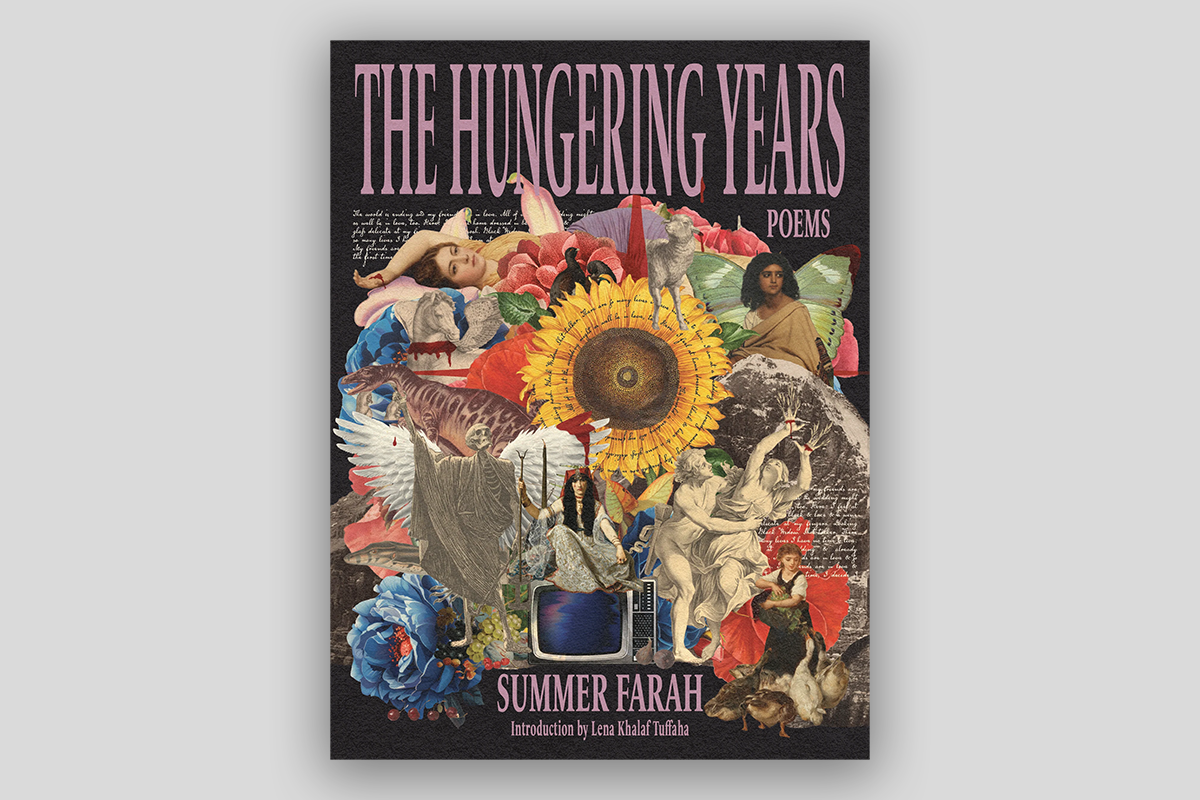
Today, Mizna celebrates the release of beloved contributor Summer Farah’s debut poetry collection, The Hungering Years, out now with Host Publications. Just as with her recent chapbook i could die today and live again, Farah’s debut weaves intertextually across genres and media, mixing figures such as Etel Adnan and Mitski in this excerpt and throughout the book. Here, as habibetna Jess Rizkallah’s blurb says, “This book a mycelium network of memories that aren’t static, unless it’s the static you reach your hands through before falling into the tv screen. Everything is connected, everything is romantic, everything is cinema. This collection changes what / how I consider. It is unafraid of hysteria.” Given Farah’s years of loving labor to our community, reviewing SWANA books, starting pathbreaking critical poetics columns, and contributing in in/visible ways to Palestinian movement work, it makes sense that her debut is generous in its ability to bring us into the wide, capacious world of her reading, and furthermore, inspire more radical, relational modes of literacy therein. Just as Etel Adnan is a north star for many of us, Summer Farah is someone to whom I’ve turned in my most difficult times, as editor, reader, poet, critic, organizer, lover of all things Zelda, and above all, friend. We hope that everyone will join us in generously, loudly uplifting this luminary debut of one of the most important rising poets alive today.
—George Abraham, Editor-at-Large
“Etel, if I had known you in life instead of art I know we would have found places to disagree, but of one thing I am sure—we mourn together. We ask each other to live.”
—Summer Farah
“I Tell Etel Adnan About Mitski”
All night, I watch my father breathe in an emergency room hallway; to the tune
of the woman moaning from a gurney:
I do not want to die here, I do not want to die here,
I turn music off and on, a poet in my pocket. God forbid my father’s breath be
covered by orchestra.
I do not want to be alone while he sleeps.
*
Once, a writing instructor advised us to be comfortable alone with our thoughts,
otherwise the work would suffer. I’ve spent more time this year with music than
myself. The voices in my head become hers. Forgive me: I am simple. It feels
good to know someone feels bad in just the same way.
*
Etel, what is it you ask of art? A memorial, a friend, a teacher? I am looking
for myself, maybe, unfair as it might be, once I sought direction, misguided
& naïve, yes, I am always looking for Palestine, and yes, I am always looking
for love, no, I couldn’t tell you what it is I truly want except I am drawn to the
beautiful eerie & echoes of something, something, something—
*
I do not want to die here.
I’m trying to allow silences at night, consider the privilege of crickets and
owls, instead of [ ]. An instructor advised us to not hurry to fill pauses
during interviews. What can silence tell you about a subject? How will they fill
the gaps?
*
My mother describes a whooshing in her ears. Sometimes, I pause my music to
understand. We sit together and strain to hear the old electrical wiring.
*
I am trying to understand poetry. I am teaching workshops on how to evaluate
art. I tell my students go with the feeling first:
When you hear her sing, what do you feel? / Let’s break apart the line /
this heartbeat of misery / the company that only comes from singing
along / I do not want to die here / Do you expect someone / to hear
you, too? / There are always politics / here / Were you trained / to
compulsively inject it into poetry? / Ask yourself / what does it mean/ to
love so much / & still consider thoughts on the state / I am always
thinking / about Palestine / Break apart the line: / everyone I love is
struggling / to live / I am always looking for Palestine / Ask yourself
what it means / to love so much / & what is love without recognition / &
what is love without knowledge / & what is fair to expect without either
*
My mother is considering church again. She wants to know who will bury her.
*
My father exhales.
*
The world is always ending. Some halls are silent in the face of my mourning;
passive, at best. My face covered, my heart soon, too. Etel, if I had known you
in life instead of art I know we would have found places to disagree, but of one
thing I am sure—we mourn together. We ask each other to live.
*
Still, and still, I seek solace in choirs and allusion. Still, and still, mask silence
with my own song. I admit, I hit skip when there is turbulence, so concerned
with taste even in the rumble of fear. I do not want to die here.
*
And if I do? Is it wise to want to be buried in this? For so long, I’ve been
drowning. I’ve soundtracked my every moment, asked Jerusalem to take me,
too, lived that voice for wedding, for funeral,
for wallow,
for sun,
and,
and,
I do not want to die here.
*
Forgive me, for confusing recognition for solidarity. I am simple. It feels good to
know someone feels bad in just the same way.

Summer Farah is a Palestinian American writer, editor, and zine-maker from California. She is the author of I could die today and live again (Game Over Books, 2024) and The Hungering Years (Host Publications, 2026). A member of the Radius of Arab American Writers and the National Book Critics Circle, she is calling on you to recommit yourself to the liberation of the Palestinian people each day.
Related
The Bringers of Violence
Review: Perfect Victims: And the Politics of Appeal by Mohammed El-Kurd
Mizna Appoints Ellina Kevorkian as Deputy Director
Boghz بغض as Re-memory: an Iranian American Counternarrative to Diasporic Zionism and U.S. Imperialism