



July 31, 2026
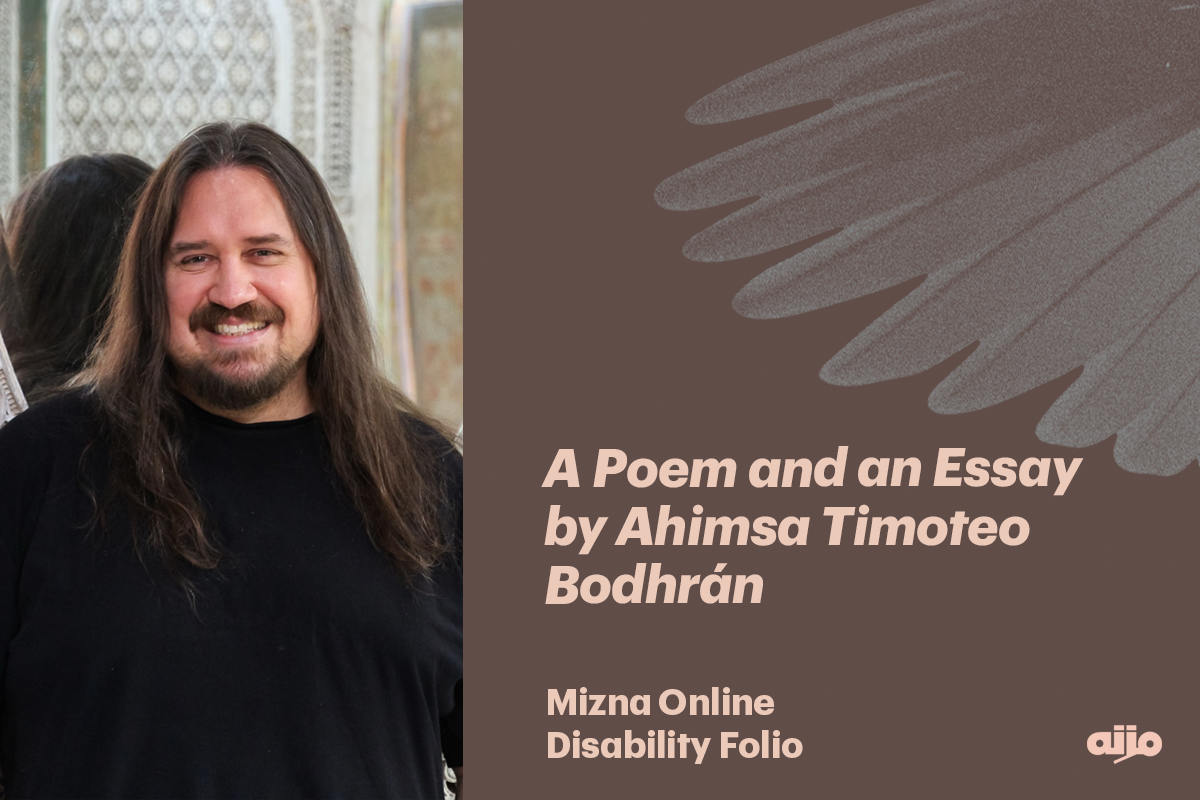
A Poem and an Essay
Ahimsa Timoteo Bodhrán’s poems “la lengua of love” and “How to Make White Supremacy Generative/How to Survive a Pandemic,” initially published twenty years apart, present different perspectives on bodies and language: the multilingual language of love and the language of virus.
Originally published Mizna 21.1: Queer + Trans Voices and Mizna 1.1, reprinted on Mizna Online as part of the Disability Folio.
—Kate Bestall, editorial intern
In a time of hatreds. Record this memory of us (not) touching. Our lips (un)locked. Hands (un)twined. Letters braid with mine. Enbrine.
—Ahimsa Timoteo Bodhrán
la lengua of love
my love for u es multilingüe many-tongued washing
over u with each wave of appreciation this gift of
sharing u n yr body with me wetness n warmth
heat hot springs from the ocean floor always
returning wave upon wave of undulation
always finding ourselves on each
other’s shores with no course
back nor wanting any
nor wanting any
How to Make White Supremacy Generative/How to Survive a Pandemic
You will be made to think of yourself as hazardous. Toxic. Waste.
You will be afraid of touching others. Told you should not touch others. Touch yourself.
You will be seen as a predator. Marked as contagion. Your body, a weapon. Your intimacy, suspect.
You will be told: You do not understand viruses, how health systems work. You know nothing. Are too political. Not enough. You are ignoring other issues. Are another issue. Special one. Wait. This is not your time. You are not pivoting fast enough; you should already be creating, organizing, innovating ways to be digitally consumed online. Monetize this moment. Make it work for you, like 9/11. Make genocide generative. You are not topical. Irrelevant to the moment, you will be forgotten. Seize it.
You are too far from the source of the center, outside quarantine zones, your narrative does not matter. Even though your family is ill; your home, you were just there. You cannot stop reading, refresh; calling, donate; emailing, do whatever you can; stop this. You wonder if you shouldn’t have left. Not leaving is always on your mind. As are your dead. Which you could be multiplying. You are not deserving of any test you will fail anyway. This is the language of the virus.
Wait three days before reading this. Three days after reading this, you can touch someone again, touch your face again.
Every self-loving fluid your body produces something they want to seal off. Encase in lace. Self-contained, you must be. Show no cracks in your veneers. Be polite-white-perfect. Put a doily on it. Not be a trouble-maker. You do not want the police, military called. If they are called, you must kneel, enact a performance of perfect citizenship, even if you are not a citizen. Even if they are far from perfect. This is how you perfect the pandemic. This how you make it pay. How you are made to pray, give thanks, for being here. Cross yourself.
You take notes and send it to another (anti)body. Our notes of this will be erased. Confiscated and conscripted, we must make an archive against the re-ordered records of the hate state. Dig in against the dearth of data. If our archives are housed in multiple locations, it is more difficult to erase us from the official narrative. Too many libraries to burn, files to delete. Back up, back up, keep your hands visible, re-distribute. Wipe away tear gas. Milken your pepper-sprayed eyes. Batons and rubber bullets bounce off skulls once intact. In a time of hatreds. Record this memory of us (not) touching. Our lips (un)locked. Hands (un) twined. Letters braid with mine. Enbrine.
Preserved in salt, we are ancient pathogens. Generations of pathology passed down upon us. Let us unscroll our holy helices, so many stories in so many pairs, un- and re-folding, we combine. Some new matrix of meaning, we mélange, bedrock-method this methane for later release. Local species will be replaced. We seep up through the cracks.
Bodies are stacked, one upon another, sometimes share a bag. Our liquids and gases exceed their containers. One, two, thousands, amass a grave. Drones deliver not births, screenshot hulls of hills hollowed. Heartless islands. Conservatives circle-jerk contagion. Gussy up a genocide, genuflect in retrospect, gaslight their soundbites. Cold trucks, not filled with ice cream, toll trolls, underbridge, maskless summer, not for we. Patriotism proselytizes punches, pulled-back triggers. Such acceptable losses. Unfriendliest of fires. Inconsequential, as long as mail-sorting machines can be repurposed to sort bodies, shred ballots. We will be blamed for colonial co-morbidities, uncounted in a census ended early. Only whites worthy of enumeration. Perhaps a property requirement can be reinstated, upon this graveyard, perhaps a man speak, make decisions for his household, suffrage be revoked. Endless dreams of delusional despots. Deplorables goosestep; duck, duck, dictator. Predators flash, grenades; pundits stroke, sound cannons. A square is cleared. A book, bunkered, undone.
Shut up, the voice telling you, is not your own. If you were more dead, you would feel less guilty. Only dead should hold pencils, type phantom keys.
The weight of all things not written upon your chest sits, each unspoken subject, indexed, unscribed mark, erased, makes it more difficult to breathe, finish a sentence. You do not have time to catalogue an accurate inventory of assaults.
Fragment and run-on, all moments, shrapnel, enter this one. You cannot stop writing about everything else. Feel bad for not writing, when you do. Weight of the interwoven constricts your rib cage, each splintering breath excised glockstops your glottal.
More directly, obliquely, you should not write about things, at all, work trash, make a fire from it.
Child of lung-cancer loss; winter of whooping cough, bronchitis, pneumonia; caved ribs; you will be suspicious of each symptom. Scared to share you might have symptoms. Don’t want to lose your job. End up homeless again. You will be scared to cough in rooms all by yourself for fear others will hear you through the walls. You become suspicious of your own body. And others. You listen as walls murmur.
As if not testing could protect you from dying, harming others. You, legion, lesion, have been here before.
Even though we are leaders of most movements, as queer/trans people of color, we are often last to be considered worthy of speaking on something. We are footnotes to an ancillary text. Last-minute-added essay. Extra-credit critique. What would it mean if we were recognized as the first speaking on something? Perhaps we could save lives. Perhaps the lives we save could be our own.
You are the not the only only one to be creating a first will and testament.
You will be counting bodies in a time of counting bodies. The U.S. never knows what to do with its bodies. With brown bodies.
This is not the first time straight white Christian men have thought their lives are worth more than others. Have the right to infect others with disease. Spit upon us, as if sidewalk. Unfold this blanket; confirm the hypothesis of our experiment. You are a controlled group. Expendable. Only once we are dead will their full freedom be exercised, excised, exorcised.
The choosing of bodies to live begins before the choice of where the ventilators and masks and gloves and bleach wipes go and don’t go. It’s where these hospitals were on the land centuries prior, who was allowed to enter them, who never returned, who still die on land that is and is not ours.
We are choosing bodies to live.
We breathe in the ashes of our dead. One day, we will tell you the rest of the cremaining story.
This was once a grave. Bodies were buried here. Before this became a graveyard, children danced, lovers necked, elders walked with care. This land has seen so many alterations, fill-ins, and drainages of swamp. Underground rivers still flow; salt still washes up on shore. Our dead keep on gathering above and below the soil.
Digital copies will be disseminated to avoid cross-contamination. There are different strains. There is a strain in speaking about this.
I will tape this smiling picture on my chest; you know you can be safe with me.
Let me adjust your mask.

Ahimsa Timoteo Bodhrán is a multimedia artist, activist/organizer, critic, and educator. A Tulsa Artist Fellow and National Endowment for the Arts Fellow, they are author of the chapbooks, Archipiélagos; Inquillry; Antes y después del Bronx: Lenapehoking; and South Bronx Breathing Lessons. Bodhrán is editor of the international queer/trans Indigenous issue of Yellow Medicine Review: A Journal of Indigenous Literature, Art, and Thought; and co-editor of the Native dance/movement/performance issue of Movement Research Performance Journal. Winner of the Poetry Contest of Expressions: A Magazine of Literature and Art by People with Disabilities and Ongoing Health Problems, their work appears in the “Queer and Dis/Abled” issue of Journal of Gay, Lesbian, and Bisexual Identity and Scars Tell Stories: A Queer and Trans (Dis)ability Zine. Co-founder of the world’s first transgender film festival, which became the San Francisco Transgender Film Festival, they organized the world’s first transgender Arab roundtable dialogue for Sinister Wisdom: A Multicultural Lesbian Literary & Art Journal. Among Arab publications, their work appears in Lebanon in Rusted Radishes; in Morocco in Gallimaufry; in the U.S. in Mizna; A Different Path: An Anthology of the Radius of Arab American Writers; and Inclined to Speak: An Anthology of Contemporary Arab American Poetry; and in Canada in El Ghourabaa: A Queer and Trans Collection of Oddities. A Nawat Fes resident, they have received scholarships and fellowships from CantoMundo, Macondo, Radius of Arab American Writers, Voices of Our Nations Arts Foundation, and Lambda Literary.
Photo credit: Melissa Lukenbaugh & Tulsa Artist Fellowship
Related
The Bringers of Violence
It’s No Secret Why The Kids on Gaza’s Beach Love To Sail—In Conversation with Nabil Amra
Disability Folio
Chahine’s Cinema of Obsession