



July 31, 2026
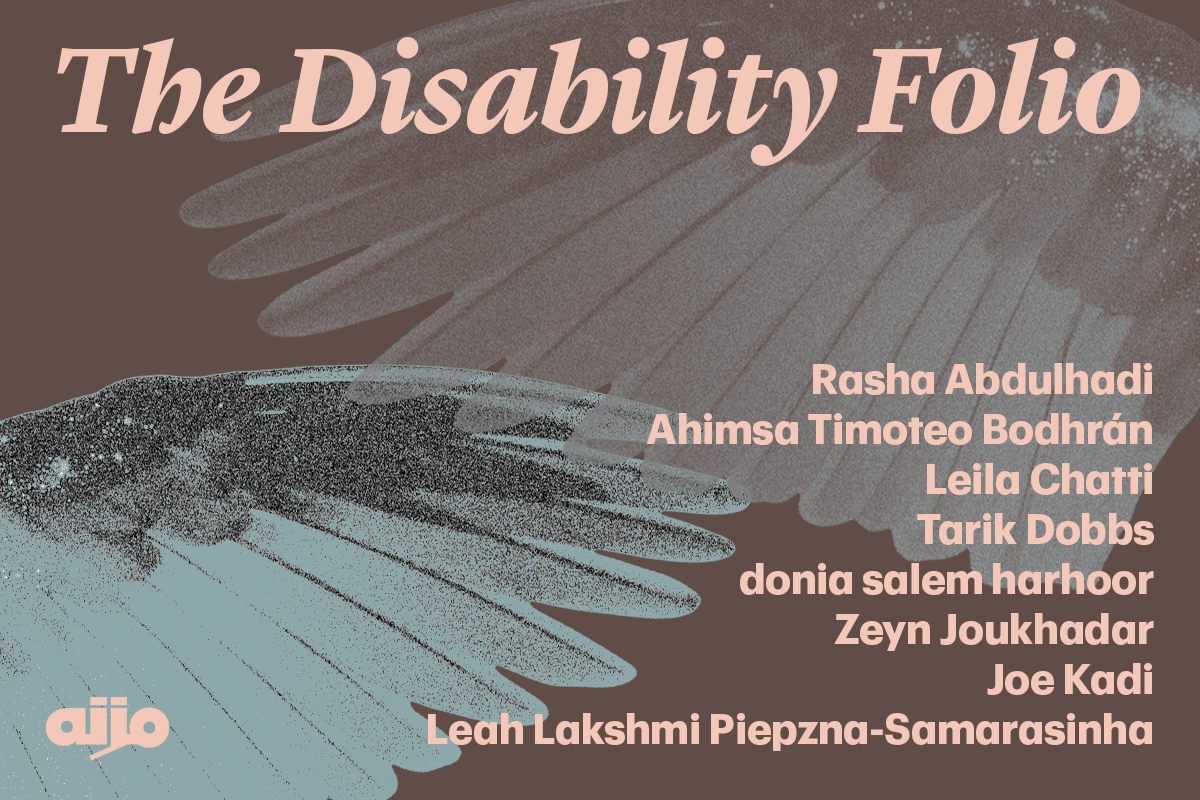
Disability Folio
As we close yet another Disability Pride Month amidst ever-escalating warfare and ethnic cleansing against Palestinian, Sudanese, Iranian, Lebanese, and many more peoples across the SWANA region and Global South, it is of dire importance to reflect on the systems that debilitize, incapacitate, maim, and otherwise catastrophize both our bodies and our body politics. The impossible, still-opening wounds of the US-Zionist genocide in Gaza, which have surpassed the long-upheld regime of necropolitics, have left Palestinians in Gaza faced with the largest number of child amputees per capita worldwide, amid what Nadera Shaloub-Kevorkian theorizes as ashlaa’, and what Sarah Ihmoud describes as the common refrain of the “luxury of death,” asking how we might “account for the impossibility of embracing Palestinian life amidst the totalizing perception of death.” Rereading the poems in the Disability Folio, I am struck by the resemblance between the form of questions Palestinian Southerner Rasha Abdulhadi asks, amid the still-ongoing COVID-19 pandemic, and what has become of our people over the past few years:
How to find that your fury has no bottom . . . . . . . . . . . . . . . . . . . . . . . . . . . . .
How to say everything you notice and feel . . . . . . . . . . . . . . . . . . . . . . . . . . . . .
. . .
How to keep yourself and others alive in America.. . . . . . . . . . . . . . . . . . . . . .
How to keep yourself and others alive in Palestine. . . . . . . . . . . . . . . . . . . . .
The closing lines, including a reference to the great Kiese Laymon, remind me of the many collectivities formed across our body politics these past several years, as Palestine becomes an issue by which the false dichotomy of so-called domestic versus international politics dissolves.
Taking this context into account, Mizna presents the Disability Folio: an archival curation led by former editorial intern Kate Bestall featuring selections from a large range of past Mizna issues as well as new works from long-beloved Mizna family on topics such as disability justice, chronic illness, and other intersections between biopolitics and settler colonial politics. It is unsurprising, as pieces by Zeyn Joukhadar and Tarik Dobbs exemplify, that many of these works discuss these topics in conversation with queer and trans politics, as the still-ongoing AIDS epidemic and still-escalating wave of US legislative transphobia remind us just how disposable queer and trans bodies are to the ruling class. These pieces are as capacious in their varied content as they are in the many forms and shapes they take: an intimate letter to a comrade; an erasure poem that enacts redactions from several intersecting systems of power; a prose poem that warps space-time around the speaker’s body; a hiking dispatch from Mizna’s Environment Issue. In a heart-wrenching poem by Leila Chatti, author of Deluge, one of the greatest recent poetry collections thinking on the intersection of chronic illness and SWANA diaspora, her speaker reckons with her distance from a catastrophe in Tunisia, ending: “I write the wrong poem. I fail the dead. I fail the dead.” Taken together, these pieces never fail to return us to the intimate fact of the body, in the context of our current world order’s body politic.
This folio spans many years of cultural production, including work by queer legend Ahimsa Timoteo Bodhrán, who appeared in Mizna’s very first issue, with a gorgeous tribute to the SWANA artists who made his work possible. In talking about this folio’s curation with Bodhrán, he gave special love to the way guest editor Zeyn Joukhadar and executive director Lana Barkawi held space for him as a contributor to Mizna: Queer + Trans Voices while he struggled with his “How to Survive a Pandemic” essay—an editorial process he called “a loving trust in which transformational art can be made” amidst Mizna’s long “radical lineage of women of color editors and queer/trans editors of color.” Here, moved by these dear words of my comrade, I too am humbled and reminded that disability justice, if it is to be truly transformational, must guide us at a level of praxis, infused into our daily editorial work as we serve our communities and work toward collective liberation. May we all work to build a world where we can hold each other, in and beyond our words, in temporalities more generous and caring to our bodies than anything racial capitalism and colonialism could ever be capable of making.
—George Abraham, Editor-at-Large

Two poems by Rasha Abdulhadi
Rasha Abdulhadi writes through the accumulation of everyday catastrophes in poems “is Palestine” and “Table of Contents for a Manual of Pandemic Response Protocols”.

Vestibular by donia salem harhoor
Claustrophobic and disorienting, donia salem harhoor’s poem invites us into a scene of recollection that weaves the mundane with the fantastical.

A Poem and an Essay by Ahimsa Timoteo Bodhrán
Ahimsa Timoteo Bodhrán’s poems “la lengua of love” and “How to Make White Supremacy Generative/How to Survive a Pandemic,” initially published twenty years apart, present different perspectives on bodies and language: the multilingual language of love and the language of virus.

A Poem by Leila Chatti
Tunisian-American poet Leila Chatti reflects upon the role of linguistic distance in dehumanization and interrogates the connection between distance and love.

Letter to a Disabled Brown Transsexual with Endometriosis by Zeyn Joukhadar
In a new essay, Zeyn Joukhadar explores the intersections of being brown, trans, and disabled, using the lens of video games like Dragon Age and Frosthaven to reflect on systemic violence.

Sharing My Days with Large Predators by Joe Kadi
Longtime Mizna contributor Joe Kadi reflects on his experiences encountering predators while hiking in Alberta’s Rocky Mountains. Originally published

My Uncle Who Died of AIDS Probably by Tarik Dobbs
Former Mizna guest editor Tarik Dobbs imagines an uncle’s history in “My Uncle Who Died of AIDS Probably.” The poem, surrounded by absence and redaction, contemplates an interpretation of the past while holding space for what cannot be known. Originally published in Mizna: Queer + Trans Voices.

cane dweller by Leah Lakshmi Piepzna-Samarasinha
Former Mizna contributor Leah Lakshmi Piepzna-Samarasinha shares an excerpt from her recently published poetry collection, The Way Disabled People Love Each Other.
Related
The Bringers of Violence

Worlds of Our Own Making
Mizna: 25 Years

Poem