



December 31, 2025
Favorite SWANA Books of 2025: Reflections on Literary Abundance from Mizna Community + Staff
This year has been a big year for books by SWANA authors. Big in the sense that we’ve seen an impressive volume of work published in English this year, but also in the sense that those works have received a lot of recognition in literary spaces, from individual readers and by way of major literary awards. Early this year, we set out to read as many of these books as we possibly could so that we might share with you the very best of the best. Our consideration of the books we call best may be as subjective as the selections of literary awards committees, but it comes from two people who truly love SWANA literature. Since 2021, we have put out a casual list of every book by SWANA authors that we read (regardless of publication year), trying to give each book attention; that collaboration has turned into this curation.
Despite our best efforts, there were limits to our capacity, both internal and external. In total, we read around sixty books—some read by both, others delegated to just one of us. This list focuses on books for adults, though there are many SWANA writers doing work in children’s picture books, middle grade, young adult, and more genres not considered here. We were also limited by what was and was not published this year. The literary establishment responds to crisis in some ways: There was an abundance of new literature by Palestinian authors, as well as literature about Palestine, across genres. Although the genocides in each context are so often spoken about in the same breath, the same was not true for Sudanese authors. It seems the industry’s opportunism is not outweighed by its anti-Blackness. It is impossible to balance the joy of seeing so many Palestinian authors platformed with the devastation that comes with the understanding that this support is often bolstered by the live-streamed violence. The fact that Sudanese authors are not offered similar opportunities highlights these contradictions within the industry, and reminds us that there are ways to support people outside of the confines of the formal publishing apparatus.
The list we’ve curated reflects the ways that available SWANA literature is shaped by publishing market appetites, but we’ve also made an effort to highlight a range of works: from authors of different backgrounds working in various linguistic contexts; from small and large presses; books that have received mainstream attention and those equally deserving of a generous readership. These twelve books of fiction, poetry, and nonfiction provide a brief slice of a genuinely vast and expanding SWANA literary landscape that we have loved seeing.


Fiction
Liquid: A Love Story by Mariam Rahmani
Of course the two LA-based SWANA PhD girls writing this list loved the book about an LA-based SWANA PhD girl. Shoutout to representation! This book was such a messy and fun romp that, even if you do not belong to our incredibly niche identity group, you are sure to love it too. The story follows an unnamed Indian-Iranian recent English PhD grad who finds herself, as all modern PhD grads eventually do, jobless. She sets out to go on one hundred dates with an eclectic cast of rich people of all genders, with the goal of securing a lucrative marriage proposal by September. Distracting her from this plan are a complex set of tensions with her best friend and his on-again, off-again girlfriend, as well as a family emergency that ultimately pulls her to Tehran. In Tehran, everything slows down: her calculus about financial and emotional security shifts (though she never gives up on getting laid or finding some kind of love). This book is simultaneously genuinely hilarious and stunningly emotional, in ways you don’t always expect. Rahmani offers an adept critique of academia, Los Angeles, capitalism, and modern romance, even as the narrator is implicating herself in all of these critiques. The analytical engagements with literature and film sprinkled throughout this book are also incredibly compelling, particularly the critique that runs through the text of anti-Indian racism in classic Farsi literature. This novel plays off of so many disparate types of writing—the romcom, the literary novel, the detached satire, the academic text—and yet the final product is cohesive and charming. An innovative, truly gorgeous read.
—Samia Saliba
The Burning Heart of the World by Nancy Kricorian
This is a quietly beautiful novel, despite the heaviness of its content. In fewer than 200 pages, Kricorian traces a reverse chronology from the aftermath of 9/11 in New York, to Beirut during the Lebanese Civil War, to the Armenian genocide in Hadjin. The story begins with Vera, an Armenian woman who grew up in Lebanon, in couples therapy with her husband when they find out the Twin Towers have collapsed. From there, we follow Vera through the reverberating traumas of wars that never leave you and the multiple alienations of being SWANA in post-9/11 New York. In the novel’s second section, its longest, we see Vera’s life as a seventh grader in Beirut during the Civil War. This section is both relentless and mundane, capturing how the contours of war become a part of the daily rhythm of life until they ultimately become unbearable. There is a deliberate slowness to this novel, its attention to the mundane amid crisis that makes it compelling. This is particularly true in the focus on Vera’s adolescent anxieties—going to the store for menstrual products, youthful crushes—all disrupted by the violence of the world around her. As the novel closes, we get a brief glimpse back into Vera’s grandmother’s experience surviving the Armenian genocide. While many novels weave the past into the present, Kricorian’s choice here to move steadily backwards, slowly unwrapping layers of trauma and memory, is really stunning. This book’s narrow focus and its economy of language make it a compelling, short read that reverberates far beyond the scope of its pages.
—SS
Empty Cages by Fatma Qandil, translated from the Arabic by Adam Talib
Empty Cages is a stunning book that I am so happy to see in translation as Qandil’s English debut. Though it is labeled a novel, this book also reflects elements of Qandil’s own life and upbringing, and may perhaps be described as autofiction. It is also certainly shaped by Qandil’s background as a poet, clear in her incredibly precise and economical use of language. This novel engages with the unreality and unreliability of memory itself—as the narrator says at one point, “All my memories felt like fabulations.” Because of this hybridity, the story is driven more often by relationships than by a particular plot structure. At the core of these relationships is the bond between the narrator and her mother, who remain—despite all the harshness of class, patriarchy, illness, and life—each other’s caretakers. Moving back and forth in time across the narrator’s life, from her beginning in a middle class but downwardly mobile family in Cairo in 1958 to a later life marked by losses, divorce, and estrangement from her brothers, Empty Cages tells the story of a sharp and fiery woman navigating all the mundane violences of a changing Egypt. This novel can be quite a harrowing read at times, with frank depictions of childhood sexual abuse, cancer, alcoholism, and domestic abuse. But, for those open to challenging themes, it is well worth the time. This is a really exciting first novel and first translation, and one that deserves to be on more people’s radars.
—SS
The Sisters by Jonas Hassen Khemiri
When I first learned that this book was coming out, I joked to Summer, What if one of my favorite novels of the year ends up being a 650 page brick? Imagine trying to convince people to read that. But then it actually was one of the best novels of the year and I must repent for ever doubting. This book is truly in its own category in many ways. It is very long, but reads very fast. It is both translated and untranslated: Khemiri wrote the book first in English, then again in Swedish (the Swedish version is a whopping 720 pages), then again in English. Its prose is at once direct and a little strange in the best way, marked by Khemiri’s affinity for massive run-on sentences that keep drawing you in and into his world. Its plot—which centers on three Swedish Tunisian sisters over decades and their Swedish Tunisian neighbor (also named Jonas Hassen Khemiri) who develops a lifelong obsession with them—is unique, and yet, the story always feels familiar. Most of all, this book is fun! It’s sad! It’s beautiful! Much of The Sisters centers on not knowing: not being able to know other people fully or not being able to be known by them. Much of that not-knowing occurs within families, in the gaps in understanding between generations, the secret family lore that is never fully revealed, the failures of friendships to manifest as hoped. Khemiri renders the difficult buffer zones between us and the anxieties and obsessions they produce with perfect honesty and simple beauty. A book for the ages.
—SS



Poetry
48kg. by Batool Abu Akleen, translated from the Arabic by Akleen, Wiam El-Tamami, Graham Liddell, Cristina Viti, and Yasmin Zaher
As a poet invested in narratives about food—cultural significance, communal possibilities, and the realities of disordered eating—and a student of Etel Adnan, Batool Abu Akleen’s collection in which each poem “accounts for a single kilogram,” whose tone and temperament has been compared to Adnan, was one of my most anticipated of the year; it did not disappoint. This bilingual edition was translated from the Arabic by the poet herself and a number of others. 48kg is a diary of starvation. Batool Abu Akleen’s poems are sharp and, as beautiful as they are horrifying, filled with wit and tenderness. Poetry is a speculative space, and these poems are illustrative of those potentials, the way reality can bend around the speaker’s will through metaphor and image. The most striking of these poems are rendered from the impossible plausibilities of Israel’s genocide in Gaza; as the enemy invents new ways to destroy the body, these poems answer the impact of the enemy’s imagination without surrender. My favorite poem reads:
I don’t know how to sew
Why haven’t you taught me how to sew, grandmother?
There I am.
Standing in front of you.
All I can see are the convolutions of your brain.
I hold a needle & thread in one hand.
& your features in the other.
I look among the doctors who are busy with the living
I look for someone to sew your torn face together again
so I can kiss it
for the last time.
—Summer Farah
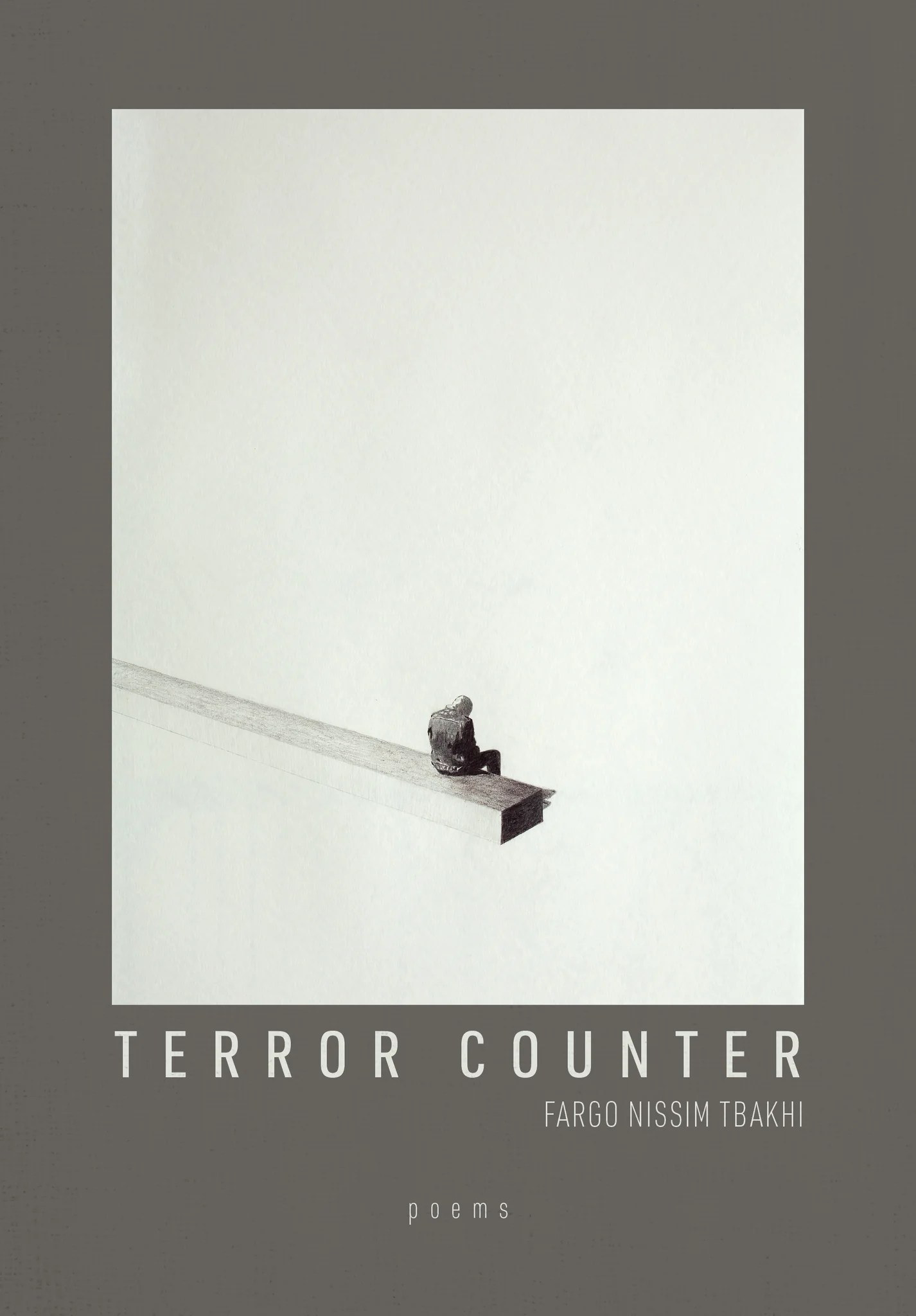
TERROR COUNTER by Fargo Nissim Tbakhi
Fargo Nissim Tbakhi is the greatest mind of our generation; I say this in affectionate jest for a writer I have grown alongside, but I mean it when I say TERROR COUNTER is a generation-shaping collection. Politically sharp and unafraid, the reverberations of Tbakhi’s thinking and approach are already apparent in the work of our peers, but this collection is just the beginning. Whether it is the desire to antagonize a reader through thwarted expectations in “Palestinian Love Poem,” the blunt critique that fluidly shifts into vulnerability in “An American Writes a Poem,” or the innovation of the “Gazan Tunnels” sequence and the energizing, paradigm shifting “PALESTINE IS A FUTURISM,”TERROR COUNTER offers an abundance of challenges, whether it be to fellow Palestinian diasporic writers, those who may consider themselves aligned with our cause, or those who do not know quite what it means to be on the side of liberation. Alongside the challenge there is tenderness, alongside the discomfort there is love. Never consolation, though, as Tbakhi’s poems remind us a better future is not guaranteed. TERROR COUNTER urges us to reconsider our first thought—the propagandized thought, the conditioned thought, the one we might need to unlearn—and instead to put in the work toward something different, something more free.
—SF
Wildness Before Something Sublime by Leila Chatti
This is the book I have reread most this year. Wildness Before Something Sublime begins with a disclaimer—something I am both unused to and am trained to be against. My first poetic home was the slam poetry scene, where every second counted—to begin a poem with an explanation was to lose out on the three minutes on which you would be judged. In my later poetic spaces, the disdain with which poets of marginalized backgrounds spoke of “explaining” their work made it clear to me that the burden of explaining was a remarginalization. However, Chatti’s disclaimer becomes part of the craft of the book itself—this is a book that was written while I was not writing, she says. It is important for the reader to know this, that this book became something organically rather than from a methodical proposal, circulated to awards and grants committees. Wildness wraps the anxiety of not having an easy answer to “what are you working on?” or “what do you write about?” into a formal extreme—the poems do not necessarily detail a specific time in the poet’s life, nor do they borrow a specific thematic approach, but instead, they are divided by construction. These constructions are innovative, strange, and sometimes clumsy, generously so, letting the about be in the making of the poems rather than what they contain. Samia mentioned this book simultaneously carries appeal for nonpoets while reminding poets what it means to love the act of writing poetry. Like the best of the poets who find themselves in that rare spot of being loved by poets and nonpoets alike, like Mary Oliver or Richard Siken, Chatti’s work contains absolute gut-punches: poems that invite us to look inward, wonder what it is we are afraid of saying, and ask what will happen if we just do it instead. Attempts define the formal experimentation of Wildness, with each subsequent attempt there is a processing of avoidance, a confrontation with it, and a move toward self-actualization. At the end of the book, Chatti has a brief lyrical craft essay for each technique. The marrying of disclaimer, content, and notes all within the same sort of attempt makes Wildness especially unusual as an art object; different from her past works in that it is not dictated by a tight motif or theme, Wildness is about the act of making itself and all of the tensions encompassed within.
—SF
Mercurial, or Is That Liberty? by Rachelle Rahmé
Rachelle Rahmé’s debut is a work of dualism: framed by the title’s question, Rahmé presents the reader with interrogations of border, citizenship, philosophy, and political allegiance. So often her line dances gently back and forth on the page, a gentle unsteadiness to complement these lines of inquiry and the stickiness they produce. Her work has a beautiful affinity with poets like Zaina Alsous or mónica teresa ortiz in the way that each poem has a strong intellectual root that blooms into a unique emotionality. These poems come from a distance, but are never apathetic—instead, they are rendered with humor and irony. Mercurial, or is that Liberty? invites the reader to move slowly through its lines—it is not loud in the way it demands attention, rather lilted and meticulous. The final poem, “Disabused Migrations,” steadies itself, a loose assurance with the anaphoric “Perhaps” driving us down the page—“Perhaps I do have other things on my mind,” “Perhaps do dream poorly,” “Perhaps I shouldn’t be driving.” These elegant repetitions add another layer to the collection as it closes out. Rahmé’s poems are the kind that invite rereading, again and again, offering more on each subsequent read.
—SF


Non-Fiction
Perfect Victims: And the Politics of Appeal by Mohammed El-Kurd
In the second chapter of Perfect Victims, El-Kurd writes: “I have always wanted to be human.” A debate of humanity is at the core of Perfect Victims, but perhaps not in the ways most expected. This debut essay collection, released early in 2025, so simultaneously perfectly timed and also evergreen. I really enjoyed his poetry collection Rifqa when it was published in 2021 and was excited to see some of the ideas gestured toward in the poetry—humor, this intense burden of study—come to fruition in Perfect Victims. El-Kurd presents a critique of the “politics of appeal,” or the methods through which Palestinians and our allies “re-humanize” ourselves in response to the violence of the Western media industry. He details how this process of rehumanization—in its aspirations to white, Western hegemony—defangs and belittles the resistance and often betrays the Palestinian cause. It is a short book made of digestible chapters; El-Kurd’s accessible, beautiful, and often funny writing makes it an easy recommendation for anyone who wishes to understand the layers of rhetorical gymnastics that Palestinians are forced to navigate. This book refuses to waste time on those gymnastics. I recommend this book more than any other released on the discourse of Palestine this year; El-Kurd writes with an honesty that most other writers would collapse under. There are so many conversations, distractions, and roadblocks in the language of the liberation struggle covered in the pages of Perfect Victims. May this text circulate widely and halt those inane arguments that are meant to take our focus off of what truly matters, what is truly at stake.
—SF
Forest Euphoria: The Abounding Queerness of Nature by Patricia Ononiwu Kaishian
Patricia Ononiwu Kaishian introduces us to the queerness of nature through the luscious scenes of her childhood in the Hudson Valley through her present-day research and work as a mycologist. Blending personal vignettes with folklore and science, Kaishian builds on the contemporary canon of nature writing like Braiding Sweetgrass to present her particular perspective as an Irish-Armenian queer scientist. It is a privilege to see the world through her eyes. I sent Samia a passage from one of the early essays, where Kaishian writes about dropping a box of crickets in her home. Unable to attend to them before she had to leave for the day, she returns to a house full of sounds—frogs and crickets chirping, as if she is by a riverbank at night. She writes, “This delighted me . . . I had brought the swamp inside, flourishing in the mess.” I told Samia, “I hope to one day challenge my relationship to nature enough to get to a place where I could experience this and not want to die.” I say this crassly, but the sentiment is true: I enjoy a work that challenges my social norms, pushes me to consider where discomfort lives and why that may be. What is the harm of living alongside the frogs, the crickets, outside of the discomfort I’ve been socialized into experiencing? These questions are raised lovingly, gently. The way Kaishian writes about fungi quite literally brought me to tears; she writes about her specialization with such love and care, while offering niche histories I cannot imagine encountering otherwise. While this debut was satisfying, I hope to see more books that dig even deeper—there are some writers from whom I would read quite literally anything, despite the subject not being an obvious one on my list. Kaishian is one of them.
—SF
I’ll Tell You When I’m Home by Hala Alyan
Hala Alyan is already one of my favorite poets AND favorite novelists of all time, and her newest book proves that she can write a masterpiece in any genre. This memoir is gorgeously and lyrically written, and in some ways its vulnerability exceeds even her poetry. Sometimes it can be so vulnerable that it is uncomfortable to read, which I think is the mark of a truly incredible memoir. This book is structured around Alyan’s experience of becoming a mother through surrogacy after years of fertility struggles. Each section is built around one month of the baby’s gestation through which Alyan weaves different periods of her own life, her family’s multiple displacements, her and her husband’s conflicts over becoming parents, and the multiple alienations she has felt from her own body emphasized through the experience of having to trust another person’s body to birth her child. Throughout the text, Alyan plays with Arab storytelling traditions alongside therapy techniques from her background as a psychologist to narrate her way through the woven, multigenerational traumas that shape her life and the life she is hoping to build for her daughter. I was struck throughout this book by how effectively Alyan moves between particular, close, bodily intensities and broader, collective violences of war and displacement. If you’re a fan of Alyan’s poetry, you might find a lot of familiarity in the stories in this book, and yet, it crafts these stories anew into something completely distinct. If you’re not already familiar with her work . . . well, get on it! I’ll Tell You When I’m Home is an incredible place to start.
—SS
Fire in Every Direction by Tareq Baconi
If Qandil’s Empty Cages is a novel that at times moves like a memoir, Fire in Every Direction is a memoir that moves like a novel. Especially in the first half, this book has all the narrative contours of a tragic love story, contending with Baconi’s queer coming of age in Amman through intimate scenes and dialogue. There’s a profound sort of honesty to this narrative style in a memoir that you don’t often see. From the start, I was completely immersed in the story, but then I would remember that it was true, and the weight and vulnerability of it would hit me all over again. Told mostly chronologically through the course of Baconi’s life, he also weaves in moments of familial history throughout, including his grandmother’s displacement from Palestine during the Nakba and his mother’s displacement from Lebanon during the civil war. I found these moves outside of the self, their celebration of the strength and survival of the women who raised him, to be particularly compelling. In later sections, Baconi discusses his time living in Palestine, finding his grandmother’s home in Haifa, and his time in Gaza. His reflections on Gaza are particularly powerful, highlighting the revolutionary nature of abjection and insisting that Gaza holds the secrets to our world. In many ways, despite it all, this book brought me more hope than anything else I read this year. Baconi’s angry address to his first love toward the book’s close sticks with me: Ramzi, we are all complicit in maintaining the suffocating norms that shackle our communities. No one is going to save us—we must do the work ourselves.
—SS


Mizna Staff Picks
As 2025 draws to a close—after yet another year of fighting western imperialism’s genocidal horrors, failed “ceasefires,” and escalating US fascism—we at Mizna want to highlight some books that have helped keep our community grounded, focused, and sharpened through it all.
In talking to our staff to write this piece, I noticed that several of us spent our reading time this past year revisiting revolutionary historical texts across various Afro-Asian contexts or literary works not published in the past few years. In fact, many of my personal favorite SWANA books of 2025 explicitly engaged radical archives and thought capaciously beyond their own contexts. Nasser Abourahme’s The Time Beneath the Concrete, alongside this essay which remains one of the most useful works of scholarship to be produced within the western academy post-2023, reminds us of just how long Palestinians have been staking their whole lives and livelihoods on the project of resistively opening timelines and potentialities beyond the narrow confines of settler colonial futurity.
Another favorite, beloved equally for its deep engagement with long histories of anticolonial thought and for its exquisite lyric narrative craft, is habibna Sarah Aziza’s The Hollow Half. Having seen this book moving through various contexts—university classrooms, Palestine movement spaces, memoir workshops, conversations with fellow loved ones struggling with recovery, Aziza’s book—I am astounded at Aziza’s exceptional ability, like El-Kurd’s, to speak to such a wide-ranging audience while remaining firm and uncompromising in her politic and care for Palestinian life. Like Baconi’s heart-stopping memoir, Aziza’s deftly weaves personal, queer, embodied narratives with transnational Palestinian exilic histories. Though separated in space-time by many decades and borders, Aziza’s, El-Kurd’s, and Baconi’s books’ narrative arcs end with Gaza: as mother of our resistance, as the embodied refusal of the Western imperial world order, as a site of unknowable potentialities for life despite genocidal Zionism, as a spark that demands us in diaspora to wake and rise to its call, staking our lives in confronting the most abject versions of our selves and communities wherever we are in the world.
Taken together, the Palestinian nonfiction releases of this year are a reminder that we are our most capable storytellers, despite the unique epistemic erasure we face in nonfiction spaces, academia and western journalism outlets and the publishing industry writ large. As Mizna Poetry Coalition Fellow Tamara Al-Qaisi-Coleman writes, particularly noting her love for Perfect Victims and I’ll Tell You When I’m Home: “If El-Kurd asks the world to stop demanding Palestinians be perfect in order to live, Alyan asks Palestinians to stop demanding closure in order to imagine. Together, these books insist on a futurism that does not wait for liberation to begin dreaming. It is already happening—in anger, in kitchens, in poems, in motherhood, in revolutions, and in refusals.”


I will now turn to the poetry and fiction that has felt meaningful to our Mizna community. To Farah and Saliba’s selections, our Executive Director Lana Barkawi also adds the anthologies Heaven Looks Like Us, a Palestinian poetry anthology edited by myself alongside habibna Noor Hindi which features many Mizna authors, as well as Sleeping in the Courtyard, a groundbreaking new collection of Kurdish writing, edited by habibna Holly Mason Badra. I also want to take a moment to appreciate habibna Huda Fakhreddine’s unparalleled translation of Samer Abu Hawwash, as Ruins will be the first poetry book I assign to my students in 2026, and Mizna beloved Omar Sakr for The Nightmare Sequence, a collaboration with Safdar Ahmed that, taken together with Abu Hawwash’s Ruins, has been a north star of sorts, guiding my own writing practice as we resist this genocide.
I will end by highlighting a few new fiction titles that have been impactful for Mizna’s community. First, to call Rabih Alameddine’s National Book Award win “well deserved” is an understatement; returning to his older work like KOOLAIDS and I, the Divine, alongside his most recent novel The True True Story of Raja the Gullible (and His Mother), has single-handedly been my most formative reading experience this year. Secondly, the most memorable novel I read this past year was habibna Mira Mattar’s Yes, I Am A Destroyer, whose US release was just published with Litmus Press. In talking with other Mizna contributors about Mattar’s work, we had the most beautifully difficult time describing it succinctly, but the best I can do is: I have never seen a reckoning with Palestinian interiority as rich, exciting, and brilliantly rendered as this novel. This is an anti-Bildungsroman that feels and becomes Palestinian at a molecular level and is an unforgettable contribution to our community’s global arts and letters. Third, I would like to highlight long-time Mizna contributor Sahar Mustafah, whose newest novel The Slightest Green is a gorgeous and devastating novel about Palestinian return, grief, and the embodied cost of resistance. Alongside hosting Mustafah, who recently visited Western Massachusetts thanks to our Interlink habayeb, my November travels to the UK also put recent novels by the legendary Sudanese writer Leila Aboulela and Mizna contributor Mohamed Tonsy at the top of my 2026 reading list.
Although it is an impossible time for our people, our literary abundance persists, as 2026 brings so many exciting books. Upcoming in the Mizna Online slate is a most anticipated SWANA books of 2026 by Samia Saliba, and several new installments to Hazem Fahmy’s excellent “Uncrafted” series. We look forward to renewing and sharpening our commitments to our movements and each other as we continue building together in the new year.
—George Abraham, Editor-at-Large
Summer Farah is a Palestinian American writer, editor, and zine-maker from California. She is the author of I could die today and live again (Game Over Books, 2024) and The Hungering Years (Host Publications, 2026). A member of the Radius of Arab American Writers and the National Book Critics Circle, she is calling on you to recommit yourself to the liberation of the Palestinian people each day.
Samia Saliba is a writer from Washington state and a PhD candidate in American Studies & Ethnicity. She is the author of the chapbook conspiracy theories (Game Over Books, 2025), and her poems have appeared in Split This Rock, Apogee, AAWW, Mizna, and elsewhere. Find her atsamiasaliba.com.
Related
The Bringers of Violence
Sunbird
Ink is the Strongest Gunpowder
The Experimental Issue Virtual Launch