



May 19, 2026
Poems: “Come From,” “Learning to Write in Arabic,” & “Arabic Abecedarian”
We might think of the two poems “Come From” and “Learning to Write in Arabic” as prefatory notes to the longer “Arabic Abecedarian” that follows. They signal to the reader something about where we are going, which is a language-place full of questions and paradox, presence and absence, intimacy and estrangement all at once. Illuminating these contradictions and the ways that they exist simultaneously is a unifying seam that runs across all three of these pieces. Ultimately, these poems aspire to honor the relationship between me and my mother tongue, which is fragmented and incomplete, especially according to the dominant rubrics of belonging. There is grief for what is lost. There is wonder for what remains.
The abecedarian (which is also a parable sequence) experiments with shape and form, resisting linearity. There are patterns and strands that emerge throughout, but, ultimately, it’s a sequence that asks us to read lyrically. To make “lyric sense,” which requires surrendering to some level of uncertainty, perhaps. It invites unknowing; it is interested in forging new forms of knowledge. Some of the poems are written in response to the sound of a particular Arabic consonant, while others are crafted around the shape of the letter, the visual reverberation made by each mark on the page.
The parables invite readers to linger over each shape, to witness the speaker as she practices making vocal utterances and feels the worry of not knowing how to make certain sounds correctly. There is self-consciousness, awe, familiarity, strangeness. It’s labor intensive, especially for the non-Arabic speaker/reader. In this way, it reproduces the sensation of being simultaneously inside and outside of a language, feeling the barrier, working slowly at the edges.
—janan alexandra
The following poems are part of the Mizna Online digital curation, Tongues Untethered: Cross-Cultural Writing and Identity Beyond Language. We encourage you to read them alongside other works in the folio.
Come From
if we do not speak
in the night in the kitchen
here leaning over the starry counter
like two hunched sunflowers
if we do not stand stooped
like this picking at cold lasagna
which is neither the food
of your country nor my own
how will we carry this tin pail
sloshing with the question
can you imagine walking
into a softly lit room
in the world & feeling
hereiam, homewithallofyou?
to be known in the arithmetic
of belonging we follow
an order of operations
we do the math
enough & not enough.
what are you really really?
from from?
really we are the field
in each other’s eyes
we hope to die surrounded
by our own languages—
even those we cannot speak
Learning to Write in Arabic
( i ) sheen
i wake with the shape
of the ش in my right hand
carving midair
left hand still closed
in sleep
& this time i trace
the medial version
who like us is touched
by what comes before
& after
i ride the curves cool & smooth
as a line of breath though i can’t see
the whole page i still listen for the story
my ش wanted to tell:
shukr rising thanks be to all
who rowed this pencil-boat before us
& all who offered us their oars
( ii ) qaf
Inside the night a shawl gathers
at my throat where shyness lives.
I flick the tail of the ق with my tongue
& the word قلم rises, pencil I swallowed
who tilts my chin to the moon: القمر
I repeat, holding her meat half-formed
& shining in the maroon sky of my mouth.
I worry I’ve been deprived of a mother-
tongue but am wrong. القمر is a gift lifted
by the needleworker who practices behind
my curtain of teeth, spinning new muscle
& sinew. I heave my ق into cool air thick
with cloth pockets of speech. I feel for
the seams, for the sounds trying to be.
Arabic Abecedarian
parable of the aleph
ا
aleph, arrow, sapling, wand
needle that lengthens what comes before
ink stroke who draws sound
& bears the little hamza
see:
girl squatting at the base of a tree إ
or
girl perched atop a stone pillar أ
studying
the thousand ruins
ألف ألف ألف
parable of the three sisters
( i )
ب
studying the thousand ruins
girl sees ox horns, belly,
boat who ferries to & fro
&: smallest scale weighing desire:
(i want) بدي
(tomorrow) بكرا
(dad) بابا
(i love) بحب
(house) بيت
(girl, daughter) بنت
(enough) بس
iwanttomorrowdadilovehousegirldaughterenoughenoughdaughtergirlhouseilovedadtomorrowiwant
i love dad
i love house
i love girldaughter
i love tomorrow
i love enough
girl i love
( ii )
ت
girl loves to touch
a teacup to her tulips
to try the saucer
as tinkling bell
to turn the cup
upside down
to tip it as a hat
to trace the shape
of her big sister
grinning
to lift her like a tray
of crystal & twirl
teeth flashing
maybe girl’s sister
is laughing
ta-ta-ta-ta-ta-ta-ta-ta-ta
( iii )
ث
girl’s father fills a bowl
with fresh mulberries.
see it? in Arabic we say
nus-nus. meaning half
for you & half for me.
our teeth speckled
with purple seeds. girl sees
ox grazing in the bottom
of the bowl. crow flocks
his horns. girl makes
her tongue a slab of meat
between rows of teeth.
th! th! th! : sound of feet
slicing through snow.
parable of the three cousins
( i )
ج
girl is the little essence
her one eye who never blinks
she is the dark part
heart’s center
innermost kernel
umbilicus
aureole
fish
darting
eye of Horus
& good health
falcon’s eye in flight
eye of the camel’s
slow hump
tipping girl back
to earth
( ii )
ح
girl fogs a mirror
in the mouth of sea
puffs out her lungs to match
sparrow’s breast,
skirt swishing breathy
in the courtyard.
She touches ح like a door
knocker, gust of air
sweeping in, sail hauled up,
raspy wave cresting.
girl’s mother coos babybear
over the phone
&
حياتي
( iii )
خ
girl skates down the alley
legs loose & arms wide
black dress billowing
she tears a crust
of bread & chews
while dead leaves
rustle under the neighbor’s rake—
akhh, akhh, akhh
parable of broken bones
( i )
د
door
(d)ear
as in dad
bell; crook
of girl’s arm
fractured
bone
( ii )
ذ
girl leans forward, clasps her cast close. she draws
cats and tulips on the plaster that holds her arm in
place. she faces west & folds over her legs, worry
making of her spine a sloping hill, the rocks loose
& tumbling.
when her friend Four Hornets lands
nearby, they make rhymes together: swarm rhymes
with mourn. torch rhymes with search. alone with
grown.
girl lists
words she loves for Four Hornets: hooves, hum, rib,
oil. Four Hornets listens—lantern, apricot, wood—
by the way, serendipity !then it’s Four Hornets’ turn:
Four Hornets pierces words into girl’s calves, each
one leaving a welt. the air vibrates in girl’s ear,
dhhhh, dhhhhh, dhhhhh, dhhhhhhh
parable of the field
( i ) ر girl practices reading in both directions
oh busted knuckle rusted scalpel oh
oh rusted scalpel radish pale oh
oh radish tail fingernail &
& fingernail oh comma
oh crescent moon oh comma
oh comma shoulder bone
oh shoulder bone wheezing lung &
& wheezing lung oh ghost sailing
oh ghost sailing beneath eyelid
beneath the eyelid with stitched sleep
stitched with sleep oh brushstrokes
oh brushstroke teeny & mufflers
& teeny muffler sized-ant oh scarves
oh ant-sized scarf wish blown lash &
& wish blown lash you say come
they say you come from pictogram
from the pictogram call they ahead
of a head, they call alveolar uvular you
you alveolar uvular & liquid consonant
& liquid consonant which means slippery
which means slippery clustered when
when clustered I but love to slip
but I love to slip you little on
on you little thrill, thrill trickling
trickling creek, creek tap shoe
tap shoe, you are you puff
are the puff pastry of rolled
pastry of rolled & r the ruffled
up r, the ruffled rose & snail
rose & snail, your speech a ensnare
speech is a snare drum oh flutter
drum, oh flutter ferned & curled
& fern curled the in moss,
in the moss, leaf skipping
leaf skipping a across field
of flax, you canter & break
canter & break into gallop
into gallop, into gallop
wind trilling under you’re
under your —hoarse & hoof
horse hoof—
busted knuckle oh
( ii )
ز
Girl finds a human shape
lilting soul
angel in flight
Here is her candle
& wick
newly lit
Here is her scythe
listen as she combs
the grasses
zza
zza
zza !
parable of thanks
( i )
س
sea
stitch
sun
(wheel-
barrow)
sack
silver-
spoon
susurrus
sister
see
( ii )
ش
the shape of the sheen is said to mimic
the structure of the human heart:
lower larger left ventricle supplies the full body
smaller right ventricle supplies the lungs
^ small
^ three tufts
shukr rises up ^
parable of sound & grammar
( i )
ص
here is your oldest sound
may you undo the laces of your tongue
& fill like a kite, floating skyward
is this your ribbon?
your half-knot?
(half not?)
may your wing grow long with this sound
may it be a spoon you lift to your mouth
may you release the sharpened hook
of shame & throw your body back,
fish, girl, swim.
( ii )
ض
The pharynx or epiglottis is constricted during the articulation of this sound. The epiglottis is a flap of cartilage at the root of the tongue, which is depressed during swallowing to cover the opening of the windpipe. The epiglottis is leaf shaped.
This letter is called the ḍād. In English, this spelling resembles the word dad, as in father. But in fact dad with a short a (sad or bad ) is not the correct sound value here. The actual sound value is deep and thick. It is a long ancient sound that comes from the root. The closest way I could write the sound in English is: ddaawhdd. The tongue curls almost as if to make an l shape, I think.
In my careful search I have learned that Arabic, the language of my mother’s people, and the adopted language of my father, is sometimes referred to as “the language of the ḍād” ( لغة الضاد ). It is said that this particular sound value is considered to be the direct ancestor of Arabic ḍād merging with the ṣād.
I see: ancestor of dad merging with sad.
girl sees: fish, bubble, footprint, bunny, bucket, person filling basket
with tongue-shaped leaves.
parable of sharing
( i )
ط
girl brings a ladle
to dole out soup
she sets the table
with Four Hornets
together they eat
( ii )
ظ
bird drinking or
half butterfly or
girl planting sapling or
girl touching her toes or
girl leaning against tree or
girl holding tree or
tree holding girl
parable of the eye in the throat
( i )
ع
innermost letter to emerge from the throat & scraped up gut
ancestor to the letter O
O of circumference
O of looking eye to eye
O of utterance: lips a round
puff of breath
Al-Khalil ibn Ahmad al-Farahidi, writer of the first Arabic dictionary in the 8th century,
suggests that the ع ( ‘ayn ) is the first sound, the essential sound, both the voice and
a representation of the self
I am the name of the sound
and the sound of the name.
I am the sign of the letter
and the designation of the division1
my difficulty gathering a strong ع troubles my sense of self
عيوني
(girls says: I’d give my eyes for you)
( ii )
غ
in the morning
girl hears Fairuz singing
أعطني الناي وغني
parable as ars poetica
( i )
ف
The shape of the Fāʾ is assumed to come from a pictogram of the mouth. Girl sees a curled shoe, a buckle or person sitting with legs outstretched & toes flexed, arms making a pleasing loop, head studying something small.
Girl rests her oars in the oarlocks & takes notes:
Fāʾ–fathah (فَـ /fa ) is a multi-function
prefix equivalent to “so” or “so that”
Example: نَكْتُب naktub means we write
+ ف → فَنَكْتُب fanaktub means so we write
( ii )
ق
Theshap qōp 𐩤 is uncertain It is
ally suggested to have originally
ither a sewing specifice eye of a needle
(Hוף and Aramaic קופא both refer to t
and neck (qāf inmeant “nape”
Accord monkey and its tail Accord
( iii )
ك
1. (hand) كف
2. In literary Arabic, kāph is used as a prefix to mean like or as or as though
3. If kāph is a hand that means like or as or as though, then kāph is a simile
4. Simile is a hand touching two places at once, a hand bringing together
two far away things, making a transfer (metaphor)
5. For example:
كَطَائِر (like a bird or as though a bird)
6. poem
girl
as though
a bird
hand
parable of water & mothers
( i )
ل
girl draws her bucket
up from the well
her mother calls تعالي
finger beckoning come home
mother like a shepherd
with her pastoral staff
pastoral like a swan
circling in the ripple
( ii )
م
girl’s favorite shape
is the meem. she loves
to make it with her
asthoughabirdhand
م م م م
curdled milk curl of soul
snake rearing sharp nose
ميم ميم ميم ميم
ممممممممممممممممstroke cruelممممم
& sweetمممممممممممممممmeemممممم
cameممممممممfrom a symbolممممم
ممممممم مممممممfor waterممhence
the words mayyمممممmaiمممممma
مممممممممممممم mamaمممممممممم
ممممممممممممممممممimmeeمممممممممم
( iii )
ن
Girl’s favorite word is نحن
It means We
Even before she knew the word she loved the sound
Here: Nahnou
Maybe she loves it because it sounds like ننون
Or maybe because Girl is thinking about We
Girl wonders areyoumyWe?
AmIyourWe?
HowdoWeWetogether?
WouldyouWewithme?
CouldIWewithyou?
HowcanIbetterWeyou?
&YouMe? AndusWe?
In Arabic, there is an expression:
“nus-nus” (remember?)
It means half-half
Half for you & half for me
ForWe
parable of the monostich
( i )
هـ girl, snail glistering forward
( ii )
و girl, softcry, from
( iii )
ي girl, bird flown
- 1. “Thunder, Perfect Mind,” The Nag Hammadi. Also known as the Gnostic Gospels, The Nag Hammadi is a collection of early Christian and Gnostic texts. Thirteen leather-bound papyrus manuscripts that date back to the 3rd and 4th centuries were found buried in a sealed jar near the Egyptian town of Nag Hammadi in 1945.
Excerpted from come from, Copyright © 2025 by janan alexandra. Published by BOA Editions on April 29, 2025. All rights reserved.

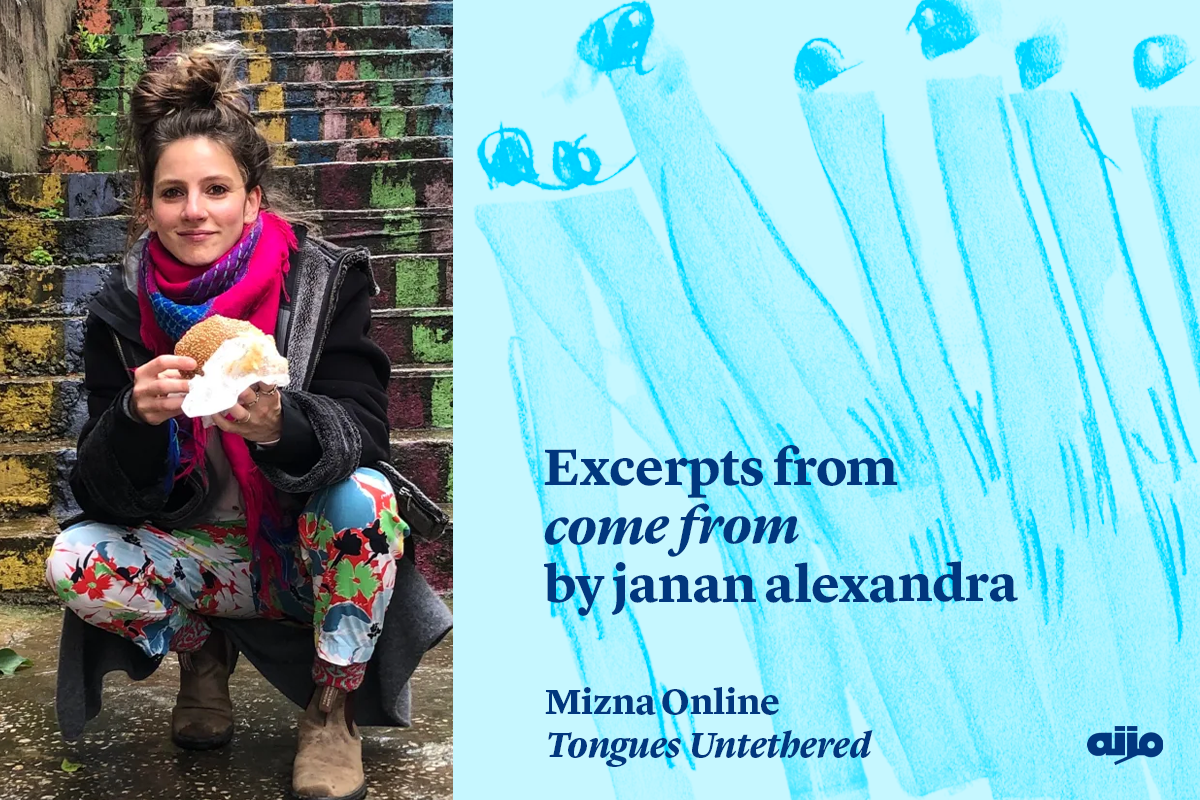
janan alexandra is the author of the poetry collection come from (BOA Editions, 2025). Her poems and essays appear in The Kenyon Review, New England Review, The Massachusetts Review, AGNI, Gulf Coast, and elsewhere. The recipient of support from Hedgebrook, the Mellon Foundation, the Fulbright program, the Vermont Studio Center, and the Provincetown Fine Arts Work Center, janan was a 2025 Djanikian Scholar in Poetry and winner of the 2023 Adrienne Rich Award for poetry. She teaches at Indiana University and at the Monroe County Correctional Center, and edits poems at The Rumpus. She’s currently working on two book projects and thinking about poetry as a study of time.
Related
The Bringers of Violence
Call for Submissions | دعوةٌ لِلمشاركات
A Liberatory Demand from Queers in Palestine
Mizna 22.1 Foreword: On SWANA Literature + Art