



May 19, 2026
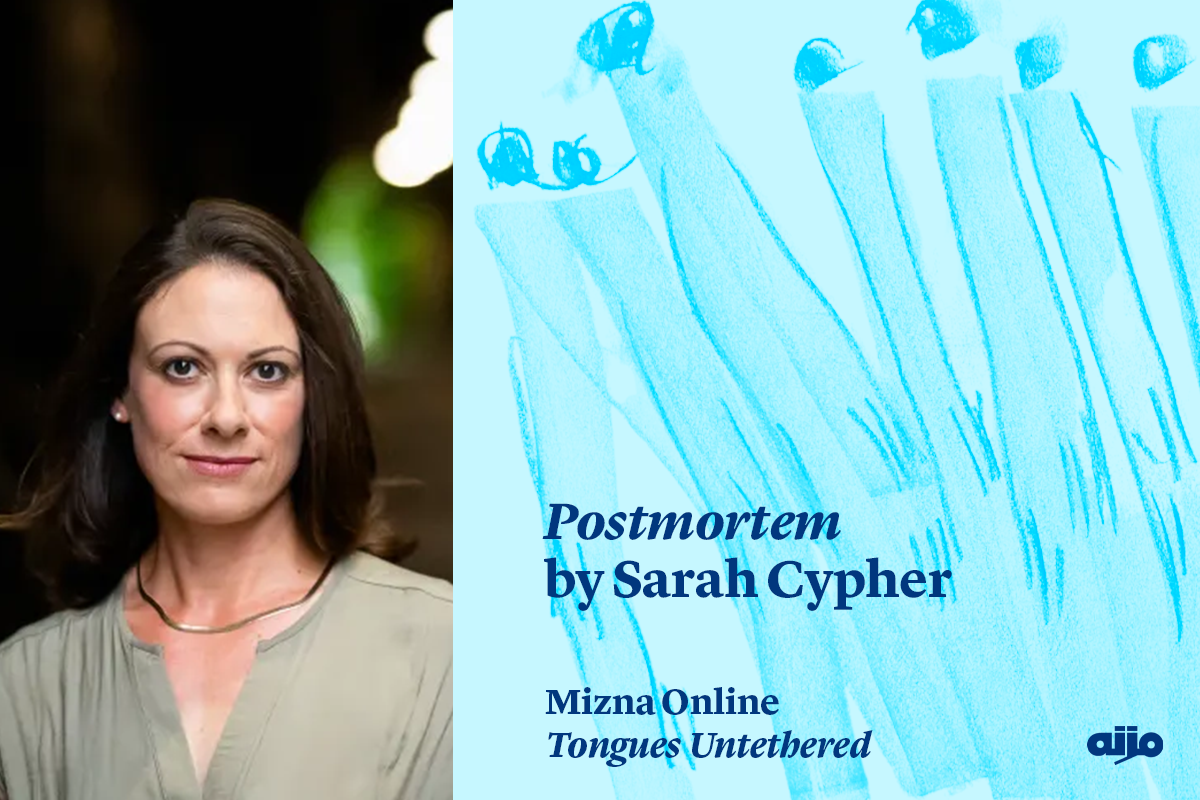
Postmortem—An Excerpt from The Skin and Its Girl
Over two and a half years into the post-October 7 genocide, language feels brittle, empty, and isolating. What is speech for? It feels grotesque to use it for anything but protest or aid, and ineffectual for navigating an American discourse space that renders our individual friends, relatives, employers, clients, neighbors, therapists, and coworkers unresponsive to horrors and to us. Neither rage nor reason seems to make any sound in those ears, and nothing is a comfort right now, if I’m being honest. But a year ago, Key K. Bird led a conversation with Elina Katrin, janan alexandra, and me in which we talked about strategies for entering the interstices between languages and breaking into the silences where received language fails.
This conversation was a healing use of language, both in content and occasion. I shared strategies that I used in my novel, The Skin and Its Girl—reinvented fables, repurposed motifs from Palestinian culture, cross-cutting humor, and family myth-making. What I read was an excerpt of a reinvented story of the Tower of Babel, but the opening pages shared here invite the reader into a mindset where departures from realism enable new linguistic maneuvers, such as subverting calcified stereotypes of Arabs and Arabic speakers in American supremacist culture. The novel’s epigraph is Mahmoud Darwish’s poem, “We Travel Like Other People but Return to Nowhere,” which entreats the listener to “Speak, speak, let us see an end to this journey,” reminding us that speech is also a means by which the future is called into the present.
—Sarah Cypher
The following excerpt first appeared in Mizna 24.1: Myth and Memory and is now part of the Mizna Online digital curation, Tongues Untethered: Cross-Cultural Writing and Identity Beyond Language. We encourage you to read this piece alongside other works in the folio.
Postmortem
Imagine this. In the final hour before dawn, the doctor pulls a baby through an incision under a woman’s belly. Everyone is doomed to this first unhousing, one way or another. And as he lifts me from the dark warmth of my mother’s body and unwraps the cord from around my neck, everyone here begins to work as hard as they can. They work for several minutes, until the outcome is obvious. Someone looks at the clock, announces the time.
My mother might be to blame—she refused to push—or the doctor, so hard on himself, so ready to take responsibility for real and imagined mistakes. All their medical instruments agree: this is not a beginning, but an ending.
When my mother has been taken away, her blood still marks the floor, the room’s metal surfaces, and the doctor’s gown. He and the nurse, who have stayed behind to clean the body, are angry—at my mother, yes, but mostly at themselves because they made promises to her and to the adoptive parents that my birth would be routine.
But at this moment, my skin is a pallid version of my mother’s wheat-colored complexion, fading to the flat yellow-gray of death. Blood vessels ruptured in my face during asphyxiation by the cord, and now, fine blue filaments around my mouth cause the doctor’s hands to shake as he wipes the waxy film from behind my ears. The nurse hands him another rag. When their work is finished, they will swaddle my body and offer my mother and the adoptive parents a chance to speak with the hospital’s chaplain.
The doctor checks the time of death with the nurse but gets no answer.
“I said, was it six thirty-eight?”
The nurse is staring at my body with a frown.
Imagine their surprise: a vein pulses on the crown of my head. And imagine, as I have many times, the strangeness of what they see happening to my face. It is turning blue. No, not an airless blue. Like a fine network of roots, cobalt filaments are wiggling outward from lips and eyelids, webbing together under the skin across cheeks and forehead. The broken blood vessels seem to multiply with every branching. They grow in density, too, coloring my face. Down my neck, across my chest, underneath my fingernails, and between my toes. Soon my entire body is an even, lustrous blue like a creature from a fairy tale.
The nurse asks the doctor, “Have you seen anything like this before?”
Later, in his report, he will make a fuller description which will be filed away and forgotten among the handful of other strange cases in the hospital’s history, reread only by me a few decades later when the hospital is about to purge its archives. But just now, he can only stare, stranded between curiosity and shock.
The nurse sets the bell of a stethoscope on my bare chest and says, “There’s a heartbeat.”
The doctor ignores this observation and gropes for the EEG leads. Yet no doctor in the world needs a machine to prove what anyone’s eyes can see. My whole body is alive and blue: the pure cobalt of a gas flame. The color is most brilliant on my thighs, belly, and cheeks. On a normal baby, the pattern would indicate a healthy flush. My blue eyelids twitch, my blue limbs move, and I sneeze.
My birth comes over two centuries after our family first exalted the glories of the color blue, Auntie, but you taught me a few rules of interpretation. Everything depends on context. I will get around to why I am here at your gravestone, but first, let me try again to understand how you came to my bassinet on my first day in this world.
You taught me stories so old they were last repeated when today’s aunties’ aunties were still small enough to run barefoot around the soap factory. The curse of the despicable woman, they said, is to give birth to stones, to puppies, to a piece of cannibalistic dung. In that world, there are crones and magic rings, red-eyed ogres and water-dwelling djinn. Back then, everybody knew that Aladdin meant the Glory of Religion (Ala’ ad-Din, if you want to break it down) and that every tale is an allegory.
To be clear, ours was no longer that world.
Yet we found ourselves one day with an uncanny pure thing on the top floor of a middling Portland hospital. Here we had, somehow, me—a blue baby—and, soon, three fairy godmothers.
Excerpted from THE SKIN AND ITS GIRL, Copyright © 2023 by Sarah Cypher. Published by Ballantine Books, an imprint of Random House, a division of Penguin Random House LLC, on April 25, 2023. All rights reserved.

Sarah Cypher is the author of The Skin and Its Girl, a Stonewall Honor Book also shortlisted for the 2024 Ursula K. Le Guin Prize for Fiction. Her work has received support from Austin’s Wild Basin Creative Research Center, the Headlands Center for the Arts, Vermont Studio Center, and the Bread Loaf Environmental Writers Conference. She currently serves as the executive director of RAWI, which means “storyteller” in Arabic and is a space-making organization for SWANA writers. She grew up in a Lebanese family near Pittsburgh and now lives in Austin, Texas, with her wife.
Related
The Bringers of Violence
Mizna At Home: Virtual Cinema Filmmaker Bios

In Response to the Capsized Boat and 65 People Drowned off the Tunisian Coast, a Flood of White Americans and Europeans on Twitter Write Who Cares and Thank You and Good, and I Tell My Father

Four Poems