



May 19, 2026
Poems: “On the Other End of Translation” & “On Sunday Night I am Tired of Proving I Deserve Languages”
For the last ten years, I’ve been writing in my third language, English. It’s preceded by Russian, my mother tongue, and Arabic, my father tongue, which I picked up while living in Syria in my early childhood, then lost, gradually, over the years spent away from one of my homelands. My practice of incorporating Russian and Arabic has taken many shapes over the years, evoking a variety of emotions. I dwelled in shame and guilt over my imperfect Arabic, eating up imposter syndrome each time I attempted to incorporate Arabic into my creative work. I felt like I was failing my mother and my heritage each time I forgot a word in Russian and reached for English instead. But the more I read the works of other multilingual writers and internalized the permanence of immigration, the more I was able to negotiate the flaws of all my languages. Slowly, I found beauty within the loss and imperfections. I understood the personal necessity of turning to my tongues, spiritually, mentally, and physically, of building bridges and hope where once only betrayal and absence thrived.
The two poems below present languages as something lived and experienced within the body and outside it. The fragmented section structure of “On the Other End of Translation” emphasizes distance, the breaking and the gathering of family members amid the linguistic and geographic dis/connection. The prose poem form of “On Sunday Night I am Tired of Proving I Deserve Languages” allows for the dreamscape nature of the piece to shine through, blurring the lines between knowledge and feeling, reality and imagination, borders and livelihood. I hope these examples help readers to further embrace the duality and dichotomy within the often-contradictory multilingual writing practice, confirming that there is no singular way of incorporating languages other than English into our creative work. Within our diasporas, each experience is valid, each word—precious.
—Elina Katrin
The following poems are part of the Mizna Online digital curation, Tongues Untethered: Cross-Cultural Writing and Identity Beyond Language. We encourage you to read them alongside other works in the folio.
On the Other End of Translation
My jiddo’s smile is a purple fig
sliced open.
Poor video chat connection doesn’t stop
him from telling me, inte helwe,
and I see that to him I am pretty
despite dead pixels and distance.
□
Syria – Russia – America
In a three-way call my father loses track
of languages, and in this orchard of words
I can’t harvest enough of Arabic phrases.
Here: ana bahebek.
Here: meshteklek ikteer.
I can’t scrape the hardened glue
of Arabic from the tip of my tongue,
can’t pull out the rope of right words
stuck down my throat.
□
بتمنى عيش حتى شوفك شخصيا
Я надеюсь, я доживу до того дня, когда увижу тебя лично.
I hope I live till the day I see you in person.
My jiddo says. My father translates. I translate.
I am at loss.
□
My jiddo knows the feeling like the weight
of ripe fruit on his farmer’s palm.
His wife, my teta, dead four months ago.
Sons refugeed in a foreign land.
His brothers killed, some jailed.
The loss is stuck to his unstable teeth,
sealed in calluses on his fingers,
pressed against his abdomen,
a burst appendix.
So much of the fig is seeds.
So much of his smile is gone.
□
My jiddo is as soft as an old plum, as sincere
as a tear when he says
بتمنى عيش حتى شوفك شخصيا
These words might be wrong.
I can’t read Arabic. I can’t write.
Google Translate reduces all Arabic dialects
into one language selection, and this choice
is the one I have to trust.
□
Ya Allah, let there be room to feel in a language
without speaking it.
Here: ana bahebek.
Here: meshteklek ikteer.
Take these words. Enhance their meaning.
Multiply. Multiply.
On Sunday Night I am Tired of Proving I Deserve Languages
This is me. My eyes, chameleon-licked and buggy, my eyebrows black and thick as late grandmother’s valenki. These are my lips, plump and thick like two Antonovka slices. And this is my nose my mother named malenkiy nosik, a tiny nose, a nose so cute she can’t call it a nose without adding a diminutive suffix, and when she says this I know she means Thank God your nose is small, unlike mine, but I love her nose and want to look more like her. We shared more facial similarities when I was younger, my toddler back imprinted in her chest, me as warm as a freshly baked loaf of rye, my mother, breathing quietly as not to wake me. Now this is my bed, and I alone sleep in it. Sometimes before sleep I pray, which is a word I use to say I bargain with God. First in Russian, then in English. I don’t know which God listens. I don’t know what language He wants me to speak. But this is my house, and I am honest in it. It’s not my real home, of course, but my fake home, the home I mean when I say let’s go home after a neighborhood party, the temporary place I keep my belongings for periods of time when I live in this country—home, for short. I dream of my real home sometimes, but in those dreams of St. Petersburg every passerby speaks English. This is my subconscious proving to America that I am loyal, that I deserve her language. And every phone call with my mother I have to convince her I am still fluent in Russian, because in her eyes for me to lose Russian is for me to lose her, and at times I can’t conjure words that are enough in either language to tell her all I want is for her hands to extend beyond my phone screen and oceans, I want my mother’s hands to hold me, I want to smell the back of her neck and tell her mama, ya doma. Mama, I’m home.
Excerpted from If My House Has a Voice, Copyright © 2023 by Elina Katrin. Published by Newfound on October 3, 2023. All rights reserved.

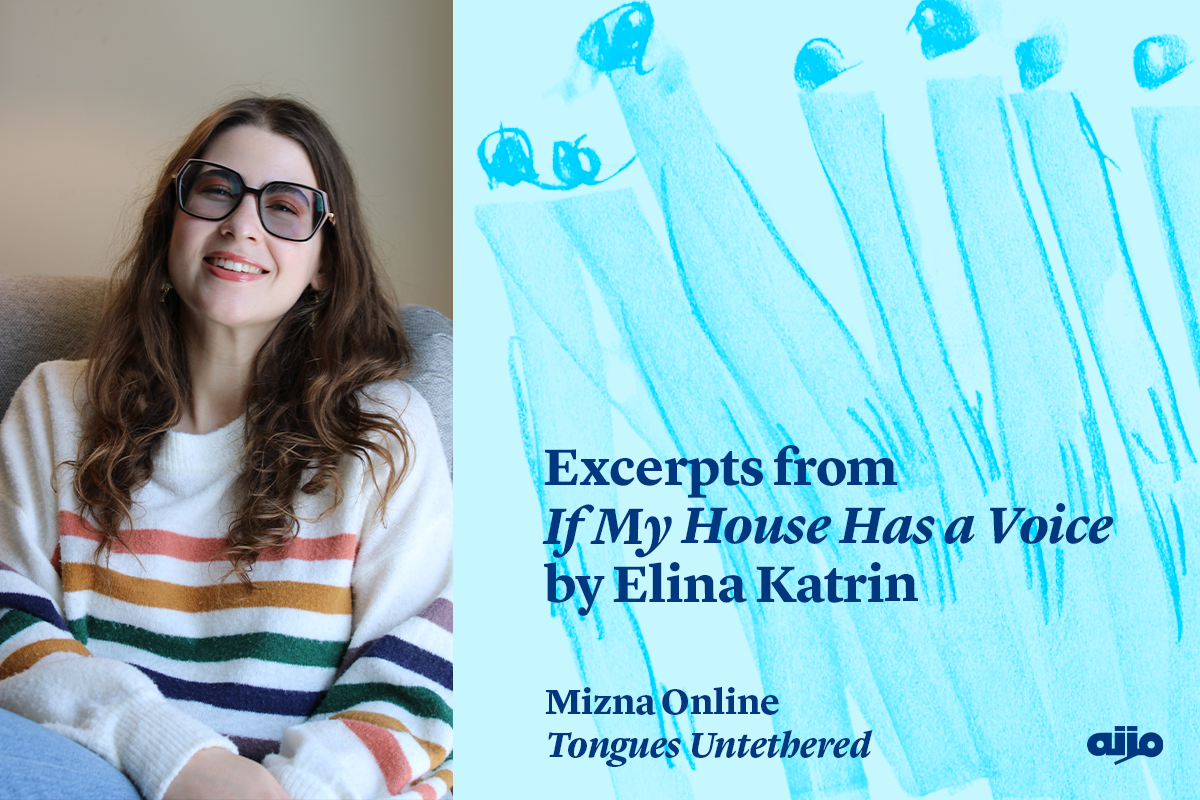
Elina Katrin is a Syrian-Russian immigrant writer and editor. She’s the author of “Overwintered” (Trio House Press, 2027) and a poetry chapbook “If My House Has a Voice” (Newfound, 2023). Her work has appeared in Electric Literature, Poet Lore, Poetry Daily, Shō Poetry Journal, and elsewhere. A recipient of scholarships and fellowships from Lambda Literary, Vermont Studio Center, and Periplus, she works and organizes with Mizna as an Assistant Editor. She holds an MFA in Creative Writing from Hollins University and currently lives in Los Angeles, CA, with a dream and her cardigan.
Related
The Bringers of Violence

2024 Annual Report
Tunisian Afterglows, Chronic Collision
Postscript on Myth and Memory: Kan (Ya)( )Ma( )Kan