



June 4, 2026
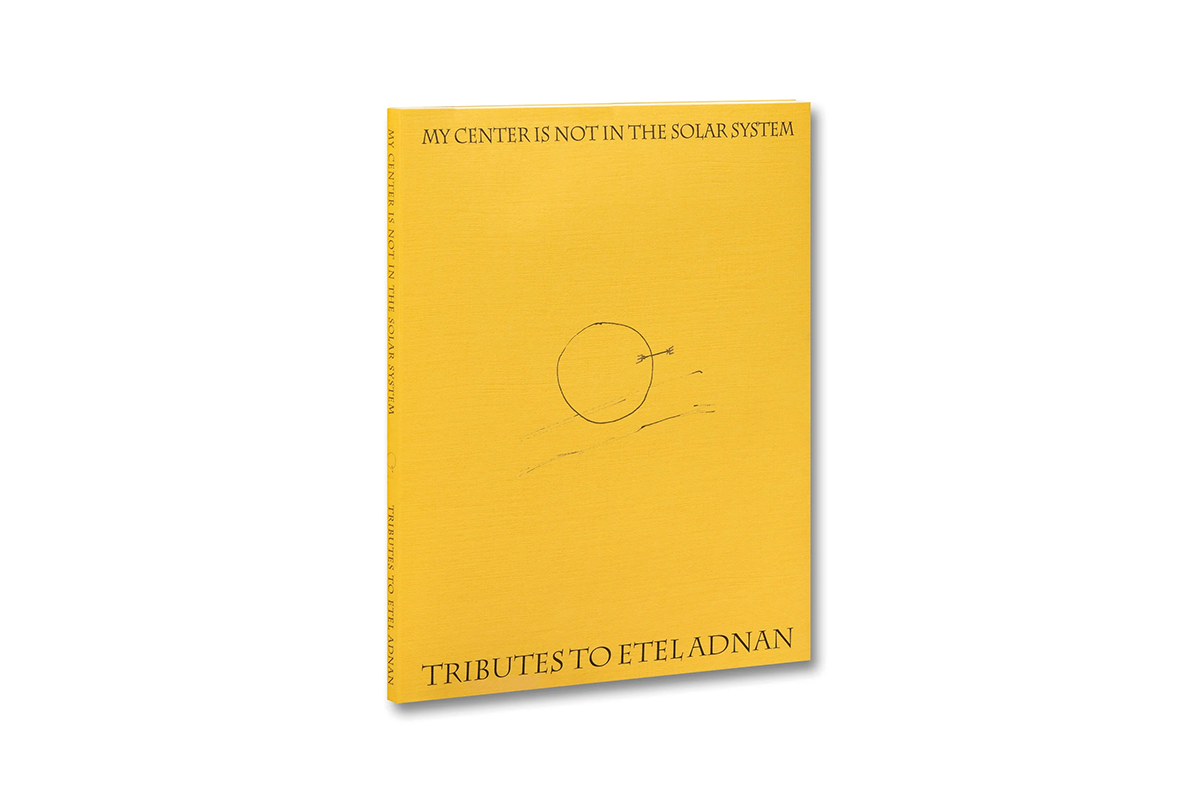
Excerpt from My Center Is Not In The Solar System: Tributes to Etel Adnan
Upon receiving this gorgeous volume, My Center Is Not In The Solar System, I had a similar reaction as habibna Brandon Shimoda: What a gift to be sitting with one of my favorite genres of writing! That is, writing with, about, and in the orbit of our ancestor and celestial comrade Etel Adnan! Between our own tribute issue, recent works by Summer Farah that converse with Adnan, and epigraph shout-outs in nearly every other issue, this genre of Etel Adnan writing is not unfamiliar to us at Mizna. One thing that stands out about this recent volume, edited by Negar Azimi, Anna Della Subin, and Michael C. Vazquez, is the care with which the editorial team brought in translated remarks from Francophone and Arabophone community members, including an unforgettable piece by Fawwaz Trablousi recalling an intimate memory of a conversation just before Adnan’s passing. I cannot imagine an adequate tribute to a force like Adnan that isn’t innately transnational and multilingual. And just as the linguistic and national contexts vary widely across contributors, so too do the genre, with many including intimacies like transcribed conversations or excerpts from letters, and others like Isabella Hammad reflect more broadly on teaching Sitt Marie Rose in Palestine, while others like Anne Waldman, Omar Berrada, and Aria Aber give their tributes in the form of poems. I find myself reading this book very slowly, savoring the small details, be it quirks that make Adnan feel so alive on the page, or personal reflections on even her most famous works that, make me see Adnan in a different light. To capture the relational and caring spirit of this volume, and celebrate its co-publication with Mack and Bidoun, Mizna presents the following excerpt, featuring a new poem by long-beloved Afghani poet and acclaimed novelist Aria Aber.
—George Abraham, Editor-at-Large
I need you, I thought: I need the future tense.
—Aria Aber
from My Center Is Not In The Solar System: Tributes to Etel Adnan
For years before he died, I was watching you. Friendship.
That’s the word I think of when I see your paintings.
What N. called “the owls blistering in light array.”
What A. called “our ghost image.”
The way dawn articulates the mountains in Northern California,
tap water falls and falls over a bowl of cherries
in the sink. You’re dead. It was my dream to move there.
It was my dream, for years, to wear a flower in my hair:
to go beyond my life, abdicate that other coast, and see the self
disintegrate, or shimmer. A joyousness pours over me.
You had love in you, a fierce intelligence.
He died, and I think of him when I think of friendship,
I think of you. The jar embraces the paintbrushes, an apartment
in Paris. The careful order of your life: canvases stuck to the side,
the curtain drawn for the afternoon sun. There,
in that powdery room of your mind,
the exiled world came close and left me again . . .
I need you, I thought: I need the future tense. It was my birthday,
and on a bus toward Berliner Allee, I read your words:
Cafes right on the water, the trees already yellowed,
and a hint of Byzantine gold in the air . . .
You knew what language was. That place. You knew the deer.
Note: this poem is from My Center is Not in the Solar System: Tributes to Etel Adnan (2026), which was published by MACK and Bidoun. It is reprinted here with permission of the author and publisher.

Aria Aber was born and raised in Germany and now lives in the United States. Her debut poetry collection, Hard Damage, won the Prairie Schooner Book Prize and the Whiting Award. Her first novel GOOD GIRL, published with Hogarth (US) and Bloomsbury (UK) in 2025, was shortlisted for the Women’s Prize in Fiction, the New Adult Prize, and longlisted for the Center of Fiction’s Debut Prize. She is a former Wallace Stegner Fellow at Stanford and graduate student at USC, and her writing has appeared in The New Yorker, New Republic, The Yale Review, Granta, and elsewhere. She serves as the poetry editor of Kismet, as a contributing editor at The Yale Review, and works as an assistant professor of Creative Writing at the University of Vermont. Aber divides her time between Vermont and Brooklyn.
Related
The Bringers of Violence
Vestibular
Mizna x AAWW: Announcing I WANT SKY

2024 Annual Report