



July 2, 2026
Silver & Black Terrorists, Steve Kerr’s Dad, Green Wristbands & Aboutrika Piñatas
This essay first appeared in Mizna 19.1: The Playing Field, and is republished here, joining 19.1 guest editor Shireen Ahmed’s Foreword to the issue in commemoration of the 23rd FIFA World Cup.
—Nour Eldin H., Managing Editor
I understand. This is a self-identified Male story. I claim this because sports taught me how to be a Male within its context. I wanted so badly, as a young man, to become that Male: an American Boy. Think, Estelle.
—Robert Farid Karimi
Corre, jadeando, por la orilla. A un lado lo esperan los cielos de la gloria; al otro, los abismos de la ruina.
El barrio lo envidia: el jugador profesional se ha salvado de la fábrica o de la oficina, le pagan por divertirse, se sacó la lotería. Y aunque tenga que sudar como una regadera, sin derecho a cansarse ni a equivocarse, él sale en los diarios y en la tele, las radios dicen su nombre, las mujeres suspiran por él y los niños quieren imitarlo.
—Eduardo Galeano, El Futbol: A Sol y Sombra
I read this quote while in a São Paulo hostel during the World Cup in 2014. I bought the book to see how Galeano, the Uruguayan historian, fabulist, journalist, and soccer lover, would weave his politics and love of sport into a story. I wrote in the book’s margins:
This could describe the player, the artist, the movie star, the star writer who wins the lottery—getting paid to play! To play a game you played as a child! A dream! A joy. Instead of working in the factory, the boring office job, you are the star! You are above law; you are above any weight put on you by any system, right? The star. The dream. To play. For money. To be. Above. The law.
Unless you’re the Iranian Soccer Team, who wore green wristbands in 2009 to support Iranian opposition leader Hossein Mousavi. Then, you’re threatened to be banned for life for protesting the theocracy. Tsk, tsk, tsk. So sad.
Soccer is in Spanish to me. Siempre. No language transmits the speed, the joy, the musical orchestration, like Spanish:
“Daei a Karimi. El mediacampisa un patazo. Karimi! Karimi! Gooooooooooool!”
Full disclosure: I read the sports page every day. I seek a reaffirmation every day of my belief that the sports page represents the last bastion of poetry in a newspaper. The box scores, an orchestration of numbers which spark narratives and haikus in my head.
Most of the time I leave empty. Yet, I find sparks of hope—a string of metaphors describing a mixed-race basketball player overcoming numerous obstacles to win a championship, or a female coach setting terms in her male-dominated profession, or the tale of the Oakland Athletics player Glenn Burke, the possible creator of the high five and the first openly gay baseball player, whose career was cut short because of homophobia.
It’s not just about adversity due to diversity.
Characters in the sports page lead me to think about leadership, how to facilitate performances, and spiritual inspiration when I need it.
From a recent Forbes article1 about basketball players missing shots:
Apply this to life. There are misses, fails and cold streaks. Those happen. If you haven’t experienced them, it’s time to expand your game and your goals. When the misses come, you can’t stop taking shots. Apply the quitter-defying circumstances-be-damned Player’s Formula: {Belief + Action} x Repeat = Success Through Perseverance.
I’m starting to write this essay as I watch the Golden State Warriors in the NBA Playoffs. I think I was the only one who saw the 2015 NBA Finals they won as a story of a coach from Lebanon versus a coach from Israel. Warriors’ Coach Steve Kerr lost his father to a bullet from حركة الجهاد الإسلامي Kerr’s father, Malcolm, a leading scholar who translated the history and politics of North Africa and West Asia to the gringos, was also one of the most respected thinkers about issues of the region. The elder Kerr’s sensitivities fell middle-left. Yet, as president of American University of Beirut in the ’80s, he became a symbol of the political moment for Islamic Jihad Movement. Now, Coach Kerr, born in Beirut, never shies from politics; he uses his platform to critique police brutality and Trump’s xenophobic policy. And when the 2015 Finals ended, I wondered did Kerr notice what I noticed? Or somewhere in a crowded bar, did a Lebanese basketball fan raise a slight fist in the air to celebrate Steve Kerr’s achievement with, “That’s for 2006!”?
At age five, I loved Kareem Abdul-Jabbar (still do!). There were no Karimis in the phone book in my home in the Bay Area, so I rationalized in my little mind that since I was a Karimi and he a Kareem, we must be related. I devoured his autobiography, Giant Steps, and used his life story as a template for my life goals. He’s Muslim; I’ll be. He had Bruce Lee as a friend; I learned karate so Lee would be my friend. I even learned how to do a sky hook, which is the stupidest thing for a three-footish boy to learn, but, in my childish mind, if I practiced it enough, I would be as tall and great as he. Generous and tall! Tio Kareem would be so proud of me!
I understand. This is a self-identified Male story. I claim this because sports taught me how to be a Male within its context. I wanted so badly, as a young man, to become that Male: an American Boy. Think, Estelle.2
I first played basketball in elementary school. As the only Karimi, basketball served as an easy entry point for me to become a part of my Catholic school, St. Bede’s. Monsignor Francis loved basketball; so we all played. Little seven-year-old boys ran to one side of the court and placed their feet on the cardboard circle cutout of C, G, and F, according to our size and where the coaches thought we should play. I had no idea what I was doing. My father never played in Iran. My mom played a little in Guatemala. But this is what you do, if you want to belong, here in the US, you play sports.
Mr. Karimi, my father, thought sports are rigged. The theory he shared: when a city needs an economic boost, a league allows them to win. Thus, the Patriots win the Super Bowl in 2002 after 9/11. The New York Yankees make it to the 2001 World Series. Coincidence? Cue the X-Files music. Or Mr. Robot music for those more modern types.
As a child, every time my team lost, I fumed. My elementary school tears burned into tiny fists dug into my eyes. My father hated this. What’s the big deal, he thought. He repeated his sports theory every time. Perhaps he thought by rationalizing with my political side, I would relent; tears would dry. There is no NFL or NBA or MLB in Iran.
My parents eventually relented. Perhaps this was part of the Asian Straight-A Student Ideal presented to me that I then applied to my sports team. Or perhaps, it exemplified a part of the American assimilation my parents understood we had to subject ourselves to.
They did not introduce US football, basketball, or baseball to me. My godmother Genevieve Valderrama did. She, a Mexican Coloradoan, loved her Raiders, Athletics, and Warriors. In that order.
I learned about America at the Oakland Coliseum.
Working-class people who spend their salaries to buy into nationalism, regionalism. Oakland and the South Bay Area of the ’70s or the ’80s—prior to Ronald Reagan firing the air traffic controllers, the closure of the GM factory, other factories—was pure working class. The US football team, the Oakland Raiders, represented the area: rough, ready, misfits, roughnecks, diverse. If you are from another city, don’t come to the Oakland Coliseum.
In the early ’70s, the Coliseum laid claim to being the home of champions in football, basketball, and baseball. We wore our team colors with pride. We weren’t San Francisco or New York; the Coliseum reconnected us to our pride about being from the US. Sports became my shield against xenophobia, a shorthand code of protection: “You don’t want to think about how different I am from you. We both down for the Raiders. Yeah, Cliff Branch! Ted Hendricks, he the man!”
Segregation is big in sports, too. Decks divide spectators. Rich from poor. One color from another. Sections divide the single and the families. The genders.
Azadi, the stadium in Tehran named for freedom, hypocritically exerts a stance of un-freedom during soccer games. The Iranian government still bans women inside its walls. My favorite thing: women who wear beards to get inside. It’s all the rage on social media. Is it for the love of soccer? Is it radical feminism? Both. None. One. All. Does it matter? The government treats you like an opponent, so you play the game. And win.
Mujeres con Barbas! Goooooooooooool.
1998. World Cup. France. Father’s Day. Perfect day to watch Iran versus the US.
I never really watched a soccer game with my father. It never excited him much. He spoke of soccer the way a secular humanist talks about God: they know about it, but don’t really believe it will get them to any sort of heaven.
It was unsaid. 1953, ’79, US relations in Iran all sat with us as we watched. The excitement built. Yes, I was born here, but I knew what this game meant. If Iran won, it would be a symbolic middle finger or thumb to the US. A way to say, you’re not better than us. Most of the players perhaps had not been alive before ’75, yet everyone knew each team represented the other’s boogeyman.
There was a moment, I don’t know if it was before the game or during it, but I noticed we were rooting for Iran to win. Maybe it was the first goal. The nationalism hit us. The American born and the Iranian born, now US citizens. Two people who disagree on a lot of things became single-minded. Cried, hugged, screamed. Iran won. Imperialism has been defeated. CIA incursions destroyed! Even theocracy had been reduced to something we could ignore for the moment. Freedom! Azadi! Right? Right?
Fast forward: 2014. Brazil. São Paolo.
Miraculously, a flyer for an Iranian rock concert magically appeared. The Iranian government decided to sponsor groups to show how supportive they are of the arts. A hodgepodge of Iranian musicians from various bands take the stage. And the headliner Pallett Band finishes the night. I came to Brazil to watch the beautiful game, but I am mesmerized by the most beautiful voice I have ever heard. The lead singer of Pallett: Omid Nemati, the Persian Freddie Mercury who blasts this tiny São Paulo club with the power that recharges my soul with something that I feel I have been missing my whole life.
As I leave the club I realize my father is right. It’s rigged. There’s so much money in these games, these sports. Without it, I never would’ve heard Omid. Drunk with joy and revelation, I say to myself in the warm São Paolo night, “We need to play the game to understand how to bend its rules in our favor! Woo-hoo!”
In 2008, Egyptian striker Mohamad Aboutrika became an instant media hero to Palestinians and their supporters. He bent a FIFA rule: no political slogans or sloganeering during a match. That didn’t stop him. At the African Cup of Nations, he scored a goal against Sudan and ripped his shirt off to reveal “Sympathize with Gaza”—a message to protest the ten-day Israeli blockade of Gaza. He received a yellow card, and FIFA threatened more actions, but nothing ever happened. Like quarterback Colin Kaepernick, Olympians Tommie Smith and John Carlos, and others before him, Aboutrika saw sports as a platform. If all eyes are on him, then he would give them something to look at after the goal. Besides, no one complains when players pray after they score, why not an exclamation of sympathy or freedom? Azadi!
Hounded by the media about his action, Aboutrika responded to Al Jazeera English:3
I wore the shirt . . . from a humanitarian point of view, and my message does not have any relation with a political issue. It was a personal statement . . . I feel great sympathy for the children of Gaza who are under siege. I wore the shirt for Gaza’s children who are suffering, who are starving, who are vulnerable and fear for their safety and have many worries.
It’s now the middle of June 2018. The World Cup roars in full strength. Will a player reveal a shirt for Gaza? For the children detained at the US-Mexico border?

In 2014, artists Carolyn Castaño and Gary Dauphin collaborated with online magazine Africa Is a Country to make a T-shirt in honor of Aboutrika and other African footballers. This shirt was not the duo’s first. Castaño (Columbian) and Dauphin (Haitian American) created a series of shirts of footballers to construct a fictional team of murdered or killed soccer players from around the world-entitled Asesinados United. Their journey to this topic was sparked by Colombian drug lord Pablo Escobar’s assassination of Colombian national team striker Andres Escobar because Andres hit an autogol in the 1994 World Cup.
I interviewed Castaño to ask her, “Why Aboutrika?” She said that Aboutrika’s act of defiance—to sympathize with Gaza—was such a loving gesture. And that, “Mentioning Gaza or Palestin[e] can be a dangerous act. It’s like starting a fight with someone.”
I told her that Aboutrika is now a complicated figure in Egypt because of his alleged support of the Muslim Brotherhood. I wondered who would wear the shirt in the WANA community? I asked her would she print the shirt for this World Cup. She said she would be hesitant, but that he is as complicated for Arabs as Pablo Escobar is for Colombians. And that the shirt still resonates, “[Escobar and Aboutrika] are a part of the history, why can’t we talk about them?”
A sport whose rules I always bent to my favor: piñatas! You may not think of destroying of three dimensional papier-mâché object as sport—I get it; there’s no global piñata league—but if you have ever watched a child attempt to open a piñata for candy, and the surrounding child spectators salivating to bash it themselves, you know it is as much sport as the Champions League or the Super Bowl. The stakes are high in children’s minds. All my piñata veterans understand what I mean.
How did I bend the rules? As a small child, people felt sorry for me and didn’t tie the kerchief tightly around my head. I pretended to have a bloody nose or runny nose before hitting the piñata; I tilted my head back so I could see my target. I didn’t like candy; I just wanted to win. Score one for Straight-A Asian upbringing!
I never understood why people choose to have piñatas of things they love. I still believe that when a young relative asks me for a piñata of their favorite Disney character or book character to beat for their birthday, I am reinforcing norms of violence against those we love. And I always balk and just get them a papier-mâché number or some whimsical object that has no face.

Who would buy an Aboutrika piñata? Would someone who supports Gaza and the state of Palestine buy it for their child? Someone who supports the Muslim brotherhood? Or someone against both?
Thinking about this complexity of the nature of piñatas, politics, and sports, I made a series of piñatas for a trial run of the future exhibit on games I’m curating. I asked a master piñata maker to make me two piñatas. One: Trump. And two: Alan Kurdi, Syrian little boy whose lifeless body became the symbol of the plight of Syrian refugees. (The master piñata maker originally refused to make the piñata of the boy unless I explained specifically what it was for.) I designed them so that they would both be tied together to challenge the player to think about the consequences of their actions.
When I received the Trump piñata, it didn’t look like Trump. It looked like a Ken blowup doll. A collaborator and I added black papier mâché to it, and I added a moustache. To my eye, the piñata began to resemble President Bashar al-Assad of Syria. This worked for my design—these two are tied together, and once players see them, we can have a conversation. I thought: No one will hit either one.
On the day of the exhibition, people saw the piñatas and ran to them like excited, hungry children. They didn’t stop to see the text on the wall or even to consider who the piñatas were of. They just grabbed the stick and blindfold and uttered sounds of glee. Before the group blindfolded the first player, I told them whom the piñatas represented. Some, unsure of what to make of the piñata’s identity, swung quickly. Others in the party argued with them. Some who had no idea just saw a father and son, angry at anyone who hit a child. And there were those that knew the politics, swung to behead the man, but could never do it; they felt hoodwinked by the game’s politics. All participants, when they removed the blindfold, realized that the image I presented complicated the notion of the piñata and the politics that each figure embodied.
The idea: that even though the instructions of the game seem simple, the mechanics of playing the sport of piñata are not that cut and dry. To simply say you are beating your enemy so that you can get candy out of them or, the flipside, that you are beating something you love so you can get something sweet out of them, depends on how you look at the game. It always does. Be it on the pitch, the basketball court, or any other field of play—that includes fields of life and death, which people erroneously ascribe the word “game” to.
All of this is to say, are we what we play? Are we what we watch others play? Do we always play to win? Did I rig the game or was it already rigged? If we play any game, are we complicit in all of its consequences, even as spectators? Can we just have fun and play sports and games without worrying about any of this? Can’t we just play to play? Isn’t that what we’re fighting for? So that we can play anywhere we want to play without having to worry about any institution telling us how to play or whom to play with? Or has this world become a place where the only people that can play are the ones getting paid?
Karimi! Karimi! Gooooooool!
- Jerry Barca, “James Harden and Why Missing Shots Doesn’t Matter,” Forbes,
May 26, 2018, https://www.forbes.com/sites/jerrybarca/2018/05/26/james-
harden-and-why-missing-shots-doesnt-matter/#76795d9c5cc9. ↩︎ - Lyrics from Estelle’s “American Boy”:
“Dressed in all your fancy clothes / Sneakers looking fresh to death, I’m
loving those Shell Toes / Walking that walk, talk that slick talk / I’m liking
this American boy, American boy / Take me on a trip, I’d like to go some day
/ Take me to Chicago, San Francisco Bay / I really want to come kick it with
you / You’ll be my American boy, American boy.” ↩︎ - “Egypt’s Aboutrika Has Sympathy for Gaza,” interview by Carrie Brown,
Al Jazeera, January 5, 2008, video, 1:56, https://www.youtube.com/
watch?v=N-M4g9xWMYE ↩︎

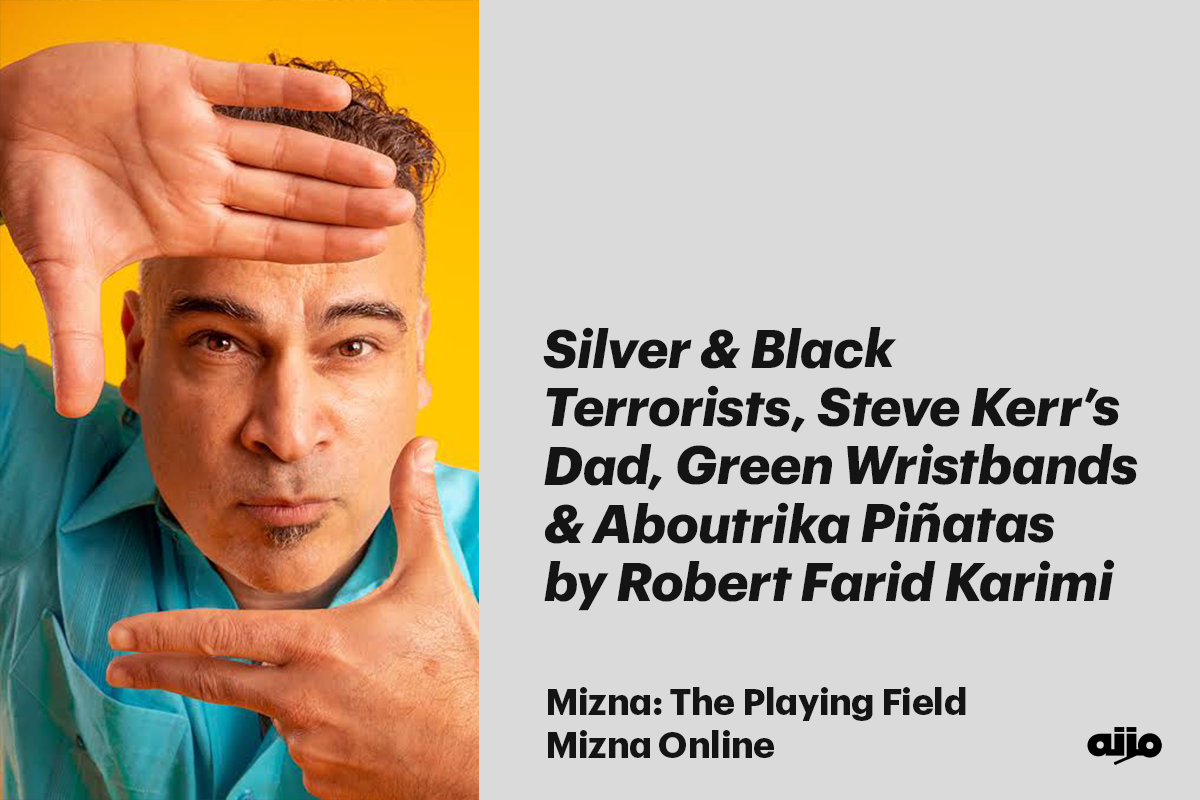
Robert Farid Karimi: Critically acclaimed trans-channel artist, interactive-experience educator, performer, author, Robert Farid Karimi, designs interactive immersive game-performance experiences to spark players to imagine worlds of mutual community nourishment. As his alter-ego, the revolutionary cook, Mero Cocinero, Karimi has cooked for such luminaries as DJ Peanut Butter Wolf, poet Jose Montoya, Yuri Kochiyama and Michele Serros, and hip-hop superstar MF Doom. Of Iranian/Guatemalan/Mayan descent, and with over twenty-five years of expertise, Karimi’s brings their playful participatory platforms to spaces worldwide—including General Mills, Off Broadway, Nuyorican Poets Café, NPR, HBO’s Def Poetry Jam, Hawaii International Film Festival, The Smithsonian, La Jolla Playhouse, and South by Southwest. Pushcart Prize–nominated, their work has been featured in the Los Angeles Times, Callaloo, Total Chaos: An Anthology of Hip Hop Theory, Asian American Literary Review, and Testimonio es Atole es Medicina: An AfterWord. Karimi is the Visiting Scholar in Residence at UC San Diego’s APT Lab in the Jacobs School of Engineering, co-director of the Public Practice + Generative Play StudioLab, and serves as associate professor in the School of Music, Dance and Theater at Arizona State University. Author image credit to Beto Soto.
Related
The Bringers of Violence
Mizna 23.1 Virtual Launch

An Interview From the Summer 2016 Issue of Mizna
Mary of Gaza