



January 16, 2026
30 NEW SWANA BOOKS TO READ IN 2026
When I started covering new releases by SWANA authors a few years ago, I could never have imagined how much the publishing landscape would expand to share our stories. This is both a blessing and a curse; it seems to me that the more a people’s suffering is broadcast live on TV, the greater appetite the American publishing industry has for their stories and poems. I would rather our people in Sudan, Gaza, and elsewhere be allowed to live than documented in English literature after they are gone.
There is always so much more to our stories than that which is recognized in English language print. Still, there are powerful voices that echo beyond the pages, and every year I find more, take greater comfort in the shared language and narratives of an ever-expanding SWANA literary landscape. My original list for this piece had over 65 SWANA titles releasing in the first half of 2026. That’s too many, but what a beautiful problem to have! So here are 30 of the most exciting adult titles coming this year, plus a few YA titles for fun. Some I’ve read, some I’ve started, and some I can’t wait to read very soon!


Poetry
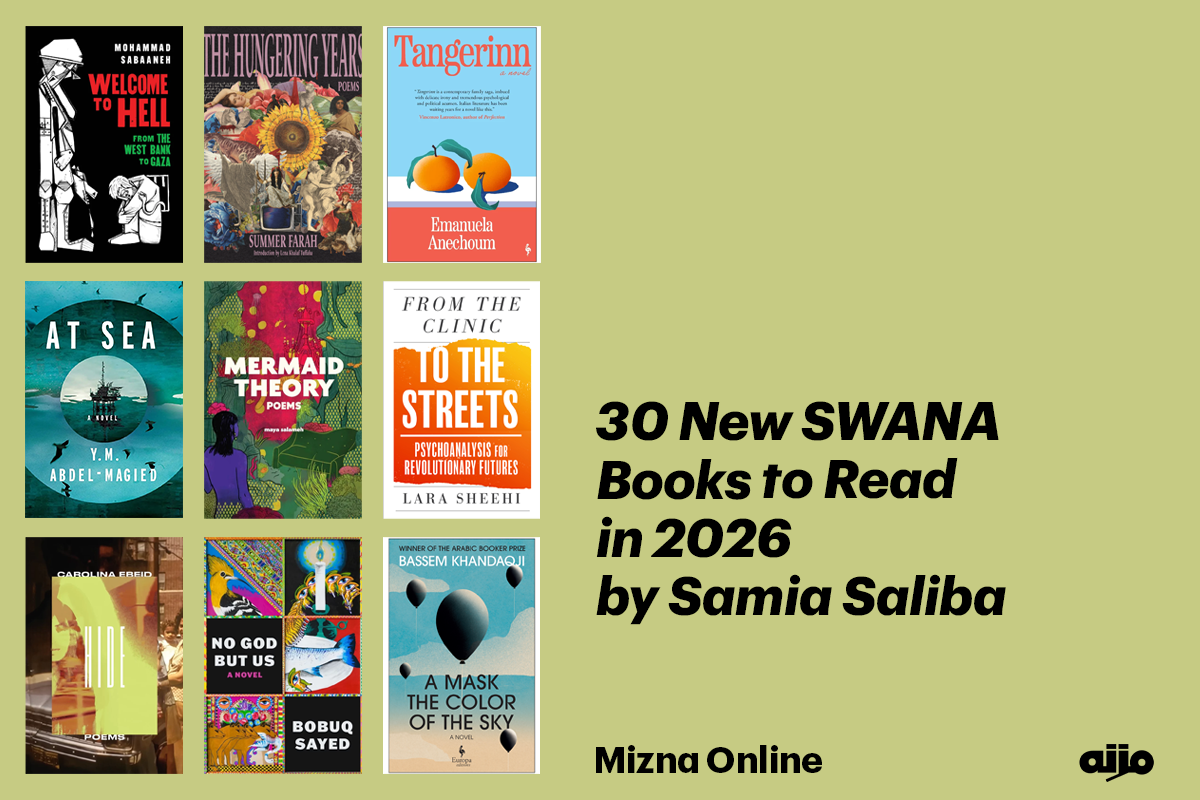
The Hungering Years by Summer Farah (Host Publications, February 24)
My friend and frequent collaborator Summer Farah’s debut full-length poetry collection is an incredible and long-awaited piece of work! This collection traces many types of hunger—for connection; for freedom from pain; for sustenance, physical and emotional; for art in all forms, ranging from the works of Etel Adnan to the CW’s Supernatural. At its core this book is a gorgeous mosaic of all the creations and destructions that feed Farah’s poetry.
Garden City by Sara Elkamel (Beloit Poetry Journal, Winter)
Sara Elkamel’s second chapbook is full of the things I’ve long loved about her poetry, rich with precise and strange uses of language and scenes that almost feel like they are out of a dream. Despite its dreaminess, Garden City is always also grounded in the harsh realities of state violence that structures Cairo. In the spaces between reality and unreality, Elkamel constructs a brilliant world.
HIDE by Carolina Ebeid (Graywolf, March 3)
Ebeid’s gorgeous second collection weaves a tapestry of language, form, and ancestral traces, drawn from a variety of people and places including her parents, her grandmothers, and the Cuban-American artist Ana Mendieta. Through playful and attentive uses of sound, letters, and archival objects, Ebeid conjures a truly singular collection of poetry.
The Town I Never Told You About: Poems 2022-2024 by Ghassan Zaqtan, trans. Robin Moger (Seagull Books, March 14)
I admire Zaqtan’s poetry for its incredible and beautiful directness. With precise language, his poems craft a narrative of place and people. I look forward to this new book, which collects poems written over a two year period cataloguing and ruminating on the intensifying violence marring Palestinian life and landscapes.
October by Nur Turkmani (Hajar Press, April 2)
This beautiful debut collection is structured by the big picture events of a life in Beirut over six Octobers, marked by revolution, fire, genocide, and bombing. But despite the largeness of its frame, this collection deals primarily in tender intimacies. Through friendship, love, care, and everyday landscapes of the city, Turkmani draws a portrait of a city and life within it that is rich and haunted by violences.
Mermaid Theory by Maya Salameh (Haymarket, April 7)
Salameh’s combination of playful language, creative form, and engagement with archives and academic theory in this text make for a stunning sophomore collection. As in Farah’s collection, Salameh’s many influences are on display and clearly cited across this book, highlighting a truly collective process of writing. This collection is full of delicious variety, oscillating like water between joys and horrors, from deconstructing rigid institutional forms to fluid linguistic experiments.


Fiction
Hyper by Agri Ismaïl (Coffee House Press, January 13)
Many novels are about money, but few really capture the minutiae of money and its dominance like this one. Hyper follows three Kurdish siblings as they navigate the hyper-capitalist hellscapes of Dubai, London, and New York during the great recession, shaped by their dejected Marxist father and a mother who always resented the poverty and exile that resulted from his politics. A really unique and engaging read with incredibly sharp prose!
Tangerinn by Emanuela Anechoum, trans. Lucy Rand (Europa Editions, January 20)
This debut novel sounds right up my alley, a tale of grief, tenuous belonging, and the ways we excavate our own selves from the archives of family and community. This story follows a young Moroccan-Italian woman who returns to Calabria after her father’s untimely death to try to keep the bar he ran functioning and find traces of him left behind. I really look forward to spending time with this story!
The Renovation by Kenan Orhan (Farrar, Straus, and Giroux, February 10)
This innovative speculative debut novel follows a Turkish woman living in Italy and caring for her father with dementia. When she hires builders to renovate their bathroom, she finds that the room is no longer a bathroom, but a Turkish prison cell, connected to a broader prison and possibly Turkey itself. This strange and unique story is enhanced by writing that is at once dreamy and expository.
The Fertility of Evil by Amara Lakhous, trans. Alexander E. Elinson (Other Press, February 17)
Lakhous’s political-mystery novel opens almost like a Wes Anderson film: fast-paced, curiosity-inducing, and populated with a vibrant cast of characters. But the mysterious death at the heart of this story implicates a deeper history, one grounded in the decades-long reverberations of settler colonialism and national struggle. Lakhous moves back and forth in time, investigating Algeria itself in this captivating novel.
Floodlines by Saleem Haddad (Europa Editions, February 24)
Floodlines is a really delicious novel, one that gives you so much to grapple with. It’s a family saga of estrangement and trauma, but it’s also engaged with some of my favorite questions in fiction: questions of memory and archives as well as the tangible feelings of loss and control housed in our bodies. An exciting, vivid sophomore novel from the author of GUAPA.
Songs for Darkness by Iman Humaydan, trans. Michelle Hartman (Interlink, March 3)
This quietly beautiful historical novel tells the story of four generations of Lebanese women from 1908 to 1982, marked by wars, famine, and patriarchy. The struggles of the women at the center of this novel are as unrelenting as Lebanon’s history, but there is beauty and recognition in the songs that stitch them together.


GUNK by Saba Sams (Knopf, March 3)
A quick and introspective read, GUNK tells the story of two women, Jules and Nim, who become intimately entangled after they meet while bar tending at a club owned by Jules’s loser ex-husband. When 18-year-old Nim becomes pregnant and Jules sets out to help her, the women fall into a strange new dynamic marked by unspoken secrets. It’s a beautifully weird and engrossing tale of alternative family and love.
A Mask the Color of the Sky by Bassem Khandaqji, trans. Addie Leak (Europa Editions, March 17)
I’ve been excitedly awaiting this novel, written by a Palestinian political prisoner (Khandaqji was released in October 2025), since it won the International Prize for Arabic Fiction in 2024. It tells the story of a young Palestinian archaeologist who adopts an Israeli identity in order to excavate a world previously inaccessible to him. I’m immediately captivated by this rich and psychological premise, and I can’t wait to dig into this story.
Paradiso 17 by Hannah Lillith Assadi (Knopf, March 17)
This is a beautiful and lyrical novel written through grief, inspired by the life of Assadi’s late father. Paradiso 17 follows Sufien, a Palestinian boy from Safad, from his early childhood as a Nakba survivor, across myriad exiles and searches for new homes, until his eventual death from cancer. It’s a sad and loving tale, carved out of all the minor paradises glimpsed across a hard life.
Of Loss and Lavender by Sinan Antoon, trans. the author (Other Press, March 17)
I adored Sinan Antoon’s The Book of Collateral Damage, so I was so thrilled to get to read this wonderful new story of memory and trauma. This book follows two Iraqi men living in exile in the US, one a doctor with dementia, one a refugee whose ear was cut off for being a deserter, as they orbit each and uncover memories of Iraq. As always, Antoon’s writing is brilliant and personal.
Woodwind Harmony in the Nighttime by Reza Ghassemi, trans. Michelle Quay (Deep Vellum, March 17)
Originally published in 1996 and now finally translated into English thirty years later, this novel is a sharp and eccentric portrait of the psychological dramas of exile. Woodwind Harmony follows Yadollah, an Iranian exile in Paris living amongst a chaotic cast of fellow exiles. His story takes a turn into mysterious matters of life and death in this vivid and humorous novel.
Aicha by Soraya Bouazzaoui (Orbit, March 24)
A blend of historical fiction and fantasy, this tale of a Moroccan woman resisting the colonization of her homeland in unexpected ways looks truly exciting. Bouazzaoui’s story brings together the otherworldly power of anticolonial resistance as well as the inherently political nature of mythology. This is an exciting new title for lovers of SFF and SWANA literature alike!


The Republic of Memory by Mahmud El-Sayed (S&S/Saga Press, May 5)
Much like Aicha, this book draws inspiration from real SWANA history but re-narrates it through a speculative lens. Set in a post-Earth future aboard a city ship run by workers who are increasingly engaging in acts of resistance to a political order that does not serve them, this book restages the Arab Spring and constructs what promises to be an intriguing Arabfuturist landscape.
At Sea by Y.M. Abdel-Magied (Pegasus Books, May 5)
I’m so intrigued and excited by this book, which has been described as a literary environmental thriller. A debut adult novel by a Sudani-Australian author who has herself worked in oil drilling, this book follows Zainab, the lone woman working an oil rig on the verge of catastrophe. I look forward to reading this riveting story of the overlapping tensions of labor, patriarchy, and climate disaster.
Farewell Tangier by Salma El Moumni, trans. Lynn E. Palermo (Seagull Books, May 6)
This novel tells the story of a teenage girl from Morocco seeking to understand and deconstruct the patriarchal fixations on her body by attempting to see herself through this unwelcome gaze. But when these patriarchal forces ultimately exile her from her country, she is forced to confront them on a different level. This promises to be a valuable feminist critique of desire and surveillance.
Hungered by Amanda Rizkalla (Henry Holt and Co, May 19)
Narrated through the eyes of a 12-year-old girl, this debut novel is intense, painful, and incredibly compelling. Hungered follows Sofia as she experiences homelessness, living out of a car with her mother and younger brother, and imagines and yearns for a different kind of life. Rizkalla renders Sofia’s voice so effectively she feels immediately real, her world at once harrowing and all too familiar.
You X Me by Ayla Vejdani (Generous Press, May 26)
For something charming and a bit different from the rest of this literary-fiction-heavy list, Vejdani’s You X Me is a collection of interrelated sapphic romance stories set in several different cities. From meet-cutes to reconnecting with exes, this book looks to be a sweet, fun exploration of love in all its stages!
No God But Us by Bobuq Sayed (Harper, May 26)
One of my personal most eagerly anticipated books of 2026, Bobuq Sayed’s debut novel follows two gay Afghan men whose lives intertwine in a shared exile in Istanbul, and who must navigate the antagonisms of many states and oppressive forces that shape their lives. Sayed’s writing is vibrant, hilarious, and sharply critical, presenting a rich and real set of characters reeling across the world. I can’t wait to see this book get the readership it deserves!


Non-Fiction
My Dear Kabul: The Incredible and Courageous Diary of an Afghan Women’s Writing Group During the Fall of Kabul by Untold Narratives (Hodder & Stoughton, January 20)
This is a really unique book, written through WhatsApp messages exchanged between members of an Afghan women’s writers group in the midst of the Taliban regaining control of Afghanistan in 2021. In the midst of loss and uncertainty, they cataloged their experience in a digital shared space, crafting a diary and a space of refuge in their shared art. A powerful project, one I look forward to spending time with.
Before the Flood: From Gaza to Paradise by Ramzy Baroud (Seven Stories, February 3)
This book narrates the political history of the Zionist colonization of Palestine through the personal narrative of Baroud’s family and community. A story told across three generations, from before the Nakba in the village of Beit Daras, to later refugeehood in Gaza, this book offers a powerful and personal stage for understanding the impacts of colonialism, occupation, and war.
Defiance: A Memoir of Awakening, Rebellion, and Survival in Syria by Loubna Mrie (Viking Penguin, February 24)
Defiance promises to be a new and compelling narrative of the Syrian Revolution, following Mrie’s experience as a young revolutionary and photojournalist. Her participation in the revolution is complicated by her Alawi background and her family’s loyalty to Assad. Narrated through overlapping conflicts of the personal and the politics, this memoir looks to be a powerful and timely account.
From the Clinic to the Streets: Psychoanalysis for Revolutionary Futures by Lara Sheehi (Pluto Press, April 20)
In my academic life, I’m familiar with Sheehi’s work on the psychological impacts of occupation and resistance to occupation, grounded in the works of Fanon. Her new book expands on these ideas beyond the academic sphere, inviting new and invigorating conversations on the role of psychoanalysis in dismantling structures of power and building towards liberatory futures.
Welcome to Hell: From the West Bank to Gaza by Mohammad Sabaaneh (Street Noise Books, May 5)
This graphic memoir weaves together the author’s experience in the West Bank in the early months of the genocide, stories from the ground in Gaza, and the author’s brother’s experience in a Zionist detention center. Transgressing the imposed boundaries between different sites of Palestinian experience, this looks to be a powerful and creatively rendered narration of the recent contours of Palestinian life.
Water in the Desert: A Pilgrimage by Gary Nabhan (Milkweed Editions, June 2)
I’m really excited by this memoir, which offers a beautiful narrative of ecology and spirituality, crossing vast and variable landscapes. Spanning from Nabhan’s childhood growing up as a neurodivergent Arab American kid along the shores of Lake Michigan, to his later life as an activist, scholar, and spiritual leader, this looks to be a powerful personal tale of the many ways we relate to and care for the earth.
Young Adult
I’ll end with a brief shoutout to SWANA YA, a genre category that gets bigger every year and which would have made a younger me so happy. This year, there’s tons of YA to look forward to, including graphic novels, work in translation, horror, and classic coming-of-age stories. A few titles on my radar:
Fustuk: A Graphic Novel by Robert Mgrdich Apelian (Penguin Workshop, January 20)
Armaveni: A Graphic Novel of the Armenian Genocide by Nadine Takvorian (Levine Querido, March 10)
One Word, Six Letters by Adib Khorram (Henry Holt and Company, March 17)
Where No Shadow Stays by Sara Hashem (Holiday House, March 31)
Landing in Place: A Graphic Novel by Sherine Hamdy, ils. Myra El Mir (Kokila, May 19)
In the Country I Love by Alaa Al-Barkawi (Peachtree Teen, May 26)
Samia Saliba is a writer from Washington state and a PhD candidate in American Studies & Ethnicity. She is the author of the chapbook conspiracy theories (Game Over Books, 2025), and her poems have appeared in Split This Rock, Apogee, AAWW, Mizna, and elsewhere. Find her at samiasaliba.com.
Related
The Bringers of Violence

Palestine, Not Zion
Call for Submissions: Mizna Summer Issue 26.1
Meet Mizna’s New Poetry Editor, Jen March. Also, Call for Submissions Deadline!!


