



July 31, 2026
In Response to the Capsized Boat and 65 People Drowned off the Tunisian Coast, a Flood of White Americans and Europeans on Twitter Write Who Cares and Thank You and Good, and I Tell My Father
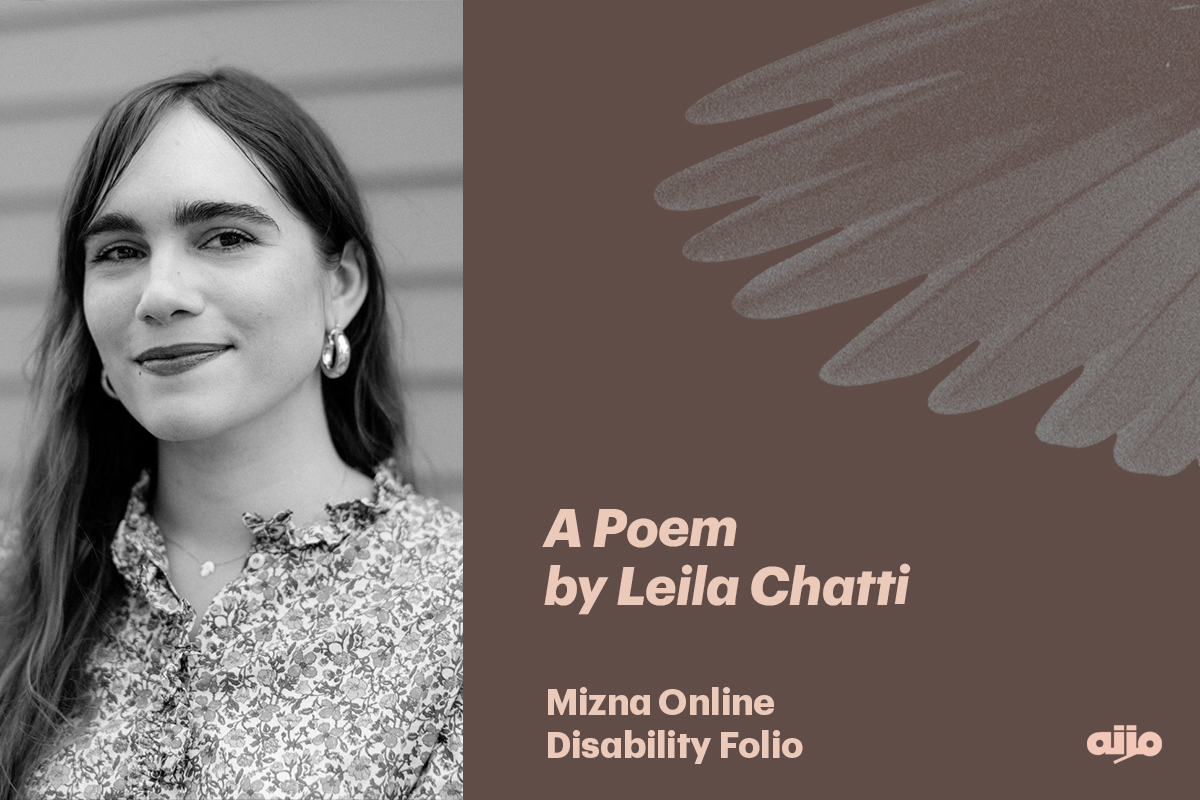
Tunisian-American poet Leila Chatti reflects upon the role of linguistic distance in dehumanization and interrogates the connection between distance and love.
Originally published Mizna 20.1: Twenty Years, reprinted here as part of the Disability Folio.
—Kate Bestall, editorial intern
At a distance,
I assume others are kind, and this seems an essential
difference.
—Leila Chatti
In Response to the Capsized Boat and 65 People Drowned off the Tunisian Coast, a Flood of White Americans and Europeans on Twitter Write Who Cares and Thank You and Good, and I Tell My Father
Maybe it’s strange, he says, but it reminds him of hunting,
those Michigan shows that appear if you leave the television on
long enough in an empty room, wandering in just as a sky-
eyed Ashley or Joe with a gun slung over a camouflaged shoulder
says something about love. My father
says it always goes like this: someone insisting it’s love they feel
for what they kill as they kill it. He means
for some there’s a distance, even in love,
which allows for violence, delights in it. In their bios,
many of the commenters describe themselves as loving
husband and father, as Proud Christian, and I still love the world
enough to be surprised by this. At a distance,
I assume others are kind, and this seems an essential
difference. Distance, in its original usage,
referred to conflict, not space. As in, America prides itself
in maintaining conflict between itself and everyone else.
One of the most illustrious films about love and distance involves a boat
which sinks. Because its occupants are Europeans emigrating
to the United States, this is considered a tragedy
as well as romantic. The term migrant is used intentionally
by the commenters to place linguistic distance between people
and that they are. They seem to take pleasure in the repeated erasure.
To illustrate the difference between the related
terms, a dictionary states The Arab migrates;
the European coming to America is an emigrant to those whom he leaves,
and an immigrant to the Americans. In this instance, the people
drowned are not all Arab, but assumed to be, all not white,
and this is what incites the language, the distance. The original
meaning of emigration is removal from a place. The sea
is a place of removal, a country which shares its border
with death. When ask to identify on a map
Middle Eastern countries, one third of Americans could,
though over half support the drone strikes in them.
One study found the less Americans knew
about a country’s location, the more they wanted
military intervention. The commenters say they want
to know what violence the drowned
were supposedly fleeing from, because violence is the requisite,
though no amount of violence would be enough. If they are
in a boat, they deserve it. If they are in a country,
they deserve it. I am disgusted, and yet
it is these commenters I give my attention, attention
a form of love. All morning I do it. Intervention once meant
intercession, a prayer on behalf of another. I say
to my father do you think they feel
a little love for us? I write the wrong poem. I fail the dead. I fail the dead.

Leila Chatti is a Tunisian-American poet and author of Wildness Before Something Sublime (Copper Canyon Press, 2025)and Deluge (Copper Canyon Press, 2020), winner of the 2021 Levis Reading Prize, the 2021 Luschei Prize for African Poetry, and longlisted for the 2021 PEN Open Book Award, as well as four chapbooks. Her honors include multiple Pushcart Prizes, grants from the Barbara Deming Memorial Fund and the Helene Wurlitzer Foundation, and fellowships from the National Endowment for the Arts, the Fine Arts Work Center in Provincetown, the Wisconsin Institute for Creative Writing, and Cleveland State University, where she was the inaugural Anisfield-Wolf Fellow in Publishing and Writing. Her poems appear in The New York Times Magazine, The Nation, The Atlantic, POETRY, and elsewhere. She is a Provost Fellow at the University of Cincinnati and teaches in Pacific University’s M.F.A. program.
Related
The Bringers of Violence
Call for Interns: Summer 2022

Calling all Arab & SWANA illustrators and comic artists!
Arab Film Fest 2019 Juried + Audience Awards