



April 24, 2026
Boghz بغض as Re-memory: an Iranian American Counternarrative to Diasporic Zionism and U.S. Imperialism
In the summer of 2024, I moved Baba into a memory care facility. His room overlooked the gas station on the corner. I hung a painting that he has owned since the 1960s on the wall of his new room and hoped the familiar sight would bring him comfort. It didn’t seem to help. He kept asking when he was going home.
After painful months of deflecting, there was a pronounced reduction in questions about his departure. Baba settled into the rigid routine of mealtime, chair yoga classes, and naps in the facility’s loungers. His sharp political analysis returned, and I was relieved. Though the florid monologues on imperial theft and plunder that I grew up with were now a thing of the past, his pronouncements had evolved into poetry: weighty words and phrases. Baba called the white man he befriended (a fellow resident with a quick smile) farangi—foreigner—and chuckled with delight.
In his youth, Baba didn’t imagine himself becoming American. When he moved to Chicago in 1965, he had just received an undergraduate degree in City Planning from Southern Illinois University. Baba was committed to following his father, Mohammad, into civil service. His first steady paycheck out of college entailed working for a city agency that supported South Side Chicago youth to access employment opportunities. It was the reason he became naturalized. Citizenship was one of the hiring requirements, and he really wanted the job.
This is the story he told me for as long as I can remember. Baba styled himself a reluctant American, backing into citizenship while the rest of his family, still tethered to Iran, watched from a distance. His birthright was limitless in Iran: the vaulted gardens of Isfahan where he was born, the steel beasts of the Trans-Iranian Railway upon which his father managed hundreds of miles of tracks, the earthbound presence of Damavand—a volcanic peak that is part of northern Iran’s Alborz mountain range—where the family escaped Tehrani summer heat in the sweet mountain air. Why give that up?
Baba traveled to the U.S. on a student visa in 1954, a year after Mohammed Mossadegh, the only Iranian national leader ever elected by popular vote, was overthrown by the MI6 and CIA-affiliated proxies of Winston Churchill and Dwight D. Eisenhower. Mossadegh had dreamed of nationalizing Iranian oil. In Mossadegh’s place, a brown-skinned, white supremacist puppet king—Shah Mohammad Reza Pahlavi—was offered a golden cage from which to rule.
Prior to Mossadegh, and true to the playbook of colonizing superpowers, the Iranian petrochemical industry was under the thumb of the Anglo-American Oil Company (AIOC), now British Petroleum. Once the puppet-king was securely installed in 1953, AIOC cut the five major American oil companies in on 40% of the profit shares as a thank you for their regime change support.
Israel had a hand in Iran’s undoing during the years following Mossadegh’s ouster. Already bloodied by their own founding genocide five years before, Isreal initially provided indirect support to the puppet king. Four years later, in 1957, Israel offered direct and ongoing lethal reinforcement to the oil companies and their political lackeys when they directed the birth of SAVAK, the puppet king’s secret police. A Farsi acronym that translates to Bureau for Intelligence and Security of the State, SAVAK—with training from Mossad—tortured, killed and disappeared thousands of Iranians during their twenty-two-year history.
Baba wouldn’t touch Israel with a ten-foot pole and didn’t want to live under SAVAK, the Shah, or the mullahs that overthrew him. It was better to stay in Amrika, he reasoned. Baba’s Southern Illinois University education was funded by loans from the Pahlavi regime. The fact that he never intended to pay the loans back may have been part of his final calculation. I think he saw the unpaid loans as small reparations in the aftermath of Mossadegh’s ouster. He refused to forget.
Ambivalence runs in the family. Before the first U.S. Israel strikes on Iran on February 28, 2026, Baba spoke to his younger brother, my Amu, every week. Amu lives on Damavand, in the family’s former vacation home. Despite having American citizenship, Amu rejects any suggestion to relocate permanently to the United States.
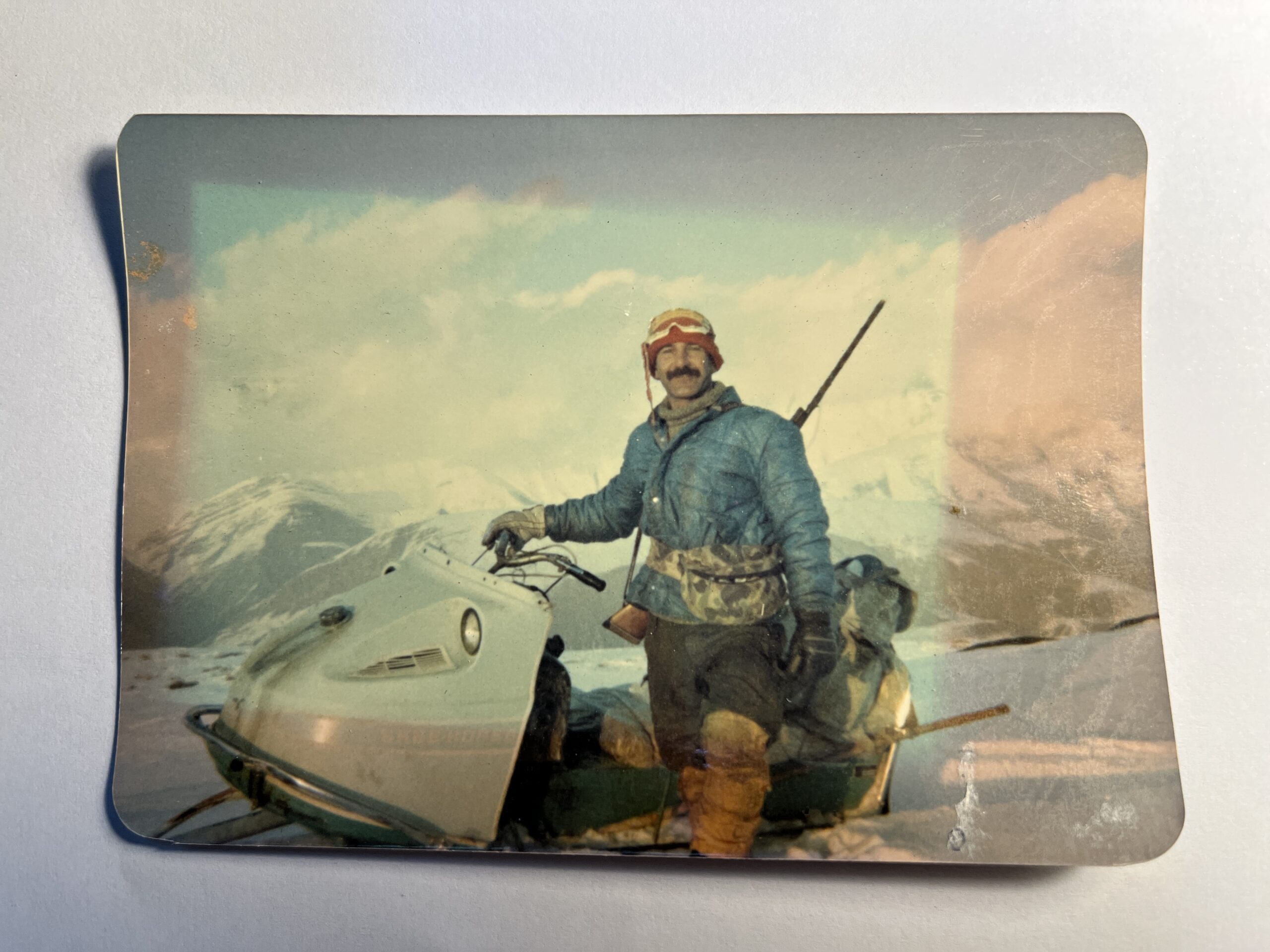
Amu has lived on Damavand for over fifty years. He fought cancer on Damavand, acquired a Soviet-made snow mobile on Damavand, hunted and ate the game he killed on Damavand. Amu avoids Tehran as much as he can, returning occasionally to keep an eye on the housing compound that’s been in the family for generations.
After Israel bombed Tehran in the summer of 2025, thousands of urbanites fled to the Alborz Mountains. Amu offered food to the shaken arrivals, going hungry when there were the inevitable shortages. Eight months later, the U.S. and Israel brought war to Damavand: to late winter snowpack, icy rivers, and Amu’s honeybees, clustering for warmth in the apiary Amu built. My family has spoken to Amu only once since February 28, and we haven’t told Baba about the war.
Before Damavand was bombed at the end of February, Baba would hold his second wife’s phone close to his mouth and bellow greetings at Amu. In Farsi liberally speckled with jackasses (lyrical English declarations), Baba expressed solidarity with Falasteen and railed against Israel. Amu’s voice was a warm hum of accompaniment on the other end. When the phone was passed to me, I would bask in Amu’s tender declarations and thank him, repeatedly, before handing the phone back. Every time Baba hung up after these conversations, he reinhabited the father of my memory, the Baba-before, at least for a little while.
The Alborz Mountains are a place where Iranians have historically found refuge from conflict. Amu avoided conscription and almost certain death in the early 1980s, when the Iran Iraq War was at its height, by staying hidden and subsisting off the land. Damavand was a high-altitude haven, 300 miles from the war front.
In the fickle self-interest of colonizers, Israel quietly supported Iran in that war. They feared Sadaam Hussein more than the Islamic Republic. Even so, there’s an often quoted quip by then-Israeli Prime Minister Menachem Begin: “I wish both sides success.” It’s this kind of colonial opportunism and its active propagation of an ahistorical view on current events that worm their way into the latest discourse around the illegal war on Iran and contribute to a collective Western amnesia.
After Israel bombed Tehran in the summer of 2025, thousands of urbanites fled to the Alborz Mountains. Amu offered food to the shaken arrivals, going hungry when there were the inevitable shortages. Eight months later, the U.S. and Israel brought war to Damavand: to late winter snowpack, icy rivers, and Amu’s honeybees, clustering for warmth in the apiary Amu built. My family has spoken to Amu only once since February 28, and we haven’t told Baba about the war.
* * *
I get a whiff of this colonial opportunism, albeit manifested in the body of one gay Zionist, from reality-television celebrity Reza Farahan’s recent social media posts full of rabid celebrations of Iranian suffering. My love/hate relationship with Farahan, the former star of Bravo’s nine-season The Shahs of Sunset and one of the current leads in the spin-off series, The Valley: Persian Style, began almost fifteen years ago. Farahan was the only openly queer Iranian American I ever saw regularly featured on my small screen. I lapped the Los Angeles-based show up like a queer kitty gorging on an endless bowl of condensed milk and paying for it with the runs.
The son of a supportive Muslim mother and an absent Jewish father, Farahan made me ill for years. Initially, this reaction was caused by my parasocial dread for his emotional well-being. In the first season of The Shahs of Sunset, we watched as Farahan attempted to reconcile with his father in the Iranian-Jewish enclave of Great Neck, Long Island. While his paternal grandmother snubbed Farahan’s queer, multifaith identity on camera, his father offered pained apologies for his absence, and Farahan bravely unburdened himself, confronting his father and externalizing the shame of abandonment.
I continued rooting for Reza joon, even as The Shahs of Sunset produced increasingly cringe-worthy TV. In Season 3, Farahan unleashed a homophobic tirade upon Sasha, a queer Iranian who had recently immigrated to the U.S. I was angered by Farahan’s outburst and disappointed by the ease with which he punched down. While Farahan had never been a reliable narrator, this instance with Sasha established him as unnecessarily performative and hostile, someone I might want to be wary of. My hunger for queer Iranian American representation meant I settled for something less than mediocre: Farahan didn’t repair the relationship with Sasha, and I kept hoping he would change.
By the start of The Shahs of Sunset’s sixth season, Farahan made it easy to finally walk away. He was swerving headlong into his role as a Zionist cheerleader, which he cloaked in a desire to reconnect with his father’s Jewish roots. Farahan hyped Israel up as a beacon of queer safety in a dangerous, backward region without the slightest indication that he understood the historical reasons that the mullahs were in power in the first place. While there were many Reddit threads that speculated over this performative embrace of pinkwashing (and the psychological implications of aligning himself with his estranged father), I took it as a sign to stop watching the show. I was already too familiar with the internal fault lines that diaspora wrought. Los Angeles holds a flurry of Iranian anti-Zionists, feminists, anarchists, internationalists, royalists (who are often synonymous with Zionists), Christians, Jews, Muslims, Zoroastrians, and Baháʼís. Most of us are here—whether directly or indirectly—because of violence perpetuated by the same nation-state that had a hand in issuing our birth certificates, green cards, and naturalized citizenship papers.
Farahan is still the most public and platformed queer Iranian American I know. His audience of 800K Instagram followers may have struggled, pre-February 28, to find Iran on a map. The first season of his new reality show, The Valley: Persian Style, concluded two days before the bombs started to fall on Tehran and Damavand and Minab.
Since February 28, Farahan has become louder in his support of a U.S.-Zionist killing machine that continues to traffic in genocide, decimating countries like Lebanon and Palestine through the attempted erasure of their people, ecological systems and ancient cultures. Just like the Israeli Defense Forces soldier who, in the month after October 7, 2023, posted an image of himself to social media atop Gazan rubble, carrying a rainbow flag that was inscribed “In the Name of Love,” Farahan manufactures queer consent for invasion, conquest, and the slaughter of civilians. Farahan gleefully aligns himself with and explicitly cosigns onto the Zionist and imperialist narrative that this is a just and righteous war, all while conjuring the boogeyman tropes of Oriental intolerance and barbarity in the form of—in this case—his own people.
It is undeniable that the Islamic Republic brutalized Iranians for almost 50 years. By backing up a few decades, we can uncover the origin story of this patterned brutality. Despite efforts to amplify an ahistorical narrative that encourages collective amnesia, we need to begin in 1953. Mohammad Mossadegh’s vision of an Iran independent of Western corporate interests was a threat. The CIA and MI6 staged a bloody coup to remove him. It was followed by the installation of the Shah’s brutal puppet-regime who were trained in repressive tactics by Israeli intelligence. This led to a popular, secular 1978 revolt against the puppet king and his imperial backers. In 1979, the mullahs co-opted the popular uprising and established the Islamic Republic. It took about a year of state-building before the Islamic Republic began its own systemized campaign of repression that cloaked the same systemic brutality in the robes of purportedly pious men.
As Iranian leftist news creator Ariana Jasmine says: “(Khamenei) was a piece of shit.” Punto. The mullahs and the Islamic Revolutionary Guard Corps were more destructive than SAVAK in part because they were in power for almost twice as many years as the puppet king, who was installed like a second-hand kitchen appliance by American and European oil interests in opposition to the will of the Iranian people. The puppet king’s bloody reign was funded in our name. Now, history repeats itself.
Seventy-three years after Mossadegh was overthrown, what makes England, the United States and Israel think that—this time—the long-term outcome will be ever in their favor? The “decapitation of Khamenei” (General Jack Keane) will not resolve the root dilemma: a bloated colonial mindset and a cruel economic system that dehumanizes and seeks to destroy life that isn’t made in its image. No wonder we are now faced with Donald Trump’s threat that “a whole civilization will die tonight.” In early April, Baba’s birthplace was bombed. The vaulted gardens and tiled sanctuaries of Isfahan will never greet me with the same splendor they offered my father. The U.S.-Zionist entity is reaching its logical conclusion and saying the quiet part out loud, with the support of mouthpieces like Farahan.
As U.S. Israel engage in the eighth week of an unprovoked war against Iran, the ongoing bombardment of Lebanon, and the continued extermination of the Palestinian people, Iranian imperial flag-waving performances of collective amnesia are platformed while the more nuanced and complex reality of life both in Iran and in the global diaspora is silenced. This dominant narrative has found its most vociferous spokespeople within a right-wing, politically privileged diasporic minority, a certain class of monied, platformed Iranian Americans like Reza Farahan who somehow think that the current Israeli Prime Minister’s imperative to “change the face of the Middle East” doesn’t mean obliteration for them as well. Many in this minority offer passive support for a return to autocracy in Iran, including recent social media posts by actor Sholeh Agdashloo. There is deafening silence from Farahan’s The Shahs of Sunset co-stars and from queer Iranian lifestyle influencers, many of whom continue to exclusively post fashion videos, opulent vacation photos, and images of luxury real estate to social media.
* * *
Within my extended queer and biological Iranian family there is a spectrum of responses to the war. They range from the daily DM exchange with my cousin, where we trade anti-Zionist videos and articles with headlines such as, “Ana Kasparian Says We Need to Airdrop Senator Graham into Iran,” to the overly saccharine—though loving—greetings from a long-time Iranian dyke friend at a recent art opening that celebrated queer and trans futurity. When my long-time friend greeted me with platitudes about wishing the U.S. and Iran would “just get along,” part of me wondered if it was a dissociative trauma response, or a canny way of sidestepping her pro-Shah imperial sympathies. I didn’t ask her to elaborate. There is a gap where the answer should be.
Many Iranians in diaspora are conscious of living in some version of this gap. What brings me strength is the politically wise generation of Iranian content creators worldwide who refuse binaries, who give language to this liminal place in which we live: our own memory care facility where we sit within the historical reality, reclaim a narrative of resistance to empire, and imagine ourselves free. The Iranians that embrace a counter-dominant narrative understand that two things can be true at once: the Islamic Republic was and is a harmful state actor that operates institutions designed to crush citizens into submission, and the U.S.-Zionist entity continues to perpetuate genocide and perform murderous dominion over people and land, history and culture that do not belong to them. To live in both truths is to embody what Iranian artist and scholar Newsha Valentine rightfully characterizes in a social media post as بغض which, in transliterated form, is spelled boghz.
In the Valentine’s post, researcher Parand Danesh’s text is overlaid onto an X-ray image of a cervical spine, created by graphic designer Emad Barazandeh. Danesh’s text reads, “Boghz (بغض) has no exact equivalent in English. It names an embodied state where grief, anger and humiliation accumulate without release. It is felt as a tightening in the throat and chest. . . . It is the pain of what cannot be said, cried or acted upon…” When this tender post came across my feed, I wept and acknowledged that, yes, I did have that knot in my throat. The weeping was simply an acknowledgement; it did not release anything. I received boghz as a familiar friend, the weaving of grief, anger and humiliation a familiar sensation. When I shared Valentine’s post as an Instagram story, an Iranian American poet friend reacted with a bullseye emoji.
I like to think of my relationship to boghz as a project of re-memory, of honoring Baba, of standing in the unnamable. Boghz reminds me that I have a body, that the monolithic complicity around U.S.-Israeli aggression can be dismantled. I am surrounded by both chosen and blood family who enact this refusal every day in ways both acknowledged and invisible. Re-memory counters the colonial boosterism that Farahan and his kin promulgate.
Palestinian Iranian poet Dailah Lina gestures toward boghz and re-memory through her spare black-and-white posts:
freedom
is understanding
stability
has always meant
submission
to western interests
The Collective for Black Iranians produces vivid media that is an archive of historical and contemporary Afro Iranian life. The beautifully produced videos range from humorous on-the-street interviews about Black Iranians’ dating preferences to a heartbreaking animation of the current bombardment of Iran, overlaid by murderous Truth Social posts by Donald Trump that gleefully announce: “48 hours before Hell will rain down on them. Glory be to GOD!” The animation portrays an Afro Iranian femme, knees pressed to her chest, holding a glass of tea. Behind her, bombs fall on a city. Her eyes crumple and contort. At the end, she holds a book up to the viewer, displaying text in both English and Farsi. It reads, “We deserve to live.”
Ariana Jasmine creates explainer reels in her “big sis” persona, folding the viewer into a big virtual family. I have found great comfort in her documentation of New York City Mayor Zohran Mamdani’s early days in office as she invites us into Mamdani’s Ramadan iftar and Iranian New Year celebrations. Esau World, an Iranian comedian from Portland, OR, uses physical comedy and aching satire to embody boghz in all its striations, including frequent videos behind the wheel of his car. In one video, World is encased in a fuzzy jacket that makes him look like the Cookie Monster, the avatar of constant, unfulfilled desire. If that’s not boghz, I don’t know what is. In the video, Esau fights back tears and offers to help dispel U.S.-Zionist propaganda. He implores his non-Iranian followers to extend support to the Iranians they are in relationship with and, in doing so, makes me feel less alone.
All these examples of re-memory enact an ethics of collective care. By engaging in memory care, we inject diaspora with both the euphoria and the ache that necessitates our tenacious continuation.
I want to tell Baba about what is happening in Iran. I want to share the absence of news: how we haven’t heard from Amu since late March, how it remains to be seen whether our family home in Tehran still stands. There is a part of me, the child who watched his steely pride flare as he navigated this country while holding the direct memory of the 1953 coup—and the diasporic memory of revolution and counter revolution—that wants him to cradle me in a protective embrace.
I imagine into the physical distance between Baba and I, as I write this essay in a town 600 miles north of his memory care facility, I imagine that surrendering to boghz itself might be the protective embrace that I need. After all, I inherited this knot, this diasporic ache, from him. I imagine Baba slipping extra boghz into his pocket as he boarded a plane to the United States in 1954. I imagine boghz taking on the physical form of a smooth gray stone that holds no reflection.
With this vision, I am employing scraps of the ancestral archive, particularly a photo of Baba on the cusp of his departure from Iran. In the photo, which isn’t dated but was probably taken in 1953, he is standing with Amu on a flat dirt road. Their figures are rendered in grayscale. Behind them appears to be a square hut made from the earth they stand on. Thin wands of branches twine to create a border fence along one side of the road. Beyond that—only sky. This is the high desert, not Isfahan or Tehran or Damavand. I neglected to ask Baba where the photo was taken until it was too late for him to remember. My cousin tells me that it was probably taken in Suri, where Baba and Amu’s father was stationed as a railroad administrator. Suri is known for its high desert climate.
It is midday in the photo. Baba’s square chin is lit from above, its shadow extending across his shoulder as he turns, looking away from the photographer. His suit dazzles, and I envisage—improbably—finding it in a closet in the Los Angeles home where he no longer lives. I want to wear the suit, to inhabit the boghz it represents.
What makes it extraordinary is the symbolic power of the suit’s styling. The jacket length gives it away, even with a cursory glance. It’s a zoot suit—the tie thick, the white shirt starched, and the long jacket’s lapel broad—loosely inspired by the Third World revolutionary movements of the time, some of which considered the zoot suit a battle standard.
The jacket’s hem hits just above his knees. In the photo, Baba’s hair is cropped short on the sides, scalp peeking through, a high-top fade. The crown of his head is a glory of pomade: hair standing straight, reaching toward the sun. About a year after the photograph was taken, Baba left Iran with—I imagine—a knot in his throat and some boghz to spare in his jacket’s pocket.
Now, I sit in the tight knot of the boghz he gifted me and the collective boghz of our shared grief: my throat full of sand, my chest heaving under a cold compress. I engage in the practice of re-memory. Like the honey that Amu used to hide in his suitcase and offer to his American family, packed with the waxy comb that his Damavand bees created, each moment of re-memory contains every drop that came before and envisions a way forward. Like the dried mulberries that carry the spirit of ripe fruit and tree blossom and soil—of past, present, and future—I gather and witness and offer a tiny burst of recognition, should you choose to partake.

Mahru Elahi (they/او) is a recent Pushcart Prize and Best of the Net nominee. Their prose, both published and forthcoming, can be found in the Bellevue Literary Review, Seventh Wave, Foglifter Journal, Black Warrior Review and Sinister Wisdom, among others. Mahru’s current project—THE FUEL OF NATIONS: Essays on Girlhood in Amrika—is in-progress. The collection unspools their coming of age in the 1970s and 80s as a queer American-born Iranian who was emotionally dismembered by global conflict and its localized impacts on the family. Mahru urges you to act against genocide and towards a love that cannot be acknowledged by empire.
Related
The Bringers of Violence
Press release: As Poetry Foundation Censors Pro-Palestine Voices, Mizna Uses Their Grant for Palestine
The Poem Is Good
H.O.M.E.S