



January 22, 2026
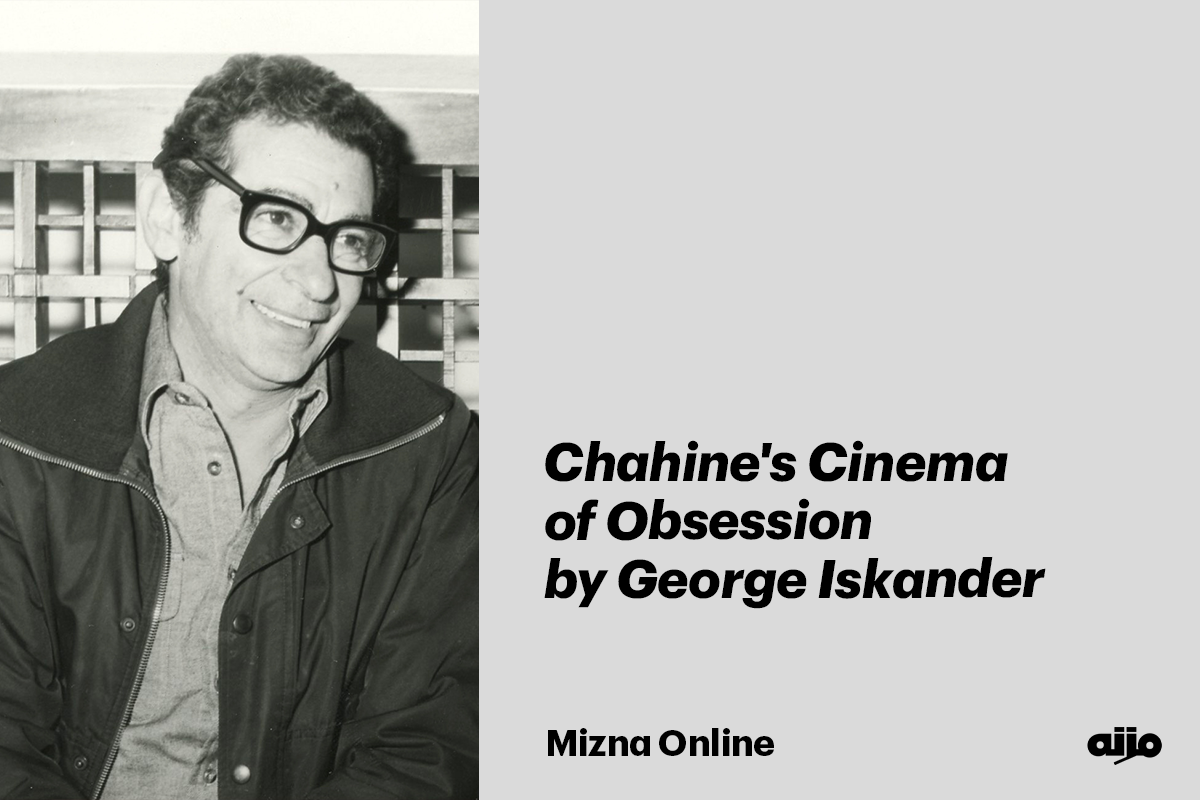
Chahine’s Cinema of Obsession
Do you know the difference between love and obsession?
No.
Desire, “Under Your Spell”.
* * *
Sometimes, when I have nothing else to do, I browse through the aisles of my local bookstore, waiting for something to catch my eye and change my life, if only for a few weeks. In April, I picked up Iman Mersal’s Traces of Enayat, Mersal’s own recounting of her journey to re-trace the life of Enayat al-Zayyat, an Egyptian author whose lone work, Love and Silence, was published only after her suicide in 1963. Twenty-six years after its publication, Mersal would discover a dusty copy of Love and Silence in a Cairene souq. Another twenty-six years later, she would publish the story of her nearly three-decade-long efforts to reconstruct Enayat’s life. Traces of Enayat is equally Mersal’s story as it is Enayat’s, as their two lives become enmeshed through Mersal’s investigation. Through the work, as Mersal talks to Enayat’s surviving friends and family, she reflects on her obsession with Enayat, and what that means for herself and Enayat’s legacy. It’s impossible to spend thirty years with someone and not fall in love.
There’s something so alluring about becoming obsessed with a genre, a medium, an artist and their oeuvre. Someone whose work sits with you time and time again, both in life’s throes and its contentment: a little, perennial garden that blossoms each year in the shade. It’s the worst, most vulnerable sort of love you can give an artist, and it’s the most indispensable.
A few months after I picked up Enayat’s book, I found myself again in the same bookstore, listening to George Abraham read his poetry and quote one of his favorites, the late Lebanese author and poet Etel Adnan. In her essay, “Letter to a Young Poet,” she writes, “You don’t need to read too many books of poetry to come closer to the heart of poetry, but you need to love a few poets madly, love them more than yourself…more than any person or living thing.”
I posted an excerpt of Enayat on my story, and one of my old college classmates messaged me, “Did you know my mom wrote this book?” I didn’t. I told him to tell her I was a fan of the book. I sat for a while and wondered about obsession.
* * *
I’ve been meaning to watch the films of Youssef Chahine for far too long. Chahine is someone I’ve been meaning to sit down and attend to: he’s the most noted director to ever emerge from Egypt. Over a career spanning from the 1950s all the way to the late 2000s, Youssef Chahine cemented himself as one of the most interesting, idiosyncratic, and well-known Arab and Middle Eastern filmmakers. Almost twenty years after his passing, he remains Egypt’s foremost auteur and director.
Born in 1926 in Alexandria, Egypt to a Christian family, Chahine loved Alexandria. The city came before almost everything: “I make films first for myself, then for my family, then for Alexandria, then for Egypt.” Alex—as it’s affectionately known—occupies a massive tract in the land of Chahine’s thematic explorations. Time and time again, he returns to the city to sing its praises, to mourn the city he knew in his youth, and, if nothing else, to let the city’s beauty shine. Even after founding his Cairo-based production company, Misr International Films, Chahine never lost his fondness for his home city and would return there again and again, literally and figuratively.
Besides Alexandria, there was filmmaking, and together, these two passions found their full realization in Chahine’s lifelong auto-fictional project, the Alexandria Quadrilogy—or trilogy, if you see the last entry as misstep rather than a swan song. In the span of the twenty-five years spent creating the quadrilogy, Chahine’s project becomes increasingly self-referential and metatextual. The inaugural film of the series, Alexandria…Why? (1979) follows a young, star-struck, and starry-eyed Yehia (Mohsen Mohieddin) relentlessly pursuing his dream of becoming a filmmaker in cosmopolitan Alexandria amidst the Second World War.
Chahine followed up with An Egyptian Story (1982), Alexandria, Again and Again (1989), and Alexandria…New York (2004). Having found success after the events of Alexandria…Why?, the now-middle-aged Yehia (Nour El-Sherif) of An Egyptian Story—estranged from his family—works night and day to make his films, smoking upwards of 100 cigarettes a day. An Egyptian Story vivisects Yehia’s life, tackling his demons and traumas through the conceit of a courtroom drama set inside the chambers of his heart as he undergoes open-heart surgery. Yehia confronts his brothers, his mother, and his father, telling them they are responsible for the man he is. If he’s too obsessed with his films, if he has failed his responsibilities as a family man, if he’s distant, then their hands are not clean; they share a part in the blame. Before therapy for Arab men was in vogue, there was An Egyptian Story. Chahine opens up to put his life on trial, painting a partly-true, partly-fictive picture of his filmmaking career in vivo.
After directing and leading in Cairo Station (1958), Chahine quit acting, saying in a 1978 interview, “I’m quite happy being a director. In case a very good part comes along, I don’t think I’ll say no.” Clearly, there was something important Chahine had to say, something that didn’t rest easy with him, because in 1989, he would step in front of the camera one more time to play Yehia in his magnum opus, Alexandria, Again and Again. Picking up a few decades after An Egyptian Story, the film follows Yehia several decades into his career as a director. Within the continuity of Alexandria, Again and Again, Yehia directs Alexandria…Why?, and Amr (the eponymous Amr Abdulgalil), who plays the young Yehia in this in-universe version of Alexandria…Why?, becomes Yehia’s colleague and muse. (If it’s confusing, don’t worry, I don’t know how to explain it better!) If Chahine could at some point deflect criticisms of navel-gazing, he resigned his position with Alexandria, Again and Again—in for a penny, in for a pound. At every point, the film threatens to drown under its own self-indulgence and layers of self-reference, but is buoyed by Chahine’s vulnerabilities and his penchant for the off-kilter.
Just how weird are we talking? Alexandria, Again and Again brims with so many feet shots that as we’re watching it, my friend turns to me and says it’s a Tarantino movie; Yehia imagines playing Marc Antony in a historical epic about Cleopatra in which they make love to the 20th Century Fox fanfare; a mysterious man in a trench coat leads Yehia to the long-lost tomb of Alexander the Great under the street of Nabi Daniel, only for Yehia to realize Alexander the Great is actually his muse, Amr. Alexandria, Again and Again overflows with peculiarities, quirks, and oddities. It’s a singularity in the canon of Egyptian film, a work from a filmmaker who knows he’s in his twilight years, a late-career retrospective that somehow, sums it all.
And then, there’s Alexandria…New York. The campy charm of the trilogy suffocates the last entry of Chahine’s Alexandria project. Now past his filmmaking years, and lauded as an auteur of Middle Eastern cinema, Yehia (this time around played by Mahmoud Hemida) discovers his lost Egyptian-American son after running into his college girlfriend. Chahine’s depiction of Egyptians in diaspora responds to the rising tide of anti-Arab sentiment in the wake of 9/11, but misses the mark by defining his characters in these terms. The characters, through overwrought performances, quickly become caricatures of themselves. That’s not to say the film doesn’t gleam with brief moments of inspired storytelling—Alexandria…New York has one of the best moments in the Alexandria project, one that I think encapsulates Chahine’s evolving relationship to film. The Alexandria project begins with a bright-eyed Yehia, who sees film only in superlative terms, but he soon comes to see how film brings out his worst side: it makes him egoistic and self-obsessed, it makes him more cynical. The Yehia that closes the quadrilogy is a far cry from the starry-eyed youth in wartime Alexandria. And all the same, he can’t help but love film. There is no other choice for Chahine.
At the start of Alexandria…New York, Yehia’s friends inform him that New York is hosting a retrospective in his honor. Yehia scoffs, asking why he’d visit America and support the country supplying the arms to Israel that are killing his Palestinian brothers. His friends tell him that at the retro Yehia might gain a new following of thousands of people, people who have never seen his films before. Cut to an overheard shot of the Statue of Liberty, and in the blink of an eye, Yehia has landed in New York. It’s a moment played for levity, but within every joke is a kernel of truth, as they say: As much as Yehia cares about his principles, he can’t ever get over his desire to be seen.
This admitted hypocrisy characterizes Chahine’s approach to the entire Alexandria project: unabashed and unflinching. Though tackling a myriad of thematic concerns (to wit: self-destruction, sexual fluidity, and inner reconciliation), the connective tissue between the films of the career-spanning quadrilogy is Chahine’s obsession with filmmaking, the cinema, and his hometown of Alexandria. Chahine cannot perform his cinematic autopsy of self through any other lens. Even though it barely features in Alexandria…New York, Alexandria’s presence hangs heavy, as Yehia recalls the city of his youth time and time again to whoever cares to listen. Chahine once said Alexandria…Why? was his favorite film, owing simply to the fact that it takes place in the city he was born. Chahine is the poet that Etel Adnan writes about, the one that he loves more than anything.
“Simple words on paper become emotions,” says Yehia in Alexandria, Again and Again when asked why he’s obsessed with film and actors. Chahine at once represents film as a fixation that drives him and as an isolating force that tears apart at his relations with his family, friends, and muse(s). The problem for Yehia (and for Chahine) is that they both see and understand their own genius and place in the canon. What kind of director can play himself accepting the award at Berlinale he won just a few years prior? Were it anybody else, it would read as an exercise in vanity—obsession blinds shortcomings and faults—but Chahine understands his own shortcomings, even as he holds himself in high regard, and he isn’t afraid to round out his picture, flaws and all.
* * *
Chahine is far from the first to approach his life through film. The late-career autobiography has never gone out of style (see, for instance,. All that Jazz, 8 1/2), but it’s lately become all the rage, with titans like Steven Spielberg, Alfonso Cuarón, and Pedro Almodóvar all throwing their hat in the ring with The Fabelmans, Roma, and Pain and Glory, respectively. Though I hesitate to mention it on its merit, Francis Ford Coppola’s Megalopolis looms especially large. Almost forty years in the making, Coppola’s part-fable, part-autobiography Megalopolis invites comparison and conversation with the other films of its ilk. What does it mean to be an auteur, to know that film, as an industry, is what it is because of your work? Both Coppola and Chahine grapple with these questions, to different effect. Coppola paints himself in broad strokes, connecting his life to grand questions of pragmatism versus idealism. He depicts himself both as a visionary and aging member of the vanguard, each locked into the struggle for control of the future, but ultimately, it’s in good hands: the bon mot, “when we leap into the unknown, we prove that we are free,” returns again and again throughout the film like a refrain. There is little critique in Coppola’s vision of himself; he feels caught between old and new strands of filmmaking, but his stand-ins are lauded time-and-time again by those around them.
Chahine’s understanding of his life and the industry, on the other hand, shaped by his experiences and relations to Western cinema, reads far more personally and critically. In Alexandria…Why?, Yehia dreams of studying film in America, because he knows there’s no future for him in Egypt. The film ends with Yehia sailing off to his dream of studying in America. Yehia follows the real-life trajectory of Chahine, who spent formative years studying at the Pasadena Playhouse in California. After returning to Egypt, Chahine incorporated and innovated on Western filmmaking techniques, distinguishing him from his contemporaries. This practice came at a price, as Chahine struggled for recognition among both Egyptian and international peers. Western critics saw Chahine as just another emerging director from the Middle East; Egyptians saw Chahine as provocative and controversial. Chahine occupied some liminal space between East and West, and this tension comes to bear on An Egyptian Story, in which Yehia loses an award at Cannes at the hands of bureaucratic mismanagement, which leads to him spiraling. In Alexandria, Again and Again, Yehia promises Amr that they’ll win an award at Cannes, but when they don’t, a rift in their relationship opens. Yehia directs his anger outwards, lashing out at these perceived injustices and their perpetrators.
Later in the film, Yehia meets the actress Nadia (Yousra), and when the topic of Shakespeare’s Antony and Cleopatra comes up in their long conversations about the arts, Yehia rails against the their relationship: what do Antony and Cleopatra have to gain from one another? What is the point of their love? In the end, they both die, he says. Yehia is clearly still grieving his fallout with Amr, and his frustrations find their expression thus. It would be easy to claim Chahine as entitled if it weren’t for the fact that he understood his lack of recognition and exclusion from Western cinema circles as the symptom of a greater divide within the film world. In a 1997 interview with Michael Fargeon, after winning a lifetime achievement award at Cannes, Chahine addressed this point in detail:
We sometimes even manage to invent revolutionary techniques, but they [the United States] don’t want to know. I actually directed the first chase scene in cinema history filmed using a hand-held camera, an enormously heavy old “Derbie.” I followed the actors down the narrow corridors of an ancient temple. And yet my films, like those of many other film-makers from countries of the South, have been sidelined from major international distribution circuits.
Chahine’s feelings about Western recognition were complicated by knowing that his films were innovative, not just in technique (as he says so himself), but in genre and subject matter. In the same interview, Chahine praised American filmmaking techniques, of which he was a student, but criticized American films, saying, “They’re always well-packaged, well-edited and well-acted, but the stories themselves are mediocre.” Chahine saw the stories being told in the Global South as worthwhile, but for some reason, they did not get the care and attention they deserved. He was never lacking in perspective: as much as he knew his films were under-recognized, he knew other filmmakers had it worse. As early as the 1960s, Chahine spoke highly of other African and Arab national cinemas when asked about the state of Egyptian cinema.
This isn’t to say that Chahine has been forgotten, but as Middle Eastern & Arab cinema continues to gain traction through the work of modern directors (such as Nadine Labaki, Maryam Touzani, and Kaouther Ben Hania), Chahine’s filmography remains under-watched. It doesn’t help that his films are hard to acquire, with many of them having had only physical releases on VHS. Many of them haven’t been remastered. Chahine pops up every now and again: MUBI gave Chahine a retro in 2021, BFI did one in 2023, and the Criterion Channel added Chahine’s films in August of 2024. The Criterion Channel is Criterion’s streaming service, distinct from their well-renowned Collection. For better or worse, the Criterion Collection acts as an evolving and de facto version of “film canon,” and Chahine’s absence from the Collection was a notable one, one which was only amended in August 2025 with the addition of Cairo Station (1958). It’s a start.
As important as this addition is for film lovers who can now (finally!) watch Chahine in better-than-DVD quality, I don’t think Chahine would care much about his inauguration into the Collection, had he lived to see it. Going back to the latter two films of the Alexandria project, Yehia cares about his films’ reception, to a fault. He cannot stand losing, and he craves to be known, seen, and recognized, a direct projection of Chahine’s own ego. One would say I’m reading too far into it, if Chahine himself had not confirmed it:
Joseph Massad: Yet the trilogy was semifictional, as I understand it.
Youssef Chahine: No. It used fiction as little as possible and only in keeping with dramatic necessity. Most scenes were real lived scenes.
In the same interview, which took place in 1998, as Chahine was gaining increasing attention for his long career, he dryly remarked, “Every now and then…they have to say they’ve nurtured a new director, discovered a new director. So my turn came. Fine.” As American ‘interventionism’ fractured the political economy of the Middle East in the latter half of the 20th century, Chahine became increasingly critical of America, Hollywood, and Arab leaders. Why care about recognition from the West?
* * *
But class act he was, Chahine was always grateful, and he often spoke about love in reference to his films and his audience. When asked about his experience accepting his lifetime achievement award at Cannes, he answered:
When I walked up to the microphone to thank them, I almost broke down. All those people, who are supposed to be so tough, were opening their hearts to me and love is never a one-way feeling.
It’s a beautiful way of seeing love, to know that love is always reciprocated. I don’t think Chahine was just obsessed with film, but he loved it. Sometimes, there is no difference between the two: to love is to obsess. I often think of poet Hanif Abduraqqib’s words, “Love is a change of internal architecture.” Love is a change of perspective, one that informs how we view the world. For Chahine, the world could only be seen through film and Alexandria. The first film of the quadrilogy, Alexandria…Why?, asks a question that’s never explicitly answered, but if you know Chahine, you know why.

George Iskander is a Ph.D. candidate at the University of Chicago. He writes on science and film, and his work has been featured in The New Arab, New Lines, Scientific American, MUBI Notebook, and Sight & Sound.
Related
The Bringers of Violence

It is Burning./ It is Dreaming./ It is Waking Up/: Poetry and Environmental Justice

Arab Film Fest Collab
Call for Interns: Summer 2022


