



October 7, 2025
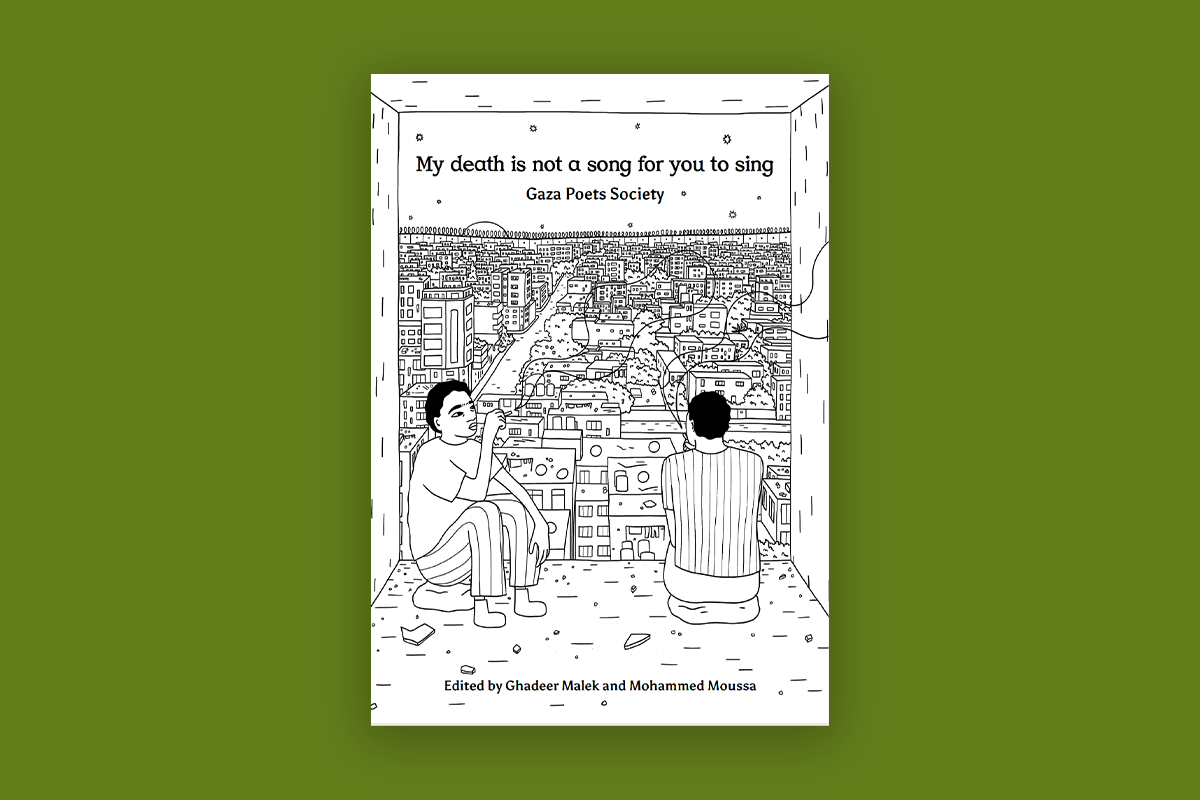
Excerpt from My Death Is Not a Song for You to Sing
The following curation is an excerpt from the Gaza Poets Society’s latest e-book, My Death Is Not a Song for You to Sing, republished with permission of the Society and publisher Mohammad Moussa, as part of Mizna’s The Memorial Folio—link to full series HERE, link to next piece in the series HERE. As the volume’s introduction says:
We survive so much while making this anthology/zine. War and fear, hopelessness and defiance, surviving the bleak—to the point of asking what for? Is this whole world ending soon? And if it doesn’t then when does the pandemic of injustice end? The human spirit is stretched to the point of showing signs of tear in the very fabric that makes us conscious humans. Does poetry make any sense, seemingly a fragile wisp of soft air (safa) in a world devoured by injustice? Perhaps poetry
and words are most called upon now, when our words are the last reminiscence of our consciousness in an unconscious world. The poetry that binds these pages are a stubborn force of survival, and are reflection of a human spirit that is stretched into a bewilderness of strength, survival but also testimony. That we are here, that we, the oppressed, the bombed, the personification of injustice and everything that does not make sense surrounding us. The context is beyond
us. And yet encompasses only us. Our survival and without it, there would be no context. We are the context, our voices do not represent only our truth but also that of the human spirit in the face of evil acting with impunity.
Please support the Gaza Poets Society and follow their work on Instagram.
—George Abraham, Editor-at-Large
I will not let myself get used to the sound of bombs
by Raneen Azzazi
I should be old enough to stop fearing the sound of bombs
I survive learning the sound of bombs succumb
they are close when they are far,
and far when they are about to hit
turning life to death
But fear does not mature with age
to the voices that sound the coming of bombs
For the bombs sound different to my ears
every time
And the nerves in my body feel them anew
every time
reacting as though they are hearing the bombs for the first time
every time
I will not let myself get used to the sound of bombs
I will close my eyes every time
and put my hands over my ears
every time
they bomb
because it is not natural
to let the bombs
feel normal
carrying misery
with every bomb
for the bombs are
not just a sound
but a voice
normalizing
an unjust death
Time
by Raneen Abdulwahab
Time is a teacher of life. Time teaches the value of life. You cannot own time, but you can use it. You cannot keep it, but you can spend it. And once it is lost you can never get it back. Time is free, but it is priceless. Slow for those who are rushed, fast for those who are scared of it, long for those who carry sadness, short for those celebrating, and for those lovers, time is eternal.
Besieged Sadness
by Nadine Murtaja
I tear sadness from out of the sky and I draw posters with it, enough to fill
the closed windows of the world.
The posters have blended with the color of the sun, within them the sadness,
so beautiful, it disappeared.
Your head is filled with the rush of an explosion as if you had stayed,
underwater for hours and hours.
The color of your eyes reveals redness that lights up, your feelings are
your kindness for others.
And your sleeplessness slumbers upon that black sky beneath your eyes,
it keeps you awake all night.
Brittle and crisp like a yellow leaf falling in a dark autumn.
You scream and hit the face of the wall with your tendons and then your
voice returns, disappointed because your walls isolate your voice.
Here are your glass walls which isolate you from what happens around you,
from your world.
You write poems and then you burn them, fearful that their letters will fly
and be revealed.
You play the tune of your sadness on your thin body, with the broken shards
of your mirror on the floor of your room.
Your cold mailbox which no one has visited in years, you hear its wailing
in the night and are afraid to send your letters to it.
You look through your closed windows, finding a poster stuck to it;
you adore your solitude and hate yourself.
My poster hides you from the outside world,
it keeps you clean from humanity.
I hung it so that it would close the hole from which
sadness crawls into you.
But I did not know that sadness would remain your only friend,
that sadness would become your poster, and the sky
your box of tears.
My death is not a song
by Mohammed Moussa
My death is not a song
For you to sing
Is not a March for
You to walk in
Is not a shirt for you to wear
Is not a road that carries my name
Will the world forget
Where I’m from
I don’t care
My stolen life is not
An abandoned
City besieged
By a weeping sea
I can hear you singing
I can hear you dancing
Remember not my name
But the names of my kids
Who you killed while
They were carrying my death
Or the land that you’ve turned into
A graveyard of broken souls
And mass graves.
Destiny wrote this poem
by Omar Moussa
The whites of his eyes take the last form,
the final dribble of tears taking paper shape.
With bullets,
he had smashed the beaks of warplanes,
and extracted the tusks off their killers.
With bullets,
he had demolished the borders of siege
and the borders of a world selfishly in slumber.
With bullets and his blood,
he had drawn the image of a free homeland
with a long and edgeless coastline
As though he had known,
that destiny would be his final poem.
Raneen Azzazi has a BA in English literature from IUG. A writer and translator from Gaza, she contributed to the Gaza Poets Society’s anthology in 2019.
Raneen Abdulwahab is a poet, writer, and English teacher from Gaza and contributed to the Gaza Poets Society’s anthology in 2019.
Nadine Murtaja, twenty-one years old, is a Palestinian poet. She writes poems, short stories, and novels in Arabic and English. She was studying dentistry but the war prevented her from completing her studies. She believes that the purpose of being alive is to fight and defend the Palestinian cause.
Mohammed Moussa is a Palestinian freelance journalist, host of Gaza Guy Podcast, and founder of the Gaza Poets Society. His debut poetry collection, Flamingo, was recently published in English. He grew up in Gaza and attended Alazhar University before beginning his career as a reporter for various international news outlets.
Omar Moussa, a Palestinian poet and journalist, holds a Bachelor’s degree in media and mass communication from AUG. From Gaza, he serves as the Arabic editor for the Gaza Poets Society and contributed to the organization’s second anthology.
Related
The Bringers of Violence

Webinar Series: Anti-Black Racism in SWANA + Diaspora
Now, for the Weather
Accountability Statement


