



February 13, 2026
for my sisters who entered the Nile with open eyes
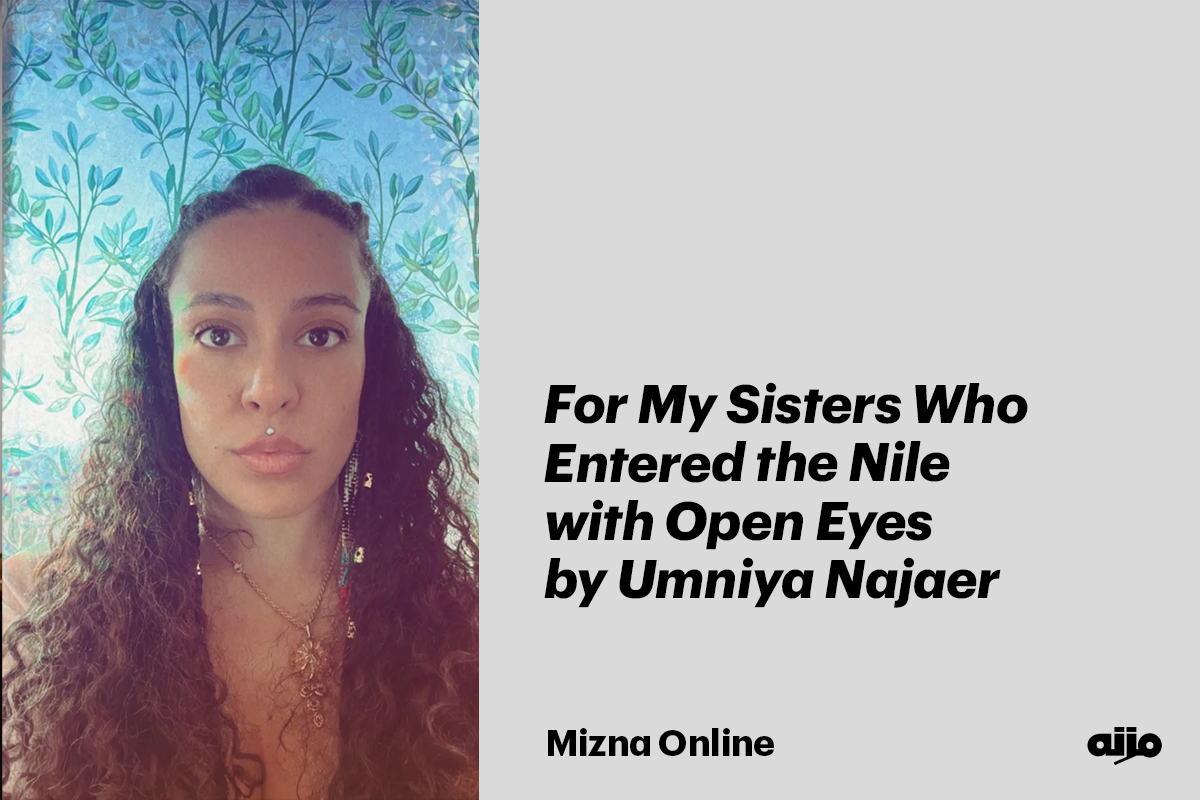
Sudanese author, scholar, and Mizna 25.2: Futurities contributor Umniya Najaer returns with a winding treatise tracing the vascular path of gender-based violence and genocide along the Sudanese Nile. As the counterrevolutionary war in Sudan nears its three-year mark, Najaer encourages readers to donate to the Sudan Solidarity Collective.
—Nour Eldin H., assistant editor
sister is the river cold?
—Umniya Najaer
for my sisters who entered the Nile with open eyes
In October 2024, activists from El Gezira state in Sudan reported that 130 women and girls committed suicide to escape rape by the RSF militia. The UAE-backed RSF militia notoriously uses militarized rape and gang rape as a weapon of war in Sudan’s counter-revolutionary proxy war. In two years, the war has claimed tens of thousands of lives, displaced 11 million people, exposed 24 million to starvation, and left 14 million children without access to education. Given the dire humanitarian crisis, precise figures of those who experienced sexual violence, and those who entered the Nile, cannot be confirmed.
clouds gather
beneath my ribs
a flock a mass a sit-in
of primordial seeds
ready to split
& drench
the earth
my heart is
a carved
hillside in
the kingdom
of ancient lutes
a river of doves
trills as my sisters
leap into the Nile
on the new moon’s eve
dew bejewels the patient
weeds with its trillion
g l i s t e n i n g e y e s
the Nile – having swallowed
& sunk so many daughters
at the dead-end of choice
the impossible verdict
to become
autonomous
sediment
&
u e c
n f n e
d
s
t i p
s r i
to
sever
life||body
my sisters
enter the
Nile and
journey
onwards
b l u s h i n g
t h e s k y
on route
to the
beyond
beyond
some
one’s
c h i l d
alive in
the breach
by foot
by field
by rain
by air
by sky
she
flees
the
men
only
to be
found
in the
verandah
overlooking
humanity
h e r h e a r t
a s m a l l
b i r d
a timeless sky
she scans the
e x p a n s e
for a sign of respite
a parcel of land
a branch to rest on
but the world
is landless
is water
&
sky
with
nowhere
left to go
not even a
wink of shade
for a sister
who weighs with
an ancient scale
death against rape
+/– spoiled harvests
+/– cholera
+/– thirst
+/– √ war
who was
the first
to plot
to enter
the Nile
limbs tied
to bricks
stones
logs
to weigh
the body
down
sister
is
the
river
cold?
who
was
the
first
to
stay
to
go
to ebb
to flow
sipping
river?
sister
who
will
you
let go
to enter
the Nile
with open
eyes to swallow
the unknown
to exhume
the w o r l d
b e y o n d
the world
of man
who is
l o s t
adrift be
wildered
& covered
in sky?
having
swallowed
too much life
the Earth is melancholic
for the time before nations
beforekingdoms, beforesongs – when
I hear you joined the brides of the Nile
the M e r m a i d s of K u s h as anchor in
the river of light in Africa’s open artery
it is as if we are one waterlogged body
in your absence I slip & fall & dent
the world’s nadir—this opaque
open field opens only
for those who
scoured
the
end
of
b
e
i
n
g
to
will
myself
back to
l if e
i become
a cicada
i crawl
like a
horse
gutt
ed
by
l
i
g
h
t
n
i
n
g
i
climb
into the
trees &
c r o o n
y o u r
names
s i s t e r
come
back
to
me
come
watch
how
the
sky
st
utt
ers
as
the
m
o
o
n
’s
fur
gets
caught
in twigs
come let us
adorn the soil
with our faces
and taste
the dust
sister
have
you ever
wondered if
s i s t e r s
a r e p o e m s
strewn along
the shore
of the world
& glazed
with a sheath
of dancing
cells?
cells like
stars do
not live long
their dance is mortal
whereas the wind is
e t e r n a l l y
f o r m l e s s
unlike the
dervish
& the martyr
light does not grow
weary of ceaseless voyage
whereas war returns
repeats itself
cloaked in
feathers
sipping
tea
war
chars
the
tran
sie
ent
world
but love
after death
begins a life
of its own
h a b i b t i
who absolves
the tune
of our
despair?
whom does
the shape of
our suffering
hold? will
anyone
remember
to remember
the light
in the seat
of your soul
galloped like
the meteors
who leapt from
their first homes?
are the stars like us
born of love?
born of violation?
born of shattered
c h i l d h o o d
life arrives
miniscule
tender
a heart
beat
eru
pts
w e
blink
& we
flicker
w e
l i v e
a little
before
vanishing
s i s t e r
can the story
of our species be
transcribed into
an alphabet of
twinkling
lights?
the rocks
the moths
the tyrants
each with
an undercoat
of synapses
this interior sky
of expiring substance
habibiti is it true
everything is forgotten
only to be repeated again?
is it true humanity
departs the echo
chamber of
blood only
to forget
when
we are
where
we are
who is
asleep
& who
if anyone
is awake
as the cold
night unfurls &
the hibiscus flowers
beside a dreaming
child anchored
to nothing
without
know
ledge
of death
where
does
the
spirit
go?

Umniya Najaer, Ph.D., is an interdisciplinary poet, essayist and Black Studies scholar of Sudanese origin. She is serving as the Chancellor’s Postdoctoral Fellow at the University of Colorado Boulder for the 2025-26 academic year. Umniya’s writing is invested in activating the human ability to feel what each other feels. Her work is guided by a profound reverence for our planetary home, a duty to protect all lifeforms, and a commitment to oppose all systems of dehumanization, brutality, and deathmaking.
Umniya’s recent publications include “Disarm Humanity: Meditations from the Third Decade of the Third Millenium,” “Dear Alice: for the Murder of {your} Bastard Child of the Starry-Eyed Tribe Born to Children,” and “Spinning: Zuihitsu Fragment on Ecological and Cosmic Consciousness.” Her poetry chapbook Armeika was published by Akashic Press as part of the First-Generation African Poets series. Her work has received support from the Cave Canem Foundation, the Sacatar Institute, Stanford VPGE’s Diversifying Academia Recruiting Excellence (DARE) Fellowship, the African American History Mellon Dissertation Fellowship at the Library Company of Philadelphia, the Advisory Council Dissertation Fellowship at the University of Pennsylvania’s McNeil Center for Early American Studies, the Susan Ford Dorsey Innovation in Africa Fellowship, among others.
Related
The Bringers of Violence
The Ineffable Resonance–Safia Elhillo interviews Charif Shanahan

#MiznaAtHome: Curated List for Keeping Up with SWANA Culture During Lockdown

Mizna Film Series Summer 2022: Joana Hadjithomas and Khalil Joreige Retrospective


