



June 19, 2026
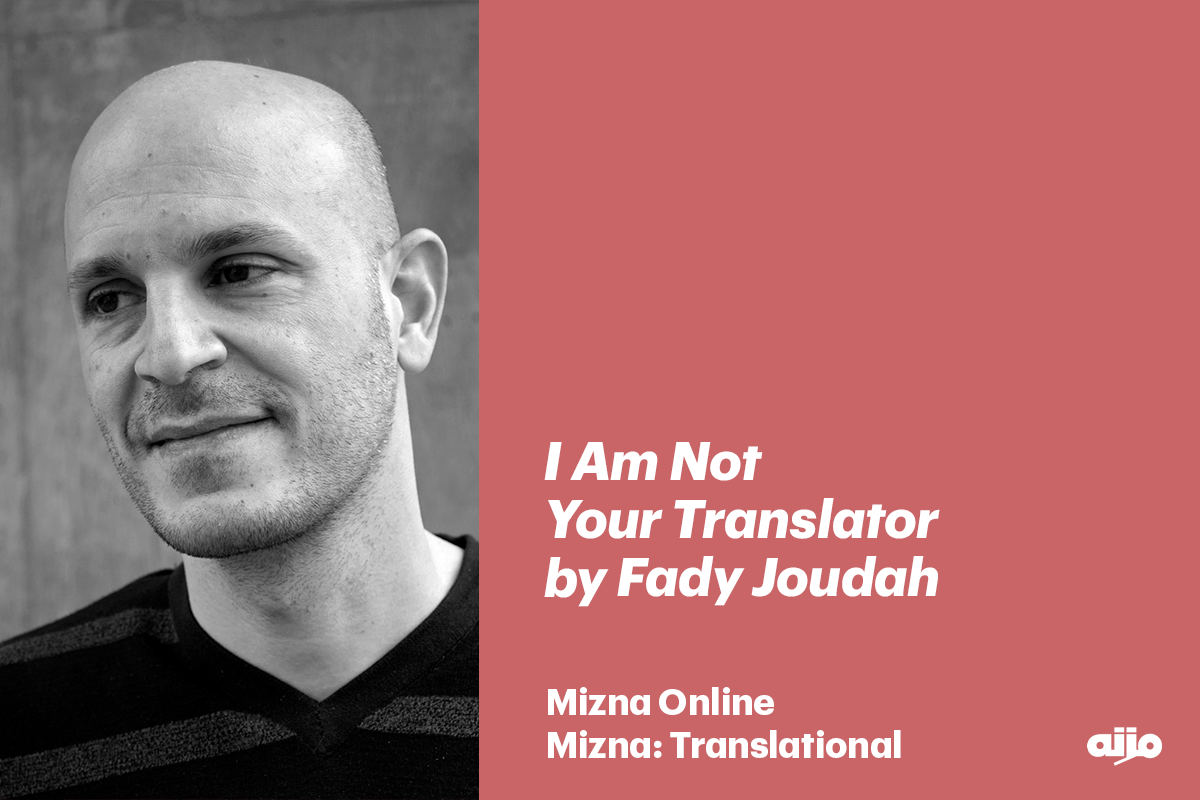
I Am Not Your Translator
Palestinian-American poet Fady Joudah, known for his own acclaimed poetry and for translating the poetry of Mahmoud Darwish, evokes James Baldwin in his wide-ranging investigation of the pleasures of translating and the simultaneous impossibility of protecting translation from reception in America that is often trivializing, exploitative, disingenuous, and otherwise harmful. This essay appears in Mizna 26.2: Translational, link here to purchase.
—Nour Eldin H., Managing Editor
Without the untranslatable the translatable is nonviable. The untranslatable, too, is a biologic imperative. At gene level, an intron is a noncoding sequence that indicates where the translatable sequence is. And the untranslatable is a cosmic imperative as well. The Arabic dark matter with which English light seems unwilling or incapable to imagine a willingness to interact.
—Fady Joudah
“Something was: My love for you. Something is: You see me.
And something that won’t be: To know me as knowledge ever.”
—Al-Niffari
For Khaled Mattawa
1.1
Love for the created precedes the beloved’s creation. Creation itself begins as a translation of the creator’s love. Translation is life. If we can agree on life we will agree on translation as cosmic and biologic imperatives. The biologic imperative, for example, that turns genes into functional proteins without which the body is impossible.
Translation: the transformation of recurrence, the creation of recreation and the recreation of creation. The travel from subconsciousness to consciousness and back, carrying and dropping loads of silence and speech within a single language as among several—between memory and forgetting, regathering and scattering. Translation is life. Bartleby and the copycat: When Bartleby started on his path of refusal to transcribe documents, he became a translator of his life. Through the untranslatable he realized his life. Translation encompasses every authorial act and each sovereign one: the translatable and untranslatable, the translated and untranslated, the chiasma of them, what precedes and what follows origin.
2.1
When we say translation, however, we often limit our intention to translation’s most literal, replicative sense: the transfer of the basic units of language, oral and written, the mirroring of coding and decoding elements between two (or more) sets of alphabets or signs. The mirroring is reduced to functionality, expediency, utility, transaction, polity. Removed from originality, and disingenuously revered for this transcendent modesty, translation as such is neither art nor scholarship—the former free of citation, the latter full of it, each in pursuit of “original” synthesis. Translation’s corpus is too exposed to the source, its immediate creator. To the voracious, imperious, commodified American reader, translation is detained as architecture toward thinking, ersatz of the love that precedes the original, authorized zone in which little may be owned or usurped. A translator is a follower who gets in the way of the commodified reader’s unstoppable drive toward the definitive source.
2.2
How many American writers begin as commodified readers is neither a negligible amount nor possible to ascertain. The mythos of the American century is that it is self-made, and so America insists on making another century its property. In the duration, American letters have increasingly encountered non-American (and non-Western European) letters principally through the lens of the political. Through the capital of projective identification, a pitiful reversal, America imposes the political on non-American letters to cast the dubious shadow off itself. This is less a debate about true or false shadows and more a dialectic of hierarchical ethics. Whoever possesses art free of politics is a true creator, an evolved species. The constructed dispute measures interior reality against an exterior one. The former is closer to a universal ideal, the latter much less so. Ironically the interior dreamland conscripts itself in the service of destructive politics that affects non-American lives.
Domestic or otherwise, no literature outside “tradition” can become American without passing through this opaque lens of the political. A lens manufactured to deny those it will eventually accept after they have convinced the manufacturer that they have become superior products. The American migration inward demands an exterior whose purpose is to affirm the authenticity of American metamorphosis. On occasion, American culture faces fierce adversaries who, despite defeat, still manage to arouse the nobility of American Catullus. This changes American culture’s dynamic toward the literature of the indomitable foe who has proven their worth through power. There is no one example that fits all, of course. There’s more than one way a foe’s literature can be deferred to, learned from, adopted as American, then hailed as eternal. But mostly enemies of America are quashed. At best, their letters are permitted initial entry through a comparative Sisyphean existentialism that, while potentially heroic, is imitative, incompletely developed, straining toward relevant originality. These vanquished contestants also come in different sizes, local and foreign. All are a translation in which love is suspect and must declare itself believable to English.
3.1
Whether artist, scholar, or translator, the Arab in English is a translation. So what is a career in translation from Arabic into English? Despite the necessary lamentations of how little translated literature is published in English, we can say that translators from Arabic are governed by the framework of the empire that classifies them—so that America can continue to be America to itself and others. The Arab in translation neither disappears nor arbitrates presence. It is ridiculous to think of Arabic writers in English (through translation or not) and not think of a vastly asymmetric power field. In English, Arabic becomes aura or phantom, apparent to the senses without a body it can call its own. Translation, then, is employed as a liminality in amber, a field where the Arab anglophone is dominated, their existence regulated, set off against itself in a taxonomy of nearness and distance: the Arab who writes in Arabic, the translator, the Arab who writes in English, the modifications thereof. Through various American institutional structures, translation of the Arab and Arabic certifies the NGO-ization of literature.
3.2
Translation for me is a freedom, not cultural bridge, not activism, not message, and not performative democracy of rights and representation. In translation, I refuse to attain my oneness. My autonomy is dendritic. The pleasure of being inside language returns me to childhood, playing camping with bedsheets in my bedroom alone, with sibling or friend, founding a world that radiates magic into synaptic clefts. My brain yearns for the song of language, a soul music that translation offers more readily than the exaggerated drama of originality might. In translation I am free of the market of visibility, the game of iconization, anti-capitalist generosity, entrepreneurial philanthropy, immigrant brilliance, or the delusional singularity of art. As mathematics mother the sciences, translation mothers art. As mathematics translates the universe and computation interprets a neural matrix, language translates the reckoning.
But for English, translation of Arabic literature is invariably less art and more what passes for art—passing as a developmental stage that Arabic literature inhabits in translation today, a stage in which art moves tragically toward a unified theory of control that explains the plural world in English. Art is the potential possession of the original author who writes in Arabic. American English is, then, free to issue its verdict on Arabic, the Arab author, and translator through the national monolingual. The original Arabic author might already be bona fide in Arabic or might possess certain passing qualities that would allow their work to be well-received in English. Between patronizing awe and the literary politics of compassion, inclusion, and solidarity, those passing qualities can be ideated, imposed on the work in Arabic so that English may operate its judgment on the work. But a poverty of such qualities guarantees cold reception in English because a crucial reference guide would be lost to English. Literary criticism in English and its legions of lesions can’t surrender to the idea of a different aesthetic in Arabic without the impulse to dissect its flaws, its factory seconds. Does the original Arabic author have a reasonable bond with English (French, German) through higher education, fortune, misfortune, migration? This might indicate how the original work in Arabic echoes the parlance of English aesthetics (and its associative web), a resonance of the universal as determined by an American culture that assemblies the articles for the universal (and, in the same breath, insists against their absolutism in favor of open-ended individuation and innovation). Meanwhile, in American English an author’s first book can win a grand imperial prize that travels the world in translation because genius and restitution in empire are real, backed by precedence and objectivity.
4.1
If James Baldwin were writing today he would ask different questions than those he asked when he was alive. I imagine Baldwin writing about what would not endear him to the warriors of safe illuminations. I imagine him without a jackpot still. He might ask America why originality is an obsession of encephalopathic proportions. How did originality come to wear the mask of imperial nationalism? How much of the game of power has got into our heads to get what’s ours and call it love? Why do we need art as cover for ingenuity as cover for domination in the pursuit of the imperfect dream that is American multiculturalism? What is it about America, in all its swaths, that wants to make the world it touches in its image, its various images, a cornucopia of one? I imagine Baldwin questioning the moral narcissism of victims within empire who are, too many of them, imperial agents, exporters of guiding lights. No jackpot for those kinds of questions. I imagine Baldwin asking America, in all its fashions of resistance—asking without denial of persistent injustice and without posturing over its pyramids—if America understands its voracious, destructive desire to keep the Arab (and Muslim) as translators of America so that both sin and forgiveness arise from and return to America: Why do you need the Arab to translate your barbarism, your consensus, your insuppressible quest for righteousness and progress, your radicalism and revolution, your fascism and reparation, your saviorhood and genocide, your revolving shame that whirls everyone in it, accuses everyone of it, your triumphs over the dark, pyrrhic they may be but always worth the price of the ticket, your terror and anti-terror, your ancient diseases and civilizational ones, autoimmunity and immunosuppression, your new expanding cuisine and cemeteries, your best of humanity and the worst of it? All this you want the Arab to mime and ventriloquize of their free will. They bring you their grief and imitation so that you process and emit your light.
5.1
It is charming how in the constructed Western canon Homer and Shakespeare escape the throes of contested authorship and go on to father originality, the dawn of us and the new dawn, the old human, the modern one, and their overlap district. Cervantes’s insistence that Don Quixote’s original author was the metafictional Arabic Muslim historian Cide Hamet Benengeli was also metahistorical. One Thousand and One Nights is authorless, Arabic, and not.
Invisibility and translation are, by now, the hackneyed twins in our commercial existence, a false humility among the many that the art world requires. A marketable addiction. If there is a translator there must be an original. The original owns rights to visibility through the authorized version that the skilled labor of the copyist provides. The skilled labor is suppressed because the conversation with originality is not really a conversation with art but with power over art.
Of course, reverence for and iconization of a translator do occur: when the quality, excellence, fame of the original work, or the celebrity of the original author are validated in English (by English, French, German, etc.). This validation is nearly always archaeologic. The excavation tools don’t belong in Arabic hands even if on occasion they are in Arabic hands. Arabic texts are more profound when detected and transformed by a native Anglophone. The original work becomes a resident alien on the path to citizenship in a preexisting English parliament of innovation, a parliament sated with foundational past but as the cosmos it finds inexhaustible ways to lead us toward unflagging expansion. And so it is that the important offer I author is the important author I offer. Whether the I is the author or the offer, it is the motto of the Arab writer in English.
Does the author of this substance display or affirm certain principles in text and context of English’s superiority over Arabic? Does the translated work provide English with alibis for stereotypes of the Arab that kiss the Arab on one cheek and slap them on the other? Or perhaps the translated Arab manages to highlight our shared humanity, a breakthrough in which the vanquished appeal (intentionally or otherwise) to the better angels of our nature, and we are delighted to see that our vanquished are capable of immanence. This kind of contribution through translation translates America to itself and imposes the product on its vanquished. Progressively more Arab anglophones today understand themselves mostly through English. The force of it is inescapable. Whether native to English or not, “heritage” Arab American or fresh out of airport customs, the Arab must convert themselves into one or several of the properly plural Arab versions available to the American psyche in compartmental form. For example, the Arab in English, by virtue of being Arab, can’t be queer to English, transgressive to the American vernacular’s norms and inevitabilities, unless actually queer.
5.2
To American English, the Arab (and Muslim) is always a translator on the governmental General Schedule (GS) paygrade: as expendable interpreter to the US military (or a cherished one to be saved), as vector of betrayal, a messenger of incoherence, a prisoner of torture, a convict of love, a victim of their own backwardness, an intelligence officer, a native informant draped in flag, an equal American, a pioneering one, a birth certificate, a doppler effect, a thermostat of color, a valued voter with or without ancestral evidence in the land, an intellectual ensconced in the “here-I-am-I-am-not” writing an essay on the dual nominative case in Arabic, which is still in use though not in colloquial Arabic, yet an example of Arabic’s inherent openness to the nonbinary, a futurism Arabs will eventually reach, or return to, since Arabic possesses the necessary tools, a beautiful past, and that’s 50 percent of the problem solved.
The means are available and transparent for the Arab translator from the Arabic to accumulate cultural currency in English, the host language, the language of the place that has been relentlessly destroying Arabs and Arabic for half a century at the very least. (Is that enough time? Enough time for what?) There is a difference between translating or writing into a lingua franca and into the language of the place that dominates you, occupies you, colonizes you, aids your colonizer, your collaborators and national bourgeoisie, arms your destruction, and sprinkles the glitter of disgrace over you for your moral deficiencies so that intellectual integrity is maintained around the spaces that purvey the violence. We know that the “savagery” of colonized people in previous centuries is now a morally bankrupt argument (or, when thinly veiled, fiercely contested) to have ever justified a people’s subjugation in English (or French, etc.). Not so for Arabs. The Arab complicates the question of the colonized in a postcolonial gala. The Arab has become recolonized, directly and indirectly, not merely occupied. The postcolonial pseudo-sovereign state (with its local actors) has taken up the role of the national bourgeoisie of the anticolonial struggle. The Arab as a colonized subject of the new American is yet to be acknowledged in plain English. The Arab in American English is a particular form of national, patriotic disorder. Its precedence is not domestic or hemispheric, and its foreignness not solely that of distant wars. The Arab lingers in Western time between policy and essence. The search for a diagnosis is coupled with abeyance. The clinical remains capital. The Arab remains a translation irrespective of their authorial role. English tells us who the more authentic Arab is. The rules are not clear but the jury is.
5.3
Authentication of stereotype and belonging and management of narrative and identity also subjugate so-called original writing in English by Arab Americans. Authenticity is translatability. And translatability’s alibi is mutability. What is untranslatable today is translatable tomorrow, and tomorrow always comes—as if tomorrow is unheralded, ungoverned by the past that polishes constituent stones into the future—a past that barrels toward tomorrow more rapidly than the present does. The translatable is not a matter of technical difficulty, equivalency, fidelity, or dislocation overcome, but of political and cultural hegemony reified.
Is it really difficult to imagine that an Arab writer inhabits an untranslatable zone in English, an art form that English doesn’t easily accept coming from an Arab? Which English? Is an Arab translator from the Arabic the same as a non-Arab one? Which Arab and non-Arab? What if the Arab translator is an American novelist or poet, man or woman? What about those who think in Arabic and write in (or through) English (French or German)? Do they destabilize authenticity and originality for the literary thought police? Is a Palestinian who knows Hebrew the same as one who doesn’t? Whether ‘tis nobler in the mind to suffer the slings and arrows of outrageous statements or to take arms against a sea of nuance in which all opposition drown in the conformity of blue. Not all waves are similar, not all water bodies are seas. The hope, then, is in a humanist kumbaya where a majority of translators from the Arabic form a small country whose range of the similar and dissimilar mirrors the acceptable, lauded pool of biodiversity that exists in English. Which English? There are many Englishes. Does one then translate from Arabic into a specific kind of English? The Queen’s English or the postcolonial nation-state English? The liberation must be liberalized.
There are also many Arabics. And not because Arabic’s diverse speakers are defeated, semi-literate, or because there was once a civilizational umbilical cord that got cut off and is screaming to be reconnected, a reboot dependent on the electricity of translation. To translate Arabic into English is to remain close to the translatable, official state English in its myriad grandeur, a messy democratic unity that maintains Arabic as a foreign lexicon, a medieval archive, a wounded tectonic plate into now, an observable spacetime.
6.1
The anguish of non-belonging is not necessarily a desire to belong. But as translator, as being in translation, the Arab American feels compelled to comply with the translatable in America. Even “subversive” and experimental writing, “leftist” and iconoclastic thought exhibit compliance with the great American translatable. The Arab American navigates the American vernacular in which they exist as echoes, mimes and memes of beauty, myth, identity politics, etc. Judgment is passed on the quality of the English as American literature and on the veracity of the voice as American. Which American? Debates erupt. Careers are made. Clones are stamped. But the Arab is restricted from imagining a relationship between Arabic and English through the untranslatable. The shrew is tamed at the outset.
Without the untranslatable the translatable is nonviable. The untranslatable, too, is a biologic imperative. At gene level, an intron is a noncoding sequence that indicates where the translatable sequence is. And the untranslatable is a cosmic imperative as well. The Arabic dark matter with which English light seems unwilling to interact. For this Arabic darkness to be optical or corporeal in America, historical changes are required—more so in the domestic, imperial US than in the Arab world. American English can’t, for example, interact with Arabic when the latter fluidly moves between the vernaculars of Judaism, Christianity, and Islam in a literary text. Not only is English light unable to engage (in detectable manner) with Islamic references in such texts but English light is also incapable of reading Arabic in translation with non-sectarian ease. It is important for English that the Arabic text point to the sectarian and the secular in their English manifestation. This and other confirmation biases become the specters and reverberations English sees, hears, and feels in almost every Arabic text or author in translation or not. What claims itself as light passes through the untranslatable as if through nothingness. If nothingness becomes energy with any gravitational force, it will be received in English as an exception likely to be acclaimed for its liberated achievement, an honor American English bestows on itself with a cycle of commemorative events and publicity festivals.
It matters not whether Iraq is restored to its people (which people?) fifty years from now. What matters is that American culture shifts between now and then to accept variable and viable Iraqi voices that won’t feed America the language America currently desires its vanquished to speak. America is capable of the magnanimous and the fair. It matters not whether Korea will ever be reunified. It matters that America is ready to listen to what Korean literature has to offer unequivocally, unapologetically, as war literature, anti-imperial art, a border zone that asserts its interiority, a barzakh. Did Vietnamese American literature reach translatability after decades of absenting and erasure? Which Vietnam? Did white American English learn to read Black American literature before or after incorporating the semiotics of Black music? Did Jazz help to translate Black writing to the mind of the American canon? The untranslatable Arab to the American sense is a classified existence waiting to be declassified. Audition before vision. The Arab American must first be translated into culture before they can become art.
6.2
Let’s assume that an Arab anglophone writer can be promoted to any of the fifteen GS levels on the paygrade in the US. Does this mean that an Arab American writer can be an authentic American writer if the Arab American is also a translator? What if they are a painter or visual artist, practitioners in two mediums? Would their work in one medium elevate the other? Does an Arab American writer stand a better chance of becoming a bona fide American author if their relationship to Arabic is notably distant from or inferior to their relationship to English? And to what extent is the Arab American writer a watchdog of America’s translatability of the Arab?
Let’s look again at the distinction between translator and writer in its reflexive garb. Under the canopy of writing there are those who write original work and those who write unoriginal work that is original in a language other than the one they write in. A bona fide American writer can be original in both forms of writing much more than an Arab American writer can be in either. The definition of bona fide can’t be articulated but, as with art, is categorically recognized when encountered. And as with untranslatability, the amorphous definition of “bona fide” is subject to change via a mysterious coefficient in an equation that solves for history and time.
The lives of American originality enjoy “deathless historical fame”—from translating the self as original to copying the self and remaining original. Not so the Arab. How can an Arab American writer be better than a bona fide American writer—not in one but two languages? Is that allowed? Are there dues to be paid? Exceptions to the rule enforce the rule. An Arab American writer with remarkable fluency in Arabic and English is suspect. They can’t be authentic enough as writers in Arabic since they write in English while translating from Arabic, and can’t be authentic American writers since their relationship to another non-European language (from the Isles to the Urals?) is too strong.
6.3
If this sounds absurd, it’s because it is. But absurdity does not make it less real. Code switching isn’t unique to the Arab American condition, but the Arab American lacks an indigeneity factor or national originator value in sufficient numbers, voltage, or volta that most other American communities retain under one heading or another. Establishing “essence” for the Arab American, however, is underway through various customary standards and practices that insist on their eventual success. Any objection that could be raised to this possibility vis-à-vis the Arab (and their melting Muslim American pot) is deemed, ironically, un-American.
For an American writer to have natural or native command of Arabic is troubled waters for English. The American obsession with surveillance, traceability, root, and loyalty extend to language and art. In the case of the dual nominative Arab American poet-translator, prose-stylist-artist, etc., the work of translation as indicator of their living experience with Arabic clarifies their stage of belonging. The more translation is part of their curriculum vitae, the more translation ratifies the extent of their American identity in maturation, in keeping with the immigrant model or the assimilation of the vanquished.
This positivistic traceability also finds expression in self-translation wherein the writer literally translates their texts from Arabic into English or inhabits a space that lends their work to the machinery of translation more readily. A genealogy of this phenomenon is well-established for the Arab anglophone writer one century into the next.
6.4
Through locality language enfolds within its cortex a primordial fear of the self losing itself if it abandons its idea of origin. The mind twins the preservation of self to language. This fear, in turn, authenticates locality. For most people the cycle is insurmountable, existential. The tangential velocity needed to escape it is tremendous. But an Arab American writer fluent in Arabic and English lives, experiences, and corresponds with transformation in almost everything they write or create. The artistic work of the bilingual and bicultural Arab American contains and is reconciled with the untraceable, untranslatable in English, a Quixotic origin perhaps. American literary systems are uncomfortable with illocality: the unmarked territory where Arabic begins and English ends or vice versa. This trans-directionality can’t be readily subjected to examination or to antecedent literary modes or cultural conversion in English. How can the system speak to the aesthetic quality of an art that the system does not know how to speak? An insult looms and must be projected elsewhere. If such art, however, can be traced more easily into a humanist tradition in which English maintains paranoiac control over its author, provided that the author furnishes English with a clarity it requires, a philosophical or metaphysical wisdom, a form of universal arrival or departure, then all is well that ends well.
For each emotion the Arab American might aesthetically and intellectually demonstrate there’s a response chart that categorizes it according to American historical experience with might. What emotional range does this essay exhibit? The defensiveness of the weak. The rant of the conquered. The naivete of the innocent. The barbed wire of grievance. The totalitarian grief. The predictable propagandist. Art in the service of alphabet and not an alphabet in the service of art. Is there room for comedy? Is there such a thing as Aranglish or Arabizi, and what does the latter rhyme with?
7.1
What else have Arabs done in history besides translate? Though they did it superbly, some may say imperially, with adaptation, transfiguration, evolution. The Prophet Mohammad has been a heretic for centuries in English because he was the worst kind of translator—he translated the language of God that had been already translated. The Arabs tried to play Greek but were no Greeks. As for zero, the Arabs translated it into time, but what has zero done for us lately: ground zero and zero tolerance? To date, no translator from Arabic has been able to offer English what Ezra Pound offered it, or so the Arabist gatekeepers have written.
There’s a desire to offer solutions to the set of problems I have laid out. A reconciliation that honors the greater good that is art’s dream and domain. A wish that seeks to escape the comparative confines of Arabic in English. I can say many things about the semiotics of love that Arabic has developed into epistemology and ontology over the centuries. But ask me again and my answer will remain that I prefer not to show the papers of the love I possess and the love that possesses me. In which language? It’s strange how love becomes an exteriority to the lens of the political before love is allowed passage to the interior. Something was: my love for you. Love’s triumph is my gladdest defeat. And it is always my most interior ethic.
1.1
Go back to a beginning. Say that everything is translation but not all translation is created equal or don’t say that last part. Be a translation that precedes the untranslatable, the singularity state so extreme and dense whose time was once one, but since space came into the fold, time’s been splitting. A translation closest to singularity remains closer to translation (to life) than to singularity. Be the distance that obliterates nearness and the nearness that is the greatest distance, point and infinity. Translation the chirality, the isomerism, the isotope, the epiphyte, the mycelia, the raceme. The blackbody of light becoming glow. Translation the “metaphor for metaphor,” two hearts in one chest so that one language has mass and the other is gravity-free, and when one is particle the other is gravity. Does language have mass? Translation as action freed from action. Translation “the silence that remains” and the silence that doesn’t. Translation as the two silences, the silence of the tongue and the silence of the heart, and “whether you keep silent or make an utterance, you speak.” Translation the barzakh that is “the mind’s grave and the graves of things.” Translation the “perfect technical immanence.” Translation and origin as particle and antiparticle annihilating themselves. If there’s a beginning, there’s an end. If you can’t return to the beginning, can you imagine the end? Why imagine an end? It’s already there. I am not your translator.

Fady Joudah is the author of […]. He has also published six collections of poems: The Earth in the Attic; Alight; Textu, a book-long sequence of short poems whose meter is based on cellphone character count; Footnotes in the Order of Disappearance; and Tethered to Stars. He has translated several collections of poetry from the Arabic and is the co-editor and co-founder of the Etel Adnan Poetry Prize. Winner of the Yale Younger Poets Prize, he has received the Jackson Poetry Prize, a PEN award, a Banipal/Times Literary Supplement prize from the UK, the Griffin Poetry Prize, a Guggenheim Fellowship, Arab American Book Award, the Lenore Marshall Prize, and the American Book Award. He lives in Houston, with his wife and kids, where he practices internal medicine.
Related
The Bringers of Violence
Call for Submissions: Mizna 2021 Summer Issue
2023 Annual Report
Mizna Presents: National Poetry Month Prompts