



July 15, 2026
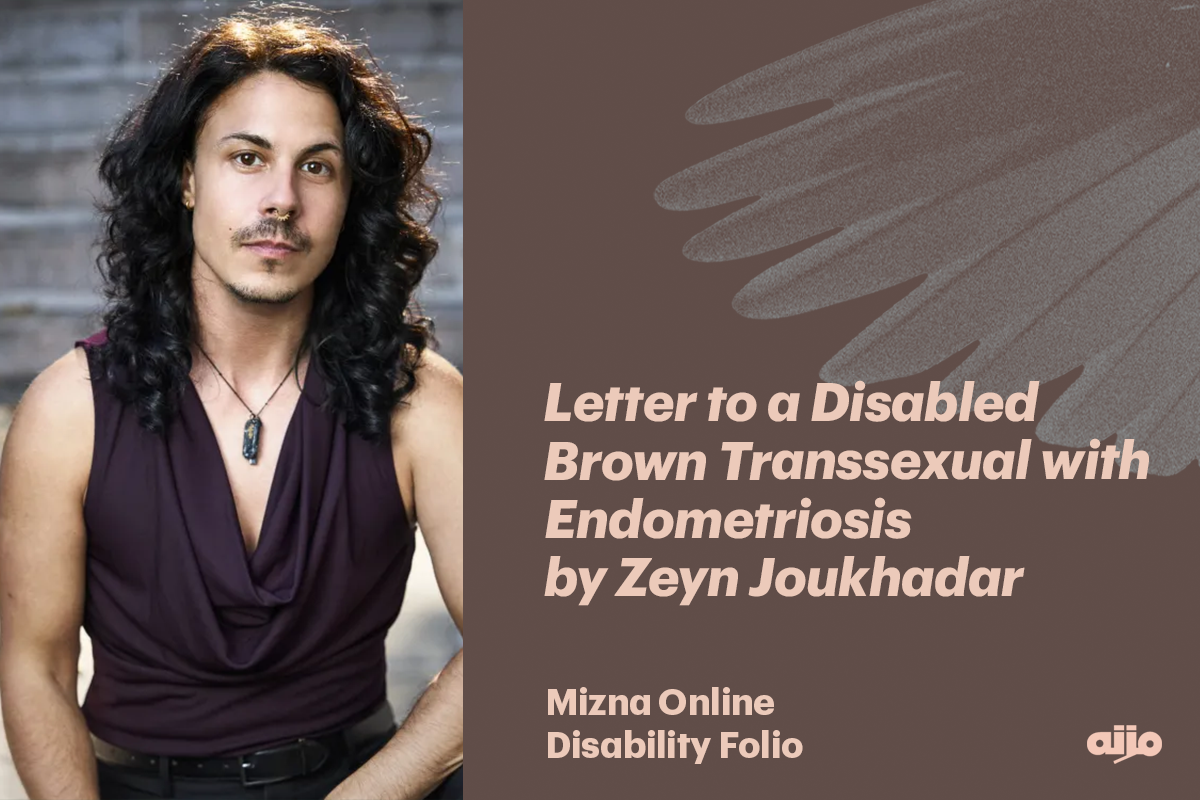
Letter to a Disabled Brown Transsexual with Endometriosis
This essay is part of the Mizna Online Disability Folio. We encourage you to read other works in this digital curation.
My anger, like my brown, trans, gender-nonconforming, disabled body, is obscene. Unsightly.
—Zeyn Joukhadar
Letter to a Disabled Brown Transsexual with Endometriosis
Ever get the feeling you’re playing some vast and useless game whose goal you don’t know and whose rules you can’t remember? Ever get the fierce desire to quit, to resign, to forfeit, only to discover there’s no umpire, no referee, no regulator to whom you can announce your capitulation? Ever get the vague dread that while you have no choice but to play the game, you can’t win it, can’t know the score, or who keeps it? Ever suspect that you don’t even know who your real opponent might be? Ever get mad over the obvious fact that the dice are loaded, the deck stacked, the table rigged, and the fix—in?
—McKenzie Wark, Gamer Theory
The scenario is complete when all enemies in it are dead.
—Frosthaven Scenario Book
Dear A,
You should’ve seen us. Three hours deep and thought we’d beat the worst of it. Six lurker crabs, four ice wraiths, and three zombie-yetis, and still one room to go. I was down to my last two ability cards. You know how Frosthaven is: treasure’s always on the far side of the map, and what would be the fun if there was nothing between you and shiny-town?
The last abominable undead snowman had double our hit points. In one round, my Blinkblade was on the floor. Zefiro had to solo that fucker for half an hour, jabbing with the spear and retreating, hitting him with the javelin, and at that point we’ve ditched the damn treasure. Half an hour of my partner singing, We’re dead, that’s it, we’re dead. My little standee, knocked over across the room, giving orders: History’s not a foregone conclusion, my Blinkblade yells, knives in its cat-goblin lap. Sometimes you roll box cars.
I mean, sometimes you roll snake eyes, too.
My favorite part of Dragon Age: Inquisition was rolling a joint and getting lost in the Hinterlands for three Thedan days. I like setting up terrain tiles. I like spending whole afternoons on a scenario. I want a game I can live in. I want to watch myself being alive.
Every character I’ve ever made has been a self-insert. Even as a 32-bit sprite, when Irenicus tried to torture me into embodying the god of murder in Baldur’s Gate 2, it was my body he hung from his hooks. Long after we made it out of his dungeon, busy hunting vampires and delivering letters and sundry other side quests, I thought about how I’d invested my flesh in this story. How my twelve-year-old, force-femmed not-girl body was already prime real estate for violence.
Dragon Age: Origins came out not a decade later, but I only just played it this year. Did you ever play it, A, way back in 2009? Did you play a female city elf? Even as a kid, when I tried playing men, something was missing. A fundamental dimension was stripped from the world. Everyone was so unrealistically nice. Playing an elf in Dragon Age’s Thedas or a drow in Baldur’s Gate’s Faerûn put racism back into the world; playing a woman restored the misogyny. Without being suspect and constantly misgendered, the fantasy world rang false.
It could be that I can’t see myself in a character who hasn’t had to fight those forces. I’ve been headcanoning all kinds of things my whole life. If we’d known each other as kids, maybe I would have invited you over to play Tomb Raider 4 with my sister and me. Not knowing any better, I decided early on that my Lara was an Arab saving artifacts from the British. I used to clear the scorpions and crocodiles from the temples so my sister could do backflips into pools and leave the artifacts alone. I wonder, if you’d been there, if I would’ve had words for what I felt when it was time to Swiss cheese turbaned enemies with an Uzi or silence their gibberish with Lara’s Jeep. But you weren’t there, and I needed to obliterate those caricatures from the screen. Their bodies weren’t my body, not technically, not yet. I packed them with lead. Their corpses dissolved like rice paper in rain.
In DA:O, if you play as a female city elf, your wedding day is interrupted by a human nobleman whose cronies abduct and rape the women attending the wedding, including your best friend Shianni. The game spares you, though there’s enough ambiguity that it’s possible to imagine otherwise. On waking with the other women at the nobleman’s estate, you steal a weapon and fight your way through to rescue Shianni. You’re too late. The nobleman tries to bribe you into letting him keep Shianni for his entertainment. I introduce his neck to my blade.
Sexual violence is about power, not sex. The writers of DA:O must have been aware of this. Violence—when critically woven into a narrative; when considered from the perspective of the marginalized who are most exposed to it; when trauma and its afterlife are taken into consideration; when traumatized characters are more than pitiable props for the character development of a (cis male, unviolated) protagonist—can teach the player about the world. Shianni’s and the protagonist’s rape reveals who the marginalized peoples in Thedas are, how the history of their oppression shapes the structure of the city, and allows the player to choose how to react to a violent and unjust world. I like DA:O’s female city elf origin story because the game allows you to express anger at the injustice it depicts.
Is a text structured by anger—splintered by rage, enervated by wrath, the kind of text I might write—a lesser text? I’ve been asking myself this for the past seven years while at work on my third novel. I’ve been told rage strips the reader of the ability to feel for themselves, that anger is the enemy of good craft. I don’t think that’s the whole story. The rage of the oppressed is a problem not because of the anger itself but because of the complaint buried within. Anger is the muscle of hope, a reminder we deserve better. This is why the ruling class beats students, why Israeli soldiers target maternity care centers and murder Palestinian children1, why right-wing politicians take away life-saving gender-affirming care from trans youth and adults, why the transphobic hate group Sex Matters wrote in response to a proposed trial for puberty blockers: “[Transitioning] ceases to be a desirable goal to present to children when they will never be permitted to use spaces or services for the opposite sex, and may in future be restricted in employment… it becomes a major, permanent social problem for those young people, since their future lives and freedoms will be seriously curtailed.”2
Without hope, anger makes no sense. The corollary seems equally true: to destroy a person’s hope, you must first kill their rage.
A, I spent years paving a track over my anger. I peeled my rage like a hardboiled egg. “An animal within an animal,” Aretaeus of Cappadocia reportedly described the uterus. Galen said it “move[d] from one place to another like a wandering animal.”3 An angry or rebellious woman—and here you must imagine me, A, saying woman with poisoned sarcasm, knowing that this was the fate of many men and nonbinary people like you and me—could only be cured of such hysterics through marriage and reproduction. “[S]he cannot ever be relieved by any aid except that of her parents who are advised to find her a husband,” a physician wrote in 1637. “Having done so the man’s strong and vigorous intercourse alleviated the frenzy.”4
The patient’s consent, I imagine, was unnecessary. After all, that’s what they tell people like me now, too. That I’m just a confused little Arab girl who doesn’t know what’s good for me. You’ll pardon me, A, if my anger is venomous and inappropriate. Surely you’ve heard of all the porn channels that popped up during the American invasions of Iraq and Afghanistan, Tour of Booty and the like, the way grainy green clips from these videos occasionally made the rounds on the internet mistaken for actual military footage.
Porn, like games, can be an outlet for the processing of trauma. Many oppressed people’s psyches integrate our trauma by subsuming it into kink. I do not, however, believe that Tour of Booty was conceived for consumption by Arab or Muslim women and gender-oppressed people, just as I don’t think the Call of Duty franchise, as a blatant U.S. military recruitment and imperialist propaganda tool, is doing much of anything for players who look like the enemies they are tasked with obliterating. As McKenzie Wark writes in Gamer Theory, “Warfare, they say, now looks like video games. Well don’t kid yourself. War is a video game—for the military entertainment complex. To them it doesn’t matter what happens “on the ground.” The ground—the old-fashioned battlefield itself—is just a necessary externality to the game.”
I am under no illusions that my body, to the makers of games and porn such as these, is anything more than an object. My body is the battlefield, the land to be discovered and claimed, corrected, corralled, cultivated with the seed that was said to cure hysteria. The objectification of my brown transsexual body is enshrined in multiple laws, most of which do not even bother to name the fact that they are also about me even as they target me: anti-abortion laws and restrictions on reproductive healthcare; laws designed to render immigrants more vulnerable to deportation, incarceration, and death; laws targeting our identification documents and our access to public space by rendering it illegal for us to use a public bathroom.
And yet my disabled trans body is a fact. It leaves marks on the world that the world resents. Since I was ten, my hellish periods would stain the full thickness of a mattress. I had to get special permission from the school nurse to carry bottles of Tylenol and ibuprofen because only round-the-clock 800 mg doses would keep me vertical on days three through eight. On the first and second days of my period, I often missed school because I could not walk. I would writhe in bed sobbing in pain until I passed out. I was permanently anemic. At random times throughout the month, my belly would balloon into a distended basketball studded with flaming knives. Sometimes it still does. I was told this was part of the beauty of womanhood. I was told to take a Motrin and stop being dramatic.
A, I don’t have to explain the bathroom floor to you. I don’t have to explain the smell of the carpet on all fours, waiting for a contraction to pass. You’ve made rules for yourself as the pain creeps, little by little, into your hours. No exercising after lunch; no belts or tight waistbands; no going out at night; pants in the closet in four different sizes. You’ve been called a drug seeker and a hypochondriac. You’ve been told, like me, to keep a gratitude diary and eat more fiber. You’ve been fed the lie that pregnancy is a cure, maybe even been told your endometriosis is caused by your refusal to procreate. Maybe you, like me, have been told that you are sick because you are trans.
Testosterone was, in fact, the only thing that saved me—for a while. After my periods stopped, I had the best year of my life. I went running whenever I wanted. I ate chickpeas and broccoli. I went out at night. I wore slinky little black shirts and tight jeans.
And then, little by little—well, you know what I’m going to say. How the pain crept back in, month by month, day by day. How the good days got rarer and rarer. And then, one afternoon two summers ago, I went for a run and limped home like I was being gutted with a branding iron.
It’ll go away, I thought, pressing a heating pad to my second-trimester belly. It always does. But you know as well as I do that it didn’t.
For a disease purported to affect 10% of reproductive-age people assigned female at birth, there’s a pitiful lack of funding for endometriosis research, and we know very well why. As a former scientist, it still boggles my mind that, during my PhD research in reproductive epigenetics and toxicology, hardly any literature ever mentioned endo. The thing that makes me angry, though, is that science could only benefit from studying the presentation and progression of endometriosis in people who are not cis women, including people assigned male at birth. In cis men, for example, estrogen therapy has been associated with higher incidence of endometriosis, though this is not always the case. There is very little data on endometriosis in trans men and transmasculine people, and even less information on its incidence in trans women and transfeminine people on hormone-replacement therapy, which would, in theory, increase their risk for developing endo. We haven’t even touched on the impact of race on studies of endometriosis: Black women, for example, are 50% less likely to be diagnosed5 with endo than white women, and times to diagnosis are often even longer than the average 8-to-12 years people with the disease wait to be diagnosed. Endo research and care, when it even exists, is often focused to a pathological degree on reproductive outcomes and even how attractive patients are judged to be,6 rather than the alleviation of pain or the quality of life of people with this disease.
Even so, the little endometriosis data out there on trans men has the potential to vastly expand our knowledge of the disease, but it seems few clinicians and researchers are paying attention. Anecdotal evidence shows that trans people on testosterone often experience some relief from endo symptoms, possibly via the down-regulation of estrogen, which, in turn, limits the progression of the disease. Vallée et al7 found that 22% of men who underwent hysterectomy with no history of pelvic pain had endometriosis, vs. 32% of men who did have pain—a huge percentage, much higher than the oft-quoted 10% figure. Considering that studies on endometriosis tend to only capture people with sufficiently severe symptoms and the financial means to get a diagnosis, or people getting hysterectomies for other reasons (skewed, once again, in favor of higher socioeconomic status and thus also white and cisgender subjects), the disease’s prevalence may be much higher than we’ve been led to believe. Transphobia, as always, makes for bad science.
Yet you and I both know, A, that none of this captures how it feels to call an endometriosis specialist and be told, “We don’t treat people like you.” To be told to see an andrologist as a precondition of surgery because even a young gynecological surgeon has never considered your existence. To be denied the surgery you need because a Catholic hospital “cannot assist in your transition” and “we wouldn’t normally sterilize a woman your age.” To find out your organs have been stuck together for years, maybe decades, and then have the gyno shake your hand and say with a smile, “You make a good looking man. If I wasn’t married, I might have asked you out.”
The years I spent hunting a diagnosis, the months I spent in the worst pain of my life—maybe it felt a little like a game. I tried to stay upbeat by failing forward. In Disco Elysium, failed rolls present you with more unconventional pathways, sometimes more interesting ones than if you succeed: a failed roll to pull off a pickup line, say—a deservedly humiliating fumble—will earn you info you can use to interrogate a suspect later on. In my own life, failing forward meant crossing a doctor or a test off my list and telling myself that was information too. I told myself failing forward was a craft technique, that what initially seems like failure often leads you down more interesting linguistic alleys. The only way to forge the tool you need is to find the place your other tools fail.
But it’s not that simple. Our continued existence represents the failure to eradicate us, so every round we continue to live, we must endure a penalty. A permanent debuff, a kind of curse or stat loss, and we both know how much players hate that. We all want to believe success can be earned, that failure is a skill issue. But I’ve played The Wretched and Endurance, and I know that sometimes, it doesn’t matter how good your strategy is. Sometimes, it comes down to what you roll.
Of course, some of us enjoy punishment. I like a good roguelike every now and again. Some of us even remember when that was the norm: slot a quarter if you want another shot at victory. Even if I get dismembered by the Crow Mauler and respawn at the entrance to the dungeon, the horrors of Fear and Hunger can be anticipated. The trauma is rule-abiding. Random cruelties just feel unfair; an able-bodied player, surely, would look at a disability that can’t be “overcome” by leveling as pointless suffering.
You and me, we get it, though. To be trans, Arab, and disabled is to play on nightmare mode. We’re used to permanent debuffs, unsalvable pain, and predation by invincible foes. We know natural order is just a euphemism for body horror. Some of us know we live because we are, as Jasbir Puar writes,8 “designat[ed] available for injury.”
A, I don’t have to tell you that we live in a time of mass-disabling events. Long COVID continues to impact millions of people even as many speak of the pandemic in past-tense. Studies have found that people with endometriosis are at greater risk of developing long COVID.9 In Sudan, where the RSF has displaced millions of people, disabled people have been strapped down on top of vans with luggage10 or left to crawl on the ground. In Gaza, an average of more than 10 children per day11 lose one or both their legs. Israel’s genocide has left, at a minimum, tens of thousands of Palestinians with disabling injuries and targeted the infrastructure that might care for them, a cruelty epitomized by the brutal assault on Al Shifa hospital and a 2026 policy allowing only fifty patients per day12 to leave Gaza to seek care, effectively condemning tens of thousands to death. Israeli snipers boast13 about shooting to maim, targeting civilians’ knees and legs. According to the UN Independent Commission of Inquiry on the 2018 Gaza protests, this was already happening well before the current escalation of the genocide, with 82% of Palestinian protestors hit in their lower limbs. During the First Intifada, then-defense minister Yitzhak Rabin14 ordered the Israeli army to ‘break the bones’15 of Palestinians. You must know as well as I do that Neil Druckmann, creator of The Last of Us, explicitly named genocidal Israeli politics as part of its inspiration, particularly for Part II.16
And that’s the thing. As writers, we know that choosing colonialism as your mode of engine building and employing Black metaphor in the design of your antagonists are craft decisions. We know who the zombies and the monsters are supposed to be. We know what our lives and bodies are supposed to represent in the “natural order” of the world: the specter of death. Even for many people who purport to give a shit about us, racialized trans people are walking memento mori. Our suffering is so foregone a conclusion that pleas for material allyship, even when made to cis people of color, are as often met by accusations of horizontal violence as they are by uncomfortable silence.
If craft is the set of rules under which artists can make our demands and our complaints, and if craft is also, as Fargo Tbakhi writes,17 “the result of market and imperial forces … the process by which our own real liberatory tools are dulled, confiscated, and replaced… [the thing] that keeps us polite while the boot is on our neck or on somebody else’s,” then we can’t be surprised that our demands, our complaints, our pain are judged just as our bodies are: as monstrous, unruly noise. Anger is heavy, and when I say heavy I mean it both personally and structurally. In art and literature, structural approaches must be found to relieve some of the pressure anger places upon a work. Western, white narratives of what makes “good” literature require that anger be drained from a work to render it acceptable. A text must be hung from its hooves and bled before white cis men will deem it literature. Perhaps this is why anger, for me, is the place where language fails.
Yet you and I, A, when we talk about Assad’s prisons, or the Israeli bombings of hospitals in Gaza and tents in southern Beirut; when we talk about the people forced to walk thousands of kilometers to escape the siege of El Fasher, we both know there are people just like us undergoing these horrors, in pain equal to or greater than our own. We don’t have to force ourselves to imagine the disabled in the apocalypse. They are the first we think of. You, like me, have dug your fingers into the rug and imagined pain pinging between us across an open-world environment. Pain is a collective digital space, webbing us to each other and to ancestors long dead. Pain the philosopher. Pain the physicist. Body razed like a match, burning at the center of everything. And of course we do reside, you and I, in the wracked heart of another kind of country: the empires whose papers we bear, zealot vassals of death, gilded executioners. A, you know my disabled Arab trans rage. You know, like I do, that to be trans is to be a repository for the disavowed anger of cis people. To be a trans person of color, regardless of one’s gender, is to constantly exhume one’s buried anger and then have that anger blamed on testosterone: transmisogyny, the common root of our suffering. Trans of color rage, like our flesh, as apocryphal text.
Anger can be clinical. It can trouble your sleep and your heart. It can even kill you. Anger can be quantified and inventoried; you can take its measure. It comes in as many forms and colors as glass. The gold standard for assessing clinical anger is the State-Trait Anger Expression Inventory 2, the STAXI-2, though some studies employ the shorter Dimension of Anger Reactions scale, the DAR-5. These scales measure things like anger-in, anger-out, and anger control. How long the leash on your anger, how tight the collar. In 2021, Kakaje et al set out to measure the anger of Syrians. In the discussion of their results, the authors indicate finding problematic levels of anger in many of the Syrian study participants but admit that translating certain inventory items was difficult. The authors translated “mad angry” as عماني الغضب, “blinded by anger,” and “I found myself getting angry” as فوجنت بأني غاضب, “I was surprised that I was angry.” But this study is far less cited than the data out of the Millennium Cohort study, a study of more than ninety thousand U.S. soldiers, which found that one in six soldiers reported “problematic” anger that interferes with functioning, even after adjusting for post-traumatic stress disorder and other mental health issues.18 I wonder what other uses the military might have for assessing clinical anger, so I Google it and find the second edition of the Iraq War Clinical Guide, written and compiled by the National Center for PTSD and the Walter Reed Army Medical Center. There, I read that Arab Americans “may have encountered pejorative statements about Arabs and Islam as well as devaluation of the significance of loss of life among the enemy.”
Veiled accusation. We’re just walking around with all that buried anger. Ticking.
I’ve been a lot of people. I’ve earned extra coin clearing caves of snow trolls in the Spine of the World. I’ve journaled a lonely fortnight as the sole survivor of an alien attack on the salvage ship Wretched. I’ve woken nameless in a Sigil morgue and spent a month as a man who couldn’t die. In Revachol, solving a murder, I once passed six days as a miserably-sober disco enthusiast convinced a two millimeter hole had been ripped into the world. I’ve even been Ernest Shackleton.
You know what it’s like not wanting to be yourself, A. For years I opened my eyes in the morning to a critical fail. Better to be a sorcerer, magic swimming in me like a tumor. I wanted to be beautiful, and powerful, and I wanted to be well. Out in the world, there were people I wanted to be, too. Beautiful men dotting hostile maps like distant waypoints. Gameplay stuck on nightmare mode. Men who looked like me—like us—we watched them disappeared, tortured, dismembered, violated by American and Israeli soldiers, even by dogs. Who knows what the hell Gary “I considered adding women in the ‘Raping and Pillaging[’] section” Gygax, father of Dungeons and Dragons, would have to say about disabled brown transsexual fags. I played self-inserts because I wanted to see one treated with gentleness, with love, even. I didn’t want to defend my moon colony, or terraform Mars, or settle an island,19 or kill monsters thinly veiled with Black metaphor and ableist tropes of deformity. When I play Dragon Age, I imagine things from the darkspawn’s perspective. Infectious invader, deformed horde that must be returned to the earth. Horizontal, ungendered. Disposable in gameplay as in life, the monster isn’t supposed to be telling this story. “Natural” order must be restored, or risk crumbling the architecture of the world.
I learned this as a teenager, useless with wrath, bent over my desk as the white sons and daughters of CEOs, lawyers, and investment bankers debated the humanity of brown people. I learn it again in 2026 reading about how, in Chicago in 1911, a City Council resolution was amended to prohibit “any person who is diseased, maimed, mutilated, or in any way deformed, so as to be an unsightly or disgusting object, or an improper person to be allowed in or on the streets, highways, thoroughfares, or public places in this city.”20
Jos Boys wrote that “the non-disabled body can ignore its own embodiment. In negotiating built space with ease, it can forget the vulnerabilities of corporeality (just as, within a masculinist and class society it can ‘forget’ the differential and inequitable effects of gender, sexuality, race or poverty).” Technology is built by feminized brown labor, and, like all extracted labor, its fruits are not meant to be enjoyed by those laboring bodies. Kara Stone writes in “Time and Reparative Game Design: Queerness, Disability, and Affect,”21
The history of technology is interwoven with that of women’s work and traditional crafts… early computer programming was likened to weaving on a loom… Pixel art is constructed in the same gridded way as cross-stitching… current technology is made by young women of colour in low-paying factory jobs wrapping thin wires in a specific pattern, bonding to chips, and packaging. They literally make phones, computers, and consoles with their hands.
Once those bodies are no longer useful as cheap, sexualized labor or target practice, even their remnants, distressing reminders of spent bloodlust, must be disappeared.
My anger, like my brown, trans, gender-nonconforming, disabled body, is obscene. Unsightly. As a child, my anger was a symptom of my gender nonconformity, of my masculinity. Girls are not supposed to be angry. This poisonous thought stills my mind, my lungs, my heart, until a single idea looms over the anger like a threat: Will I be able to justify this? I prepare my defense before I ever make my complaint. My anger is always already exaggerated, disruptive, inappropriate, unacceptable, and dangerous. A disease.
A, I’m tired of explaining. I’m starting to think explaining is a trap. Sure, I’ve encountered doctor after doctor ignorant of the existence of trans men and transmasculine people. But here’s the thing: even when I educate them, they don’t care. I managed to get a surgical date with a surgeon who was supposed to be trans-friendly, and they still canceled it with three days’ notice, blaming my food allergy. My body isn’t to blame for their panic, but the outcome is the same. We’re not human to them. We lie outside the world they think they know and have been trained to confront. Healing, for such clinicians, means returning our bodies to a natural state: the torture of detransition and conversion therapy; the control of pregnancy and patriarchy. And yes, we need more research funding and more training for medical professionals, and we need more surgeons specializing in excision surgery who know how to recognize the manifestations of the disease in patients who aren’t cis women. But you and I both know that that story—with its explanations, its heartfelt pleas, its painstaking enumeration of suffering—has no room for how it actually feels to be confined to your bed for months on agonizing months, waiting for surgery. It has no room for what is, in fact, a much bigger problem even than my personal hell, and that is that there is no negotiating with a world that wants us dead.
My anger isn’t enough to change things. A, I don’t know how to live in a world where the Venn diagram between lawful good and lawful evil is a circle. We limp home from each day’s scenario filled with joy and dread, knowing there’s always something waiting in the outpost phase, undead yetis, zealous paladins, and blonde adventurers waiting to correct us out of life. I’m a thorn in the side of the world to be solved with ibuprofen and pregnancy and overbearing fathers. Our suffering is integral to the so-called “natural order” of the world. We’re all playing Amabel Holland’s Endurance, trying to luck our way into saving all twenty-seven of Ernest Shackleton’s men from the Antarctic ice. In that game, as in trans life, there’s no win condition. Your only job is to survive round after round of disaster in a world desperate to kill you. And yet we know that sometimes history takes the least probable path: in 1916, in spite of the Weddell Sea pack ice crushing the Endurance, in spite of starvation and polar bear attacks and the disintegration of sea ice from beneath their tents while his men slept, Shackleton did, in fact, manage to sail 720 treacherous nautical miles in a 22.5 foot lifeboat called the James Caird from Elephant Island to South Georgia to seek aid. Though this feat was objectively the least likely outcome, Shackleton did not lose a single man. As Holland puts it in her afterword, she made Endurance for the version of herself who needed to come into being for her to make it, awestruck at her own improbable miracle.
I, too, play for the miracle.
- “Israel Continues to Commit Genocide and Other Atrocity Crimes by Deliberately Targeting Palestinian Children.” 2026. OHCHR. 2026. https://www.ohchr.org/en/press-releases/2026/06/israel-continues-commit-genocide-and-other-atrocity-crimes-deliberately. ↩︎
- Ahmed, Sara. n.d. Review of Words Stripped of Meaning. Feministkilljoys (blog). Accessed June 24, 2026. https://feministkilljoys.substack.com/p/words-stripped-of-meaning. ↩︎
- Gilman, Sander L.; King, Helen; Porter, Roy; Rousseau, G.S.; Showalter, Elaine (1993). Hysteria Beyond Freud. Los Angeles: University of California Press.
↩︎ - Maines, Rachel (1999). The technology of Orgasm: ‘Hysteria’, the Vibrator, and Women’s Sexual Satisfaction. Baltimore: The Johns Hopkins University Press. ↩︎
- endometriosis.org. “Putting a Stop to Misconceptions about Race and Endometriosis – Endometriosis.org.” https://endometriosis.org/news/research/putting-a-stop-to-misconceptions-about-race-and-endometriosis/. ↩︎
- Jackson, Gabrielle. 2020. “‘Disgusting’ Study Rating Attractiveness of Women with Endometriosis Retracted by Medical Journal.” The Guardian. August 5, 2020. https://www.theguardian.com/society/2020/aug/05/disgusting-study-rating-attractiveness-of-women-with-endometriosis-retracted-by-medical-journal. ↩︎
- Alexandre Vallée, Anis Féki, and Jean-Marc Ayoubi. 2023. “Endometriosis in Transgender Men: Recognizing the Missing Pieces.” Frontiers in Medicine 10 (August). https://doi.org/10.3389/fmed.2023.1266131. ↩︎
- Puar, Jasbir K. The Right to Maim: Debility, Capacity, Disability. 2017. “Duke University Press – the Right to Maim.” Dukeupress.edu. 2017. https://www.dukeupress.edu/the-right-to-maim. ↩︎
- Wang, Siwen, Leslie V. Farland, Audrey J. Gaskins, Jasmine Mortazavi, Yi-Xin Wang, Rulla M. Tamimi, Janet W. Rich-Edwards, et al. 2023. “Association of Laparoscopically-Confirmed Endometriosis with Long COVID-19: A Prospective Cohort Study.” American Journal of Obstetrics and Gynecology 228 (6): 714.e1–13. https://doi.org/10.1016/j.ajog.2023.03.030. ↩︎
- Nicholson, Tom. 2025. “‘Left like Luggage’: Disabled, Sick and Injured Victims Flee Sudan’s Genocide.” The Telegraph. February 7, 2025. https://www.telegraph.co.uk/global-health/terror-and-security/disabled-sick-and-injured-victims-flee-sudans-genocide. ↩︎
- “GAZA: More than 10 Children a Day Lose a Limb in Three Months of Brutal Conflict.” 2024. Save the Children International. 2024. https://www.savethechildren.net/news/gaza-more-10-children-day-lose-limb-three-months-brutal-conflict. ↩︎
- Maram Humaid. 2026. “Relief for Patients Leaving Gaza as Rafah Opens, but Thousands Still Wait.” Al Jazeera. February 2, 2026. https://www.aljazeera.com/news/2026/2/2/relief-for-patients-leaving-gaza-as-rafah-opens-but-thousands-still-wait. ↩︎
- “‘Shoot to Maim’: How Israel Created a Generation on Crutches in Gaza.” n.d. Middle East Eye. Accessed April 7, 2024. https://www.middleeasteye.net/news/shoot-maim-how-israel-created-generation-crutches-gaza. ↩︎
- Elmali, Burak. 2024. “Rabin’s ‘Break Their Bones’ Doctrine Haunts Gaza’s Disabled.” https://www.newarab.com/. April 15, 2024. https://www.newarab.com/opinion/rabins-break-their-bones-doctrine-haunts-gazas-disabled. ↩︎
- Hammad, Shatha. 2017. “Stories from the First Intifada: ‘They Broke My Bones.’” Www.aljazeera.com. December 10, 2017. https://www.aljazeera.com/news/2017/12/10/stories-from-the-first-intifada-they-broke-my-bones. ↩︎
- “The Politics of the Last of Us.” Jewish Currents. 2023. https://jewishcurrents.org/the-politics-of-the-last-of-us ↩︎
- Tbakhi, Fargo. 2023. “Notes on Craft: Writing in the Hour of Genocide • Protean Magazine.” Protean Magazine. December 8, 2023. https://proteanmag.com/2023/12/08/notes-on-craft-writing-in-the-hour-of-genocide/. ↩︎
- Adler, Amy B., Cynthia A. LeardMann, Kimberly A. Roenfeldt, Isabel G. Jacobson, and David Forbes. 2020. “Magnitude of Problematic Anger and Its Predictors in the Millennium Cohort.” BMC Public Health 20 (1). https://doi.org/10.1186/s12889-020-09206-2. ↩︎
- “Colonialism – the Board Game Struggle.” No Pun Included. https://www.youtube.com/watch?v=VQuFSxs9VXA. ↩︎
- Phelps Coco, Adrienne. 2010. “Diseased, Maimed, Mutilated: Categorizations of Disability and an Ugly Law in Late Nineteenth-Century Chicago.” Journal of Social History 44 (1): 23–37. https://doi.org/10.1353/jsh.2010.0025. ↩︎
- Stone, Kara. “Time and Reparative Game Design: Queerness, Disability, and Affect.” Game Studies 18(3), 2018. ↩︎

Zeyn Joukhadar is the Syrian American author of the novels The Thirty Names of Night, which won the Lambda Literary Award in Transgender Literature and the Stonewall Book Award, as well as The Map of Salt and Stars. His essays and short fiction have appeared in Electric Literature, Salon, The Paris Review, and elsewhere and has been included in anthologies such as Both/And, Letters to a Writer of Color, This Arab Is Queer, and others. They have been twice nominated for the Pushcart Prize.
Photo credit: Jesse Dittmar, 2025
Related
The Bringers of Violence

Mizna Film Series Spring 2022: Restored/Recovered: Algerian Filmmaking in Diaspora

Out of the Depths: Winter Stories

Joe Namy: The Deeper Half Blue