



April 22, 2026
On Maryam Tafakory
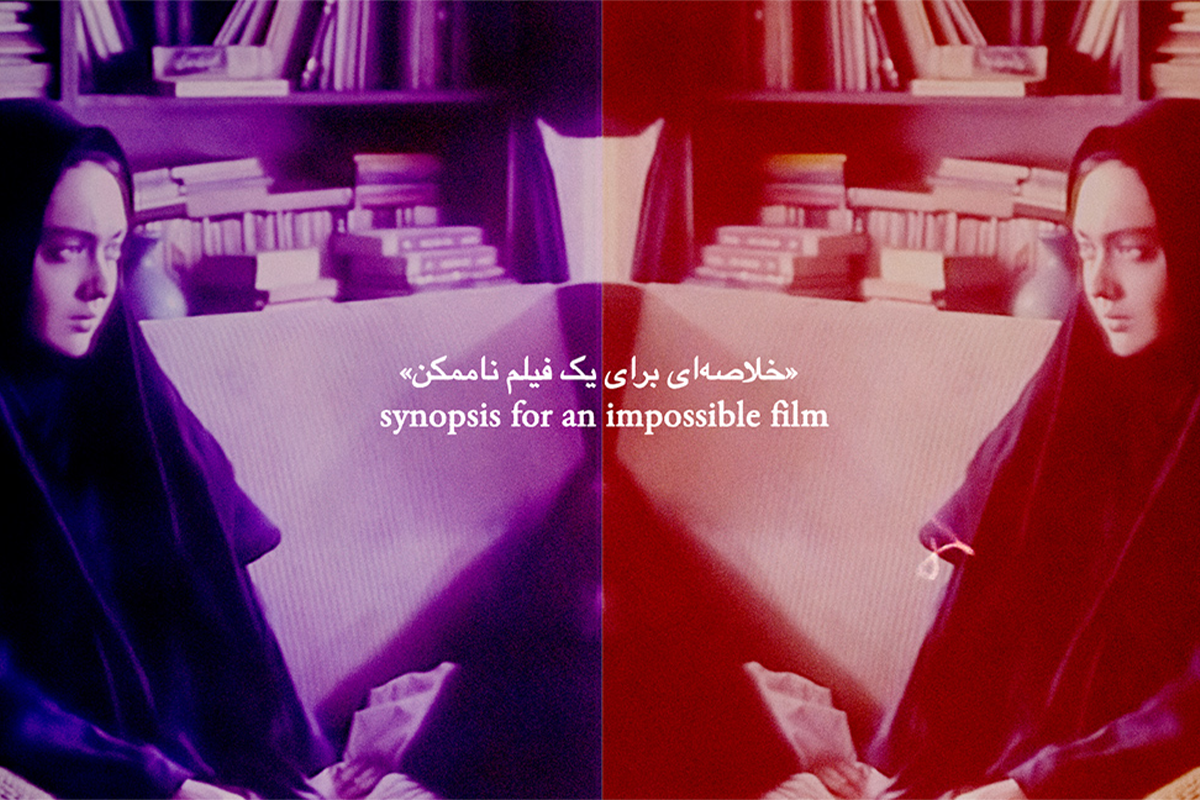
In anticipation of Maryam Tafakory’s hybrid film and live performance at the Walker Art Center in Minneapolis on April 23, Mizna and the Walker have commissioned the following piece from Saeed Taji Farouky. Tafokory’s adept work of truth-telling and Taji Farouky’s incisive reflection on it come at this time of imperial devastation wrought onto the Iranian people by the US and Israel. The devastating war on Iran and the wanton killing of Iranian people is draped in a disingenuous cloak of freeing Iranians, with righteous and authentic dissent within Iran being co-opted and instrumentalized as rationalization for a war that in actuality enacts an imperialist desire for power and control over land and oil resources. Taji Farouky’s piece reminds us of our moral imperative to be clear in our resistance to such forces and of the central, crucial role of art and storytelling in our anticolonial resistance movements. Something, he reminds us, that imperial powers know well, why else are artists, journalists, and thinkers routinely targeted and silenced? Taji Farouky guest-edited a cinema-themed issue of our literary journal, Mizna 24.2(2023), that explores the fragmentary nature of film and literalized it through a collection of varied printed pieces collected inside a stiff cover and held together with a band woven with the galvanizing statement about what art can be: film as a tool for liberation. Here, we see how Tafakory’s vital work is exactly such a tool.
—Lana Salah Barkawi, executive + artistic director
Mizna community can attend Maryam Tafakory’s film screening/live performance at the Walker on April 23 for $5/ticket with the code MIZNA5 at this special link. Limit 4 tickets per order.
This absence, like the blank spaces in Zan newspaper, contains the potential for liberation. This absence leaves her films on the verge of collapse, but in doing so, it forces us to hold them together ourselves, and gives us space into which we project our desires, our visions of freedom. The silences in which the soul can take refuge.
—Saeed Taji Farouky
On absence in the films of Maryam Tafakory
Salaam, Maryam-jan. We tried writing letters a few years ago, but we couldn’t do it. I thought we could try again, and I will start here.
I want to ask “how are you?” but I know the horrific sadism of the American/Israeli war on Iran makes this question impossible to answer.
Times like these make me wish I could disappear entirely from the face of the earth. —Saeed
You can set your own diaries on fire, release yourself from the weight of your past.
Or someone can burn your writing out of spiteful anger; an act of destruction.
You can run away from society, seek escape and isolation from the cruelty around you.
Or you can be disappeared violently by the state.
These are not contradictions, but tensions that exist intrinsically within each step in the process of liberation, tensions that bind and pull apart each sequence of images in Maryam’s films. They are based in archives but are not archival films. They don’t seek to preserve the past or to categorize it but to shake the footage vigorously, tear it apart, fold it to see what other shapes it can be made into and to occasionally undermine the original meaning, radicalize otherwise liberal images. They’re acts of archival sabotage—finding ways to excavate a new meaning from old material.
You wrote to me that, tired of seeing only weak, submissive female characters, you “took your revenge” on one particularly passive scene by “turning that annoying, obedient, voiceless, self-effacing woman into a man-killing creature.”
The now legendary story about the birth of Hollywood editing is that, associated with the crafts of sewing and stitching, it was initially assigned to women as a menial task. When studios realized how much power and influence the editor has, the discipline was—like all others in filmmaking—taken back under the control of men, and turned into a commercial, industrial practice. Like the folk medicine in (Daria’s Night Flowers), it was dismissed until it was recognized as a threat.
What Maryam’s most recent films have in common is an understanding that under oppression, imagination is suspect. Roya’s husband burns her manuscript not only because he believes it’s “obscene,” not only because he cannot discern the difference between fiction and reality, but because it represents her ability to imagine another world, and that means the ability to imagine liberation. The word is criminalized. We cannot help but make the comparison to the UK or the US today, where political speech around Palestine, in particular, is criminalized, and the ability to imagine a liberated future without fascism and ethnic cleansing is outlawed. The cultural industries in the UK—where Maryam now lives—are today suffering the same fate as Roya and Maryam, Daria and Khosrow Golsorkhi. Imagination is suspect; expression is criminalized; the desire for liberation is taboo, subject to the same punishment as the Zan newspaper: words obliterated from the page where only a blank space remains; artists arrested, their projects destroyed. This is the continuity of oppression, a concept central to Maryam’s work.
It is impossible to watch her latest films without being reminded of Israel’s decimation of Gaza, Iran, and Lebanon. And we shouldn’t attempt to, given how publicly outspoken she is about these wars; outraged at the silence of filmmakers, refusing to collaborate with complicit institutions, asserting her commitment to the liberation of Palestine and Iran and participating in cultural resistance.
Maryam’s latest works take their material from a particular time period, but they should never be confined solely to this period. The continuity of oppression they describe stretches from SAVAK to the CIA and Mossad. From the crimes of the Iranian government to the devastating imperialism of those claiming to save her from that Iranian government. Criticizing not only contemporary Iran, but the previous regime of the Shah, the West’s favorite dictator, whose security services were trained by Israel’s Mossad, and who a CIA agent describes in Maryam’s film Gol[e] Sorkh as “our pillar in the Persian Gulf.” The Shah himself was installed following a coup orchestrated by the CIA and MI6 to oust Iran’s democratically elected Prime Minister Mohammad Mosaddegh in 1953, because he threatened British and US neo-colonial interests. The parallels with Trump today are unmistakeable. But Maryam isn’t interested in presenting a trite illustration of how “history repeats itself.” In her films, history is woven inextricably into today’s genocides and imperial wars. A continuum, not a blueprint. Like a reverse editor, Maryam’s discipline is to unweave those threads to make them visible, and in doing so, she leaves spaces and silences for the viewer to construct meaning, to decide how these gently held images relate to one another.
This absence, like the blank spaces in Zan newspaper, contains the potential for liberation. This absence leaves her films on the verge of collapse, but in doing so, it forces us to hold them together ourselves, and gives us space into which we project our desires, our visions of freedom. The silences in which the soul can take refuge. Like filmmaker Michael Roemer—survivor of the Holocaust—wrote, “only a work hovering on the edge of disaster can render the tensions of being human.” Today’s world is even more chaotic than Roemer’s. The tensions of being human are now superseded by instability on a global scale, the knife edge between the apocalypse and a redemptive revolution on which Maryam’s films are dancing. In cinematic representations, the rioting at the collapse of society and the rupture of an insurrectionary moment are often indistinguishable.
The reason for this is political: states, including the US and Iran, have been using the moving image as propaganda since the technology was invented. But like Daria’s plant that “can heal and kill at once”, the moving image is also a medium of liberation for artists like Maryam. She turns the image against itself, prises the fingers away from the stranglehold that the European mode of representation has around our throats.
Maryam frees the image through obscurity and instability, a familiar strategy of dissident cinema. But while this technique will be most familiar to audiences through the self-obsessed meta-narratives of the Iranian New Wave—framing the filmmaker and the filmmaking process as the central elements in the creation of meaning—Maryam instead shifts the responsibility and the potentiality to the viewer. She not only frees the image, she frees herself from the tyranny of colonial propaganda—what was once explicit but is now called “soft-power” by the UK’s public film financing body the British Film Institute. When we are freed from strict, literal definitions, we can imagine the undefinable. The central character in two of her films is called Roya. It means “dream” in Persian; an image that refuses to be beholden to reality.
It is exactly this quality of Maryam’s work that is so subversive: the audacity of dreams. And it is exactly this quality of an artist’s work that has always made them targets for authoritarians and dictators: the capacity to imagine and express the feeling and process of liberation, an expression not only politically necessary but emotionally of fundamental importance. For many artists, the genocide of Palestinians and the horrific destruction of Iran and Lebanon have lit a fire inside us, reminding us exactly why we make films: as a cry of fury, a call to collective resilience and resistance, an act of loving collaboration, and the weeping of a broken soul. Facing genocide and threats to destroy your civilization are bad enough. But then being told it is forbidden to express yourself—like the friends/lovers in Razeh-del—is intolerable; torture. “There is no agony like bearing an untold story inside you,” Zora Neal Hurston wrote in her autobiography, while she was under the shadow of slavery and the terror of American segregation.
The Laval Decree made it illegal for colonized Africans under French rule to pick up a camera and film themselves, an attempt to choke the spread of anticolonial messages. Imperialism has always understood the power of representing yourself, and the potential of image-making to be part of the revolutionary process. For the members of the Palestine Film Unit, merely representing themselves on film wasn’t enough. They pushed the revolutionary potential of cinema even further, understanding that they were not objective documentarians of the Palestinian revolution, but active participants. Roya and Maryam understood this, too. The poet martyrs of Gol[e] Sorkh understood this, too.
But they also understood the corollary, that if you live as a revolutionary artist, you also risk dying as one. Roya and Maryam survived only because, like Borges before them, they wrote an “impossible” film that could never be made.
“We gave up searching for ourselves at the cinema.”
There is nothing more tragic than giving up searching for yourself.
Nothing more revolutionary than continuing the search, always knowing you might never succeed.

Saeed Taji Farouky is a Palestinian/Egyptian filmmaker, activist, and radical educator. He is founder of the Radical Film School, a free film course dedicated to political filmmakers from marginalized backgrounds. His work is dedicated to filmmaking as an integral part of resistance and liberation. His latest feature documentary, A Thousand Fires premiered as the opening film in Directors Fortnight of the Locarno Film Festival 2021, where it won the Marco Zucchi award for most innovative documentary. His previous documentary Tell Spring Not to Come This Year premiered at the Berlinale 2015, where it won the Audience Choice Panorama award, and the Amnesty Human Rights Award.
Related
The Bringers of Violence
Call for Submissions: Mizna 25.1
RAINDROPS
Celebrating Abundance: Queer + Trans Voices Virtual Reading