



July 23, 2026
The hero is dead, long live the mountain: Faris Dajani’s Threshold
BALTIMORE—Faris Dajani, a Palestinian-Jordanian multidisciplinary artist, stuns in his first solo exhibition, Threshold, Image. Situated in Gallery CA off East Oliver St. in Baltimore, Dajani cuts the thread of an imperial, detached reality at its metaphorical knees. As we witness atrocities and genocides in the SWANA region on our pixelated screens, lounging inside the belly of the beast itself, Dajani sharpens his knives and fractures the mirrors into a new sheen. It is a gaze and a mark that is both condemning and despairing, as the audience is urged to reconcile passivity bred by empire and its comforts.
The show is made of a series of paintings, drawings, videos and installations, curated by Delilah Jabbour. This listing, however, does not capture the way these works often blur the mediamatic threshold: glimpses of drawings appear in videos, paintings suspended mid-room become soft sculptures, and the notational, diaristic line of word and symbol cuts through translucent layers of paint.
Dajani’s entrance into the United States, via Fulbright and an MFA at Maryland Institute College of Art (MICA), was in the midst of the US-Zionist genocide in Gaza, Palestine; its ethnic cleansing of Lebanon; the annexation of the West Bank under zionist control; the historic 2024 U.S. election, where PSYOPs upon PSYOPs entrenched civilians on social media. The genocide in Palestine is still ongoing, and escalating into an all-out regional catastrophe, despite claims of a “ceasefire.”
The show was made of a series of works negotiating their “imagehood.” In Dajani’s perspective:
The definition of an image is in itself completely metaphysical. Phenomenologically, one may define an image as being an impression, or a moment suspended in time, but this does not say much materially. Because an image is not a concrete thing, it is more so a quality or meeting of qualities that have a certain affective presence. More adjective than noun.
With acrylic and charcoal, Dajani’s imagery borders on surrealism. Each piece holds a frenzied urgency—the ink forming both the ephemeral and permanent as Dajani interrogates our position as witnesses and the locality informing and shaping our politics. He demands an honest gaze, insisting on the world order where resistance brings justice.
Throughout Threshold, Image, Lebanese-American curator Jabbour expertly contextualises Dajani’s work, mapping his interests by piecing together the conversation Dajani stimulates through his artwork.
She brings the audiences inside the intimacy of the exhibition and its broader framework and dialogue, noting that: “I wrote the labels—which varied from poetic reflections to relevant documentation of real life events—in response to conversations between Faris and I. Some labels also include quotes from his journal; these are paired with my curatorial analysis of the work and its significance. Our collaboration broke down the barriers of both artist and curator, intentionally reimagining shared authorship and ethical representations of our community.”

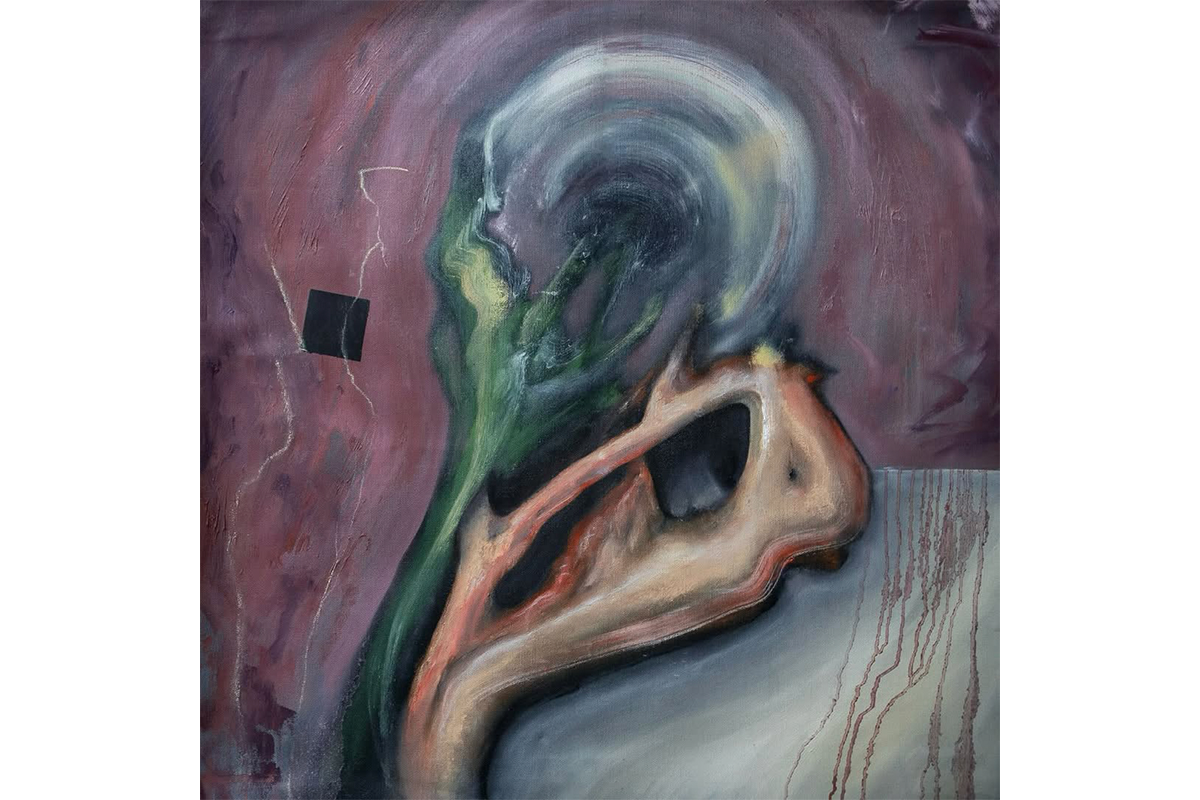
The title piece, the hero is dead, long live the mountain | مات البطل، عاش الجبل (22” x 22”, oil on canvas) is perhaps one of the strongest ruptures in the exhibition. As I look at the brushstrokes of this piece, where the mountain and greenery are both being split and spilling into a void, I cannot help but think of opacity, as the late Martiniquan writer and poet Édouard Glissant coined it. It is both a call to another world, and Dajani’s refusal of performing inside the arbitrary yet brutal borders of the colonial center.
Drenched in imperialism, witnessing becomes an act of disassociation—perhaps it is an attempt at association, unable to ever fully manifest into materiality due to the nature of empire. It is a distant gaze, compressed through the saturation of images. We see, we repost, but what is done? Protests at sanctioned hours, permits processed, the collective distance and action become civilised under the state’s prerogative.
Under Dajani’s hands, witnessing attempts to reflect the gaze back to its viewer: a gaze of horror, terror, and a stark refusal to submit into apathy through comfort, entitlement, and class. It is, as Dajani notes, a recording of what is completely, utterly unbearable. Rather than replace or render the images and violence already in existence, Dajani’s practice is a radical recording of himself.
It is an interruption, in many ways, and so often a testament to the function of the artist’s humanity, as Walid Daqqa describes in “On Parallel Time.” Daqqa speaks on his shock and astonishment, arguing, “To feel for people and the pain of humanity is the very core of civilization” and moreso, in the context of prisoners, “What is targeted is love, your sense of beauty, your sense of humanity.”
While neither a political prisoner nor resistance fighter, Dajani’s practice embraces the fundamental pillars Daqqa enshrines in his essay, as Dajani notes, “The work doesn’t arrive from a place of cynicism or darkness, but a radical expression of an aesthetic possibility, of a radically different existence, or else why would I make any of this? It is a yearning, a reaching for another world.”
In RIFT (single channel HD video, 3 minutes and 18 seconds), Dajani condemns the apolitical heart: “…beating not with life, but with the ghostly promise of a postponed future. It shrieks, once, every four years; a cry for stasis, for the preservation of comfort laced with rot. It begs you to ignore the bodies.”

A monochrome video opens, presenting a white pictorial plane split down the middle by a black rift. The spectrum of the screen is occupied, at times completely and others partially. Filled with found footage of an American—seemingly Midwestern—accent accounting of the everyday minutiae. A pendulum, with its audible ticking, ebbs and flows in and out of sync. The rift, as I am lulled by the pendulum’s refrain, begins to inch outwards and pushes the images further towards the screen’s edge.
The pendulum returns, its flickering pulls my attention to and from the footage Dajani situates in RIFT. Does the pendulum measure time, too, in this video? Is it stabilizing the rift, and thus the lives held under Dajani’s examination and excavation? I wonder if I should feel an objection to the worlds the man’s voice lovingly holds or to build a bridge and meet him on the other side. Is there another side in this moment, or am I falling under the enchantment, the easy promise of liberalism? How far does radical optimism function in these moments?
Towards the end, the exacerbated panting of a man pulses between flashing images of a building being struck—Lebanon? Palestine? Iran?—and the panting stops, a ceasefire on its own, and yet the pendulum is more pronounced and visible as RIFT closes.
Dajani, speaking on his video practice believes, “our task is to render what is almost unbearable, completely unbearable. Not through pure chaos or endless confrontation—the news cycle already performs that function—but to subvert is to seduce, and then confront. This is where the rupture happens.”
There is a negotiation, or perhaps even battle, against mediation in Dajani’s practice. His refusal to transmute Palestinians into a legible, Western understanding; and refusal to make the violence opaque, under Glissant’s definition, for the audience.
He holds the colonial violence as close as he can, refusing the allowance of passivity. Threshold, Image functions as many things: a resistance, a refusal, a guide into how to see, but mostly, I felt a visceral scream resounding from Dajani’s works.
There is a metastasis occurring, not only in RIFT, but throughout all of Threshold, Image. I walk, pushing myself away from the walls, and gravitate to the centre piece of the exhibition.
I am stunned in the centre of the room. Dajani utterly diminishes the threshold between viewer and subject in his work. In the middle of the gallery hangs summary execution | اعدام ميداني (36” x 62.5, acrylic and charcoal on canvas) which recounts the zionist siege of Nasser Hospital in Khan Younis, Palestine, from January 21 to February 28, 2024 where according to Al Jazeera English, the bodies of over 283 Palestinian hospital staff, families, and patients were exhumed shortly after the Zionist siege with their hands still tied behind their backs.

Speaking on summary execution, Dajani says, “The decision to explicitly name the event was led by curator Delilah Jabbour. The reference revealed itself to me only after making the piece. I had produced a number of automatic sketches in the months prior where the figure of a man with his hands tied behind his back emerged, or was seen in the smoke of charcoal.”
Slashes of acrylic and charcoal are delivered directly onto a long piece of lightweight raw canvas, suspended tautly between two columns by wires through eyelets—a line through the neck, another as a zip-tie behind the back, rivulets of blood seething from the frame. Near life-sized, its scale invokes the presence of a body; a presence that stands in direct contradiction to the airy delicacy of its thin weave.
As I begin to orbit the work it regresses timidly, responding to the wind in my steps. Approaching from behind, the work’s position at the center of the room becomes clearer: light shone through the surface revealing an inversion of the image, and beneath it, a history of marks and decisions buried under the layers I first encountered.
Jabbour shares more on the curatorial decision, remarking:
This placement also pushes the exhibition to become more site-specific. A lightweight, delicate fabric moved by the slightest gust of a body’s wind is being held up by load-bearing pillars meant for the gallery itself. By doing so, it places it within the local contexts of Baltimore. The instinct to walk around the piece also pushes the viewer to move cyclically around the gallery; it pushes the subconscious undertones of the cyclical nature of violence: resistance and its radical validity, colonization and its twisted persistence, witnessing and its unbearable weight.
summary execution is the frame the room orbits. Each portrait of Dajani’s is more than a haunting, but a reckoning. Throughout the exhibition, Dajani orients the audience into a beseeching vision: here is the fire, the death, the empire, the humanity, the will, the living. It is easy to say that yes, this is the totality of Dajani’s exhibition, but Threshold, Image, and Dajani’s genius as an artist, functions much more profoundly.
Dajani does not create as an act of rendering, but of recording. It is in his humanity, his depictions of himself remade by genocide, that provide the reckoning. We are haunted—as Palestinians, as humans, as anyone engaging in global solidarity and class liberation—but the reckoning in Threshold, Image occurs from seeing Dajani’s humanity, its horrified and furious shrieks throughout the exhibition, and how it sits on us all.
Here, the materiality is a compliment of content—gestural, frantic, and notational—showing the traces of time and movement within the news cycle. Newsprint, for instance, is cheap, ephemeral and notoriously difficult to preserve. The materiality in Threshold, Image follows this same pattern: lightweight canvas, in-lay frames installed on site that will be chiseled out afterwards, charcoal and graphite that can be smudged out of proportion.
Even in his smallest piece, he looked into everything | نظر الى كل شي (7” x 10”, charcoal and spray paint on yupo) the subject is both staring into the expanse of the world and the deluge of the fire. Invoking a child gazing into the rubble, the bombs still in the moment of suspension as they rain and seize the skies, a child is both whole and on fire. At times, I see two sisters, their hands together as they attempt to endure the monsters of this world. We are here, engaged in a record of empire’s oversaturated desire for death.

Dajani points to even the dogs in حتي الكلاب (31.5” x 31.5”, acrylic, oil and graphite on canvas) its skeletal head on a finely lined blood-red square surrounded by washed white brushstrokes—that even here, in this, there is no mercy, no life left under greed and brutality. It is the smallest notice, and yet. Cementing the immutable fact that everyone and everything are entrenched in the violence: from plants, to animals, children, men and women; there is none who escape the breadth of occupation. What can innocence achieve or even transcend in such conditions?

Jabbour, sharing her insight on these pieces, says: “he looked into everything and the atom are two works on the opposite side that do this through emotional, tender, and bittersweet radical possibility/resistance. Holding both truths at once, as a balancing act, is what makes the curation of this body of work read as a comprehensible theme. In order to resist colonial violence, we need that anger to be empowered by grief, love, and loyalty to our kin and land.”

In another piece, how do we (ex)pend our days? | كيف نقضي (على) يومنا؟ (18” x 24”, charcol, ink and graphite on newsprint) Jabbour posits Mahdi Amel (1936-1987), a Lebanese Marxist philosopher who was a prominent member of the Lebanese Communist Party. Amel is directly paraphrased in this piece, his words situated in a frenzy across the notations of canvas itself:
They claimed the war in Lebanon would be swift. They said that in just a few days, those who had not yet knelt, who only understand the language of force, would finally kneel. They declared that there would be no Salaam, only Shalom, and that Israel is the Rome of our day. To the kings of Israel and their imperialism masters—the masters of the foul regimes in our Arab world, to the petty fascists—we say: it pleases us to spit in your faces. We will fight you even with our nails. Our fists are the compass of history, and the bullets of our freedom will pierce your hearts that beat death inside your ribs. To you, we say: Brick by brick, we will build a world on your filthy graves. You are the dustbin of history, and Beirut is the city of the free who have made a vow: We will resist you.
Jabbour remarks, “This quote also holds Faris and I together in collaboration. What we see here is an ideological solidarity network between Palestine and Lebanon. The PFLP serves as a Marxist-Leninist group. The LCP, at its peak, was similar.”

It is as Daqqa argues: our very love and humanity, our ability to recognise and enjoy beauty, are victims of empire. And so Dajani, perhaps subconsciously, holds the refraction of light wherein we as the viewer may remember the love, the beauty, the reasons we carry on in struggle and resist.
Perhaps viewers will find Dajani’s work either a pretty portrait of Palestinian wretchedness, a sea of suffering, or others will find themselves discomforted by his refusal to look away from even the most harrowing scenes—his own acknowledgement, perhaps, of how he is forcibly altered with each atrocity.
It is in Dajani’s work we are reminded: what we see is still curated. There is a screen we are scrolling through, each video and newsreel moving past the next, seemingly to be rendered irrelevant by the next hour. The threshold through which Dajani experiences the genocide (screens) is superimposed on the pictorial spaces he constructs (cropped, delimited, partial).
In Threshold, Image, we are called into action, beyond the simple witnessing. Even as he paints his world in Baltimore’s windows and sidewalks, he is haunted by the remembrance of his presence in the imperial core.
There is an exchange, certainly, when one enters the Western hemisphere. There is also a submission when one lives under colonial rulers, despots of the imperial agenda. There is always blood, Dajani reminds us, in each act of comfort. The exchange of security for liberation, in some cases; and in others, the inherited entitlement bred through generations of colonialism and brutality.
Political violence is no longer a distant abstraction; the fictions of empire, no longer the rule; and the desire for security and stability is the passage whereby we have accepted a certain cost of blood to keep the machines running smoothly.
It is the recognition that a global order and system, led and ruled by others who are on the periphery of the collective, aim for us all. If one falls, the rest follow. It is understanding how nation-state military and security apparatuses operate; the intricate web of surveillance, money, and power. What does it mean to escape these systems? What does it mean to demand the collective meet the rot of our world and not avoid its existence and presence? Will we continue to quietly, simply acknowledge the rot, and still turn our gazes toward our own desires?

In his refusal of passivity, Dajani holds the flame, the torch, and reminds us: you cannot walk through this world unscathed. You, too, pass through this brutality. It is an abject refusal of the screen, the pixelated and virtual as the primary, and a return into the material, the physical. It is beyond a plea for humanity, but a flag staked in the asphalt.
Above all, Faris Dajani holds the mirror up and asks us, do you like what you see?

leena aboutaleb is an Egyptian and Palestinian writer who asks you to commit to the Palestinian liberation struggle. She is the author of THALASSA (Game Over Books, 2026). Her pamphlet, Expeditions of Projection, was released in 2023 (VIBE). Her film, ‘Oracle,’ co-produced with Youssef ElNahas debuted in Venice, 2025. She is a Brooklyn Poets fellow, a Kundiman fellow and Tin House scholar. Read her work at www.leenaboutaleb.onl.
Related
The Bringers of Violence
Homeland Hacker Heba Amin Joins Mizna
Mizna: The Experimental Issue
Al Asleyeen