



April 15, 2026
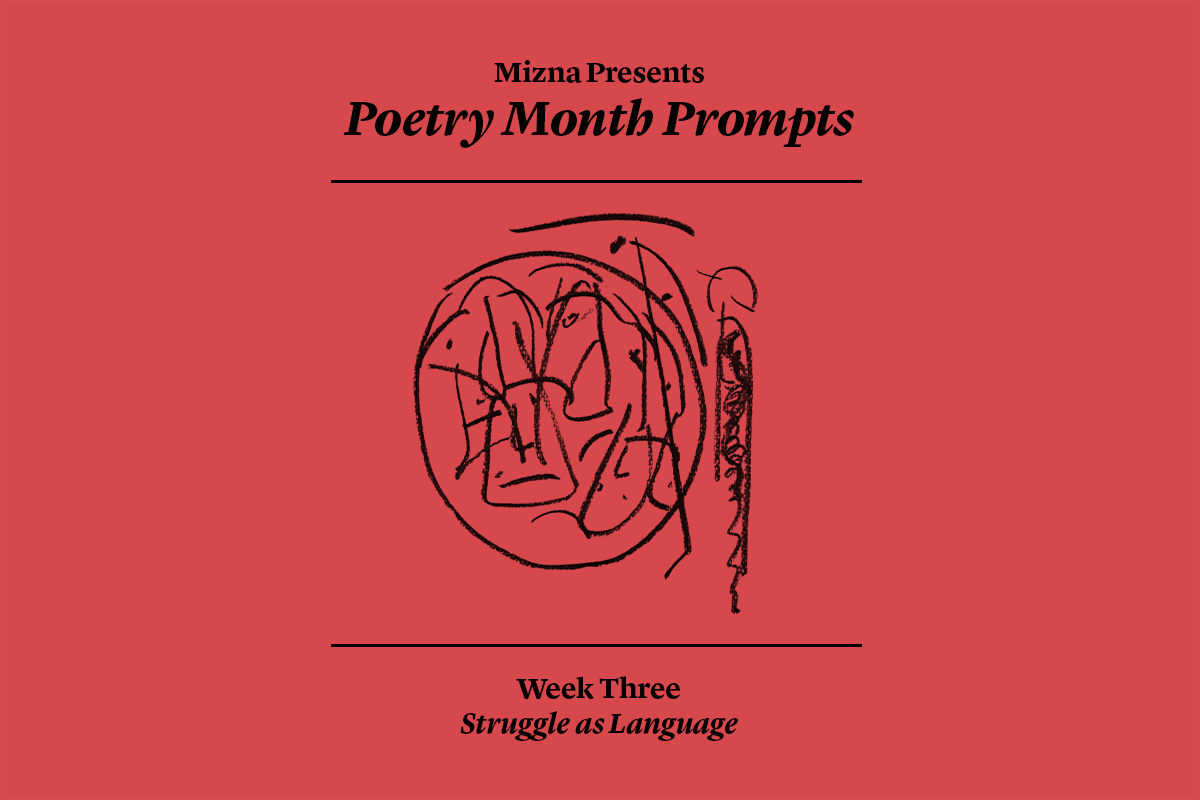
Week Three: Struggle as Language
Living with/in multiple languages is to attempt to transmit feelings, ideas, traditions, and histories into another tongue. Sometimes languages relent, and sometimes they don’t. The two poems highlighted this week strive towards a yielding, turning struggle into a language of its own.
Continuing National Poetry Month, the accompanied original prompts push Mizna’s readers to convey struggle with, through, and as language.
Read more about Mizna’s Poetry Month Prompts and find all of the prompts here.
—Layla Faraj, NNAAC Fellow + Column Editor
Lexicon
by George Abraham
Originally published in Mizna 18.2,
once, a language failed me & i hadn’t a home
to claim in my own throat—
in Arabic, the word for tonsil translates to
daughters of the ears—
we are taught, to have a body is to carry
its lineage inside of us—
& i’ve tried to make a language where my body
is just my body, my blood just my blood—
but my tongue rejected it. spat it out
like a mouthful of Arabic—
maybe it was defense mechanism; maybe it’s the only
way i know how to cough up blood, or History—
*
i was never taught Arabic growing up
[ translation – my father never wanted my throat to become threat]
i don’t watch the news any more
[ translation – i am worried my people might be on it.]
it is, as they say, tomorrow’s history
[ translation – hence always written by the victors]
i mean to say, it repeats itself
[ translation – i’ve come to expect the obvious outcome, a learned helplessness]
i saw the girl die on facebook & the video autoplayed
[ translation – how do i mourn without a language to name our dead ]
& repeated. & repeated. & repeated. &
[ translation – i am always translating]
Spolia1
by Nancy Agabian
Originally published in Mizna 26.1, Kindred
When I hear Western Armenian
I know it like the syrup that soaks
the bourma, seeped into layers
of phyllo dough. I don’t understand
but it sounds like a song. The music
my family made before they all
died. “Ooh, I like talkin’ Armenian,”
my mom says on a video
that my phone flashes me
two years after her passing.
What did you call your grandfather?
«Դեդե:»
What did you call your grandmother?
«Մարյիկ:»
What did you call your mother?
“My mother was Mommy. Her name
wasn’t Armenian.”
Images I took when her long-term memory
emerged to speak Armenian
at the dinner table. While chewing.
Words spewed and swallowed,
wedged between laughter.
«Ըսի շատ ճարպիկ եմ։
Չեմ գիդեր քի ուրկեց եկեր են։»
Her teacher-self prods me, “What did I say?”
You’re very smart. You know where you’re going.
“No, I’m very clever, though
I don’t know where I come from.”
Ո՞նցա սարքեցի cole slaw: My attempt
attempt to translate How did you make
[a staple of American barbecues]?
causes confusion: “What’s she saying?
Where did she get those words?”
Peering into the camera, her eyes
like obsidian
even on this ghostly medium.
an Armenian long forgotten
before her grandparents’ time. I speak
tentatively, visual letters carved in my head,
a Western pronunciation
of Eastern grammar that no one
in Armenia understands either.
«Հիմա—what does հիմա mean?”
Now.
“Now. That’s a good word.”
A few minutes later:
“What’s the word for stupid?”
Հիմար.
«Հիմար? I never heard of that one.”
Verbal tics remembered, insults forgotten,
she tastes her family’s language again.
The bourma crumbles like stones
tumbling when the earth says it’s time,
then patched together haphazardly.
Or blasted apart. Gone?
An angel’s wing, akimbo, pointing to a fragment of text.
Half a rare sundial spackled between two windows.
Up by the roof, the symbol for eternity.
- Latin for “spoils,” spolia refers to stones that are taken from one structure, often in ruins, for use in a new building. In the Soviet Union, historic spiritual sites were often destroyed because of antireligious policies. For example, in the villages of Tsar and Chragh, medieval Armenian monasteries, churches, and cemeteries were demolished in the 1950s. Soviet Azerbaijani builders then used fragments from the ruins to build tow new schools, placing the stones haphazardly, so relief images and Armenian inscriptions often appeared sideways or upside down. In June 2024, after Azerbaijan had violently forced roughly one hundred thousand Armenian civilians from their ancestral land of Artsakh the year before, Caucasus Heritage Watch discovered that the two school buildings, including their spolia, had been destroyed. — Caucasus Heritage Watch, “Wreckage Upon Wreckage in Kalbajar,” ArcGIS StoryMaps, June 19, 2024, https://storymaps.arcgis.com/stories/2e1ec30a50954ca2b11bc05c8fc4c289 ↩︎
Prompts for Week Three: April 16-22, 2024
- Write your own lexicon poem.
- Write a poem that includes intervening “translations.”
- Write two unique poems about the same topic: one that has interventions and one that doesn’t.
- Write a fragmented text.
- Write an embodied text: one that requires the reader to move.
- Write a struggling, bargaining poem.
- Write a conversational poem.

Layla Faraj is a Syrian-American writer, translator, and editor who received her B.A. in English Literature from Barnard College. Her own work has appeared in LitHub, ArabLit Quarterly, The New York Times, Even/Odd Studios, and elsewhere. In addition to her work with Mizna, she is currently translating a Gazan diary with HarperCollins.
Related
The Bringers of Violence
letter to fadwa tuqan
Mizna at AWP 2024
The Cat’s Cradle, or How to Play a Tongue