



January 29, 2026
The Road to Ramtha
. . . we followed the mosque motorcade to the graveyard. The first thing I saw when I stepped out of the car was a rusted, burned-out barrel. On the ground next to it was a sun-bleached container for a pair of underwear, one of those plasticky cardboard ones with a buff guy on the front. They’d already mostly buried him. It was hot and they wanted to be done as quickly as possible.
—Sanad Tabbaa
One of the nice things about being a writer is that you get to start a story whenever you like. I could start this story in 2017, when a combination of a nerve pinch, cancer, and aging macular degeneration forced me to become friends with my grandad. I could start it the February before last, when he broke his leg and we spent long nights together in Khalidi Hospital, him fucked up on morphine and me obsessively playing Hand on Jawaker. I could start it yesterday, on his deathbed, but I won’t. I’m going to start this story on our way to Ramtha.
Ramtha is a smuggler’s town and has been ever since the borders were drawn. Their singular claim to fame is their consistent moving of the Syrian border throughout the 20th century which eventually became so brazen that the Jordanian army encircled the city with tanks, machine guns, and heavy artillery. The army reportedly brought out the loudspeakers and said something to the effect of: “you’re gonna cut it out now, yeah?” Today, the central roundabout in Ramtha sports no less than twenty-five giant Jordanian flags.
My grandad was born in Ramtha and spent his childhood there in the 1930s and 40s, a time and place so different from our own that it may as well have been another reality. One of his stories that sticks with me is of his mother: an Ottoman Turkish woman from Istanbul who, upon moving to be with her husband, discovered that this backwater reach of her empire was entirely bereft of such luxuries as telegrams, indoor plumbing, and making sure you were dead before they buried you. In fact, the earliest ancestor in our family that we can trace is known only as al-Mgarfis, which translates to, “the squatting one.” This is because when they opened his grave to bury someone else in it, they discovered the telltale signs of an accidental live burial: the poor bastard was in a fetal, squatting position. She resolved to die in Türkiye when she heard this, and in fact did.
The first thing we saw upon entering Ramtha was two teenagers fighting. They were throwing wide, helicopter punches, pulling at each other’s tee-shirts, and generally expressing their frustration with one another with their wrists in a kind of violent volleyball. A dawriyeh, one of the big police vans with the barred windows, pulled up next to them. The cop calmly walked into a corner store, bought a lighter or something, and drove off.
As we drove away one had the other’s head in his hands and it looked like he was about to knee him in the face. My brother and I rubbernecked while my dad stared at them through the mirrors. As they disappeared from view I thought about pride.
The single defining characteristic of my grandfather was his pride. Not ego or arrogance—pride. Pride is tricky to express. I initially thought about using his idiosyncrasies: driving sans depth perception as one of his eyes was already too far gone, or relearning how to walk at the age of eighty-six through pure stubborn-headedness, or making basturma while blind with a very sharp knife by feel, and that kind of works. What works better is his stance, his look, his posture at any given moment.
Straight-backed, perfectly trimmed moustache, always looking at someone or something in particular. This, I would assume, is difficult to do while basically blind, but he would do it. He sat in exactly that manner, on an unreclined recliner, with a mostly stern expression. It would Not Do to show emotion, just as it would Not Do to have lax table manners, and it would Not Do to slouch. He did not say these things, he embodied them, and in so doing he had created a superstructure around himself, a personality molded by what he thought was right and what he needed to live up to. Over the years, the lines between the manufactured and the true blurred into nonexistence. A day had come where he became who he thought he was; that day would pass, too.
My grandfather was an artifact of the type who wore suits every day and imitated what they found compelling from the West, an Arab who even then would whisper harshly, “we have sovereignty, and we deserve it. We are proud of our culture and we will express it.” He was the type of Arab who didn’t really survive the fall of Pan-Arabism, whose clamoring for liberty turned into Ford cars and Phillips television sets and paper chains in the 80s and 90s. The type who had convinced themselves that the dream had been achieved, at least in part, so as to feel that their sacrifices had been for something, who traded a good life for a peaceful one, sovereignty for security. He remembered mud-brick houses and the time before Jordan had a university, when going to study in Syria was a car ride and not suicide, when you could start a newspaper or a magazine and be celebrated, not suspect. He remembered a lot of things and told me about them, and I remember some of them.
We passed the fighting teenagers, the poorly-named coffee spots, and the wide, empty streets, and got hopelessly lost. The smugglers’ plastic-façaded, glitzy houses with their faux gold gates and their pickup trucks parked up front began to repeat and we stopped for a moment so I could smoke a cigarette and my father could get his bearings. It was hot and dusty and windy, the kind of day where opening any door is like opening an oven.
It turned out the right location was only a few minutes away. We left the area with the rich smuggler houses and entered the inner city of Ramtha, my father exclaiming “this is the Ramtha I know.” The houses were close and cramped and most places were shuttered as it was a Friday. There were some people in the streets, strewn between the garbage.
The minaret wasn’t really visible from the road we’d come from, and we would have missed the mosque entirely had the more atheistic members of my family not been crowding around the grocery across the road from it, drinking boycott-approved 7-Up and smoking.
I tried to avoid entering the mosque for as long as possible, as I couldn’t remember how to pray. What exactly would the few hand and body motions and occasional faux mumblings of a nonbeliever do for my grandfather now? Especially given that he, too, was a nonbeliever. He’d often stress that he wasn’t an atheist. He had faith in a Creator, but he didn’t believe in the bullshit that had accumulated around the idea. My cousins from the other side of the family had made the trek and were inside, so my brother and I sucked it up and made the motions anyway. I didn’t count on them bringing my grandfather’s corpse into the room, though.
Was this really necessary? What was the point in parading him around the room, wrapped in an obviously secondhand, faded blue blanket? What did it accomplish to show the assembled believers the blanket pulled taut over his too-skinny legs? I thought, then, about my grandfather as I knew him, as a friend.
It started when he asked me to help him piss. It was his brother’s funeral, and he’d had a nerve pinch which made moving hard and painful, all while secretly undergoing radiotherapy for throat cancer. It was what most would consider a Fucking Terrible Week. I completely cocked it and it ended up with him pissing all over the front of his trousers, which nobody acknowledged. Later, I went with him to get a checkup at the King Hussein Cancer Centre, which was his way of letting me know that he was sick. We never spoke about it again. Seeing him in that state made me recognize that it would be worthwhile to get to know the man, as he did not seem long for this world.
Over the course of the next decade, I asked questions, requested stories, and offered my own. I would escape from the house in which my parents were slowly divorcing, into a series of bars, and from there into the safety of his house. He didn’t ask about it, and we’d have a series of increasingly intimate conversations over intensifying hangovers. Before I knew it, I was sending him voice notes, long ones, every month or so while in university to simulate sending a letter by mail.
We’d tried physical letters but my handwriting was the icing on the cake of his slowly encroaching blindness, and between his sight and his eroding dexterity, he’d also lost the ability to write. Having to rely on someone to read or write made him feel weak; he didn’t reply to my first letter. Knowing he wouldn’t reply, I taught him how to record voice notes. The voice notes always started off the same: I would make a spirited attempt to talk to him in fusha Arabic, failing, and swiftly going into dialect. I’d tell him about what was going on, asking about the family. His replies started in immaculate fusha, but as we grew closer, he’d talk casually too. Oftentimes the first ten seconds or so would have him frustratedly fumble with the phone, never swearing, sighing deeply.
I discovered he was secretly hilarious. He enjoyed careful mischief—a single word, usually a lie, at the right time. He had unorthodox ideas, and lost loves, and had made mistakes, and was pretty much the only one who remained of his friends. There were people who came over that he played cards with, sure, but these were ashab mratschbi: literally guys along for the ride. He was a person, and since he was a person and I was a person, we could be friends.
Following prayer, we followed the mosque motorcade to the graveyard. The first thing I saw when I stepped out of the car was a rusted, burned-out barrel. On the ground next to it was a sun-bleached container for a pair of underwear, one of those plasticky cardboard ones with a buff guy on the front. They’d already mostly buried him. It was hot and they wanted to be done as quickly as possible.
The sheikh from the mosque had followed and was preaching, with complete self-assuredness, that he wished he were in the hole instead of my grandfather. That after a long life of devotion and prayer, he’d get to go to heaven, and anyone who didn’t pray had better look at this stellar example and reconsider it OR ELSE THEY’D GO TO HELL. He got no response from the assembled mourners so he moved on to talking about Gaza, and then about prayer again as they buried my grandfather who probably never once prayed five times a day throughout his eighty-seven years on this earth. It was hysterical. As we walked back to the car I saw a stray dog in the distance, waiting to try its luck, and I thought about peace.
A year and a half had passed since he broke his femur and could no longer walk without supervision. During the long hospital nights while they pumped him full of morphine and waited for his surgery, I had to help him piss with one of those nasty elbow-macaroni urine containers they have in hospitals. Eventually he’d just have me hand it to him. I don’t know if it was because his pride couldn’t take it, or if it was because I was lightly crushing his balls while trying to help. He’d use one of those elbow-macaroni motherfuckers for the rest of his life.
I know he took some joy in shocking people the first few times, taking a piss in the sitting room while standing on his walker, but eventually he’d stop drinking water if he was going to have people over. He withdrew as the mischief turned into humiliation, staring into the ceiling, unsure whether he would be able to get up, even if he’d wanted to. Unwilling to try out of pride and fear.
Then some asshole convinced him to take out his teeth and get dentures.
Suddenly, he couldn’t swallow. A fungal infection, then a tumor, all combined with no teeth, made him lose weight. He couldn’t stand at all anymore, couldn’t walk, couldn’t eat or drink water. He’d gone from someone who was limited to a complete dependent. A man for whom nothing was as important as his personal sovereignty was now stuck on a recliner, wearing a diaper. He couldn’t even acknowledge it as it was happening. His personality wouldn’t allow it.
Eventually, his muscles atrophied, which happens when you don’t move and you can’t eat since anything you put down your throat is coughed out. The worst part was that he was totally cognizant the entire time. He witnessed the slow, inescapable erosion of his basic dignity as a man who held his pride above all. Forced to pee in public, wear a diaper, and become incomprehensible as his tongue, lack of teeth, and lack of airflow betrayed him, it was all taken away from him piecemeal until he wasted away on the couch.
Near the end he’d rip out the oxygen tubes we got him. He stopped taking his medication, and did anything he could to be free of the prison of his broken-down body. It would only last until my mother and my uncles asked him to resume, and then he’d selflessly accede to their browbeating. I understand, though. Watching his lips go blue and his skin go grey as he neared his goal was an impossible ask. As his grandson, I couldn’t bear it. As his friend, I wanted nothing more than for his demand to be respected.
We went from the graveyard to Planet Donuts, decked out in its fluorescent pink neon lights, to have a coffee, then we went to the wake. My dad and I stayed a while, my brother stayed a while longer. My dad and I took one of my grandfather’s friends home, some reprobate smuggler bastard. As we sat in the car, listening to the smuggler’s boasts and tall tales, I thought about how I was going to write this story. Then, I wrote it.

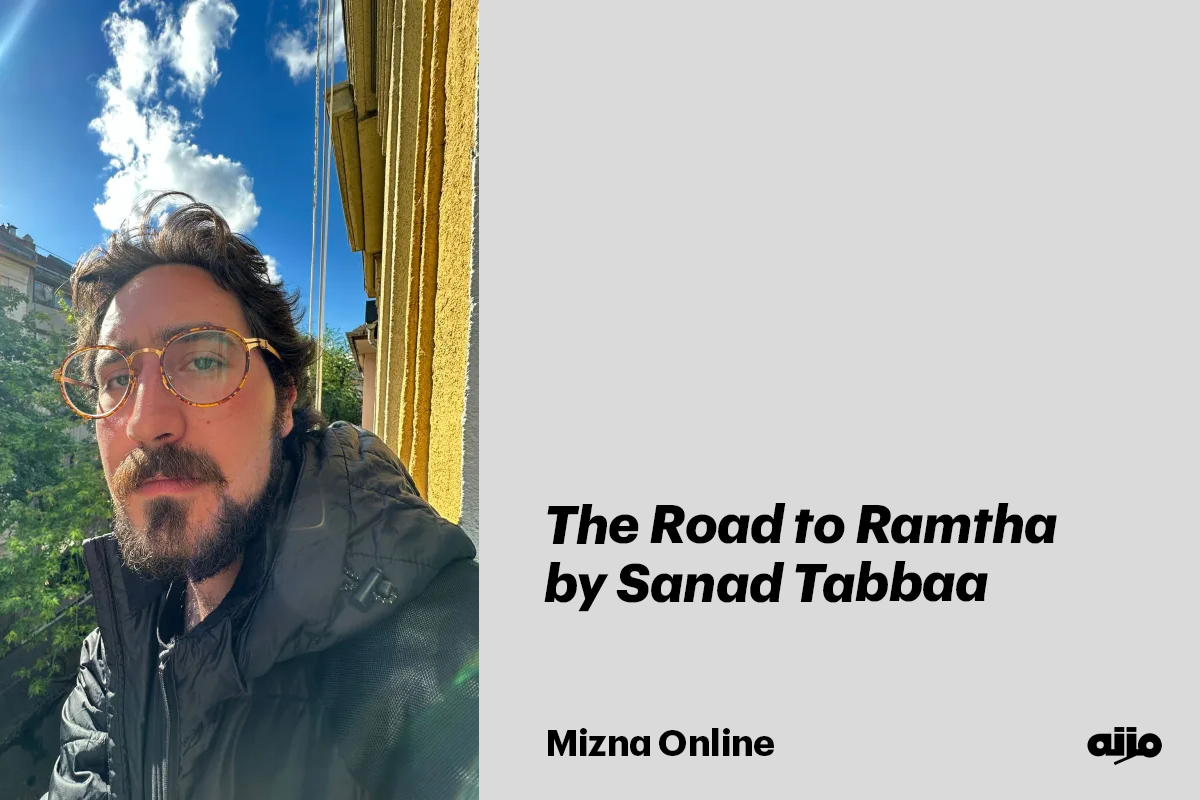
Sanad Tabbaa is a Jordanian former historian, present part-time philosopher, and occasional travel writer. He writes short stories from his hometown of Amman, where he also edits Tawahan, an Arab magazine of art and philosophy. His work has won second-place in the Dream Foundry Emerging Writers Awards and been published in The Markaz Review and Jadaliyya among others.
Related
The Bringers of Violence
Filmmaker Discussion: Mai Masri In Conversation with Miriam Cooke
Flashbang
Mizna: Twenty Years, Available Now


