



March 5, 2026
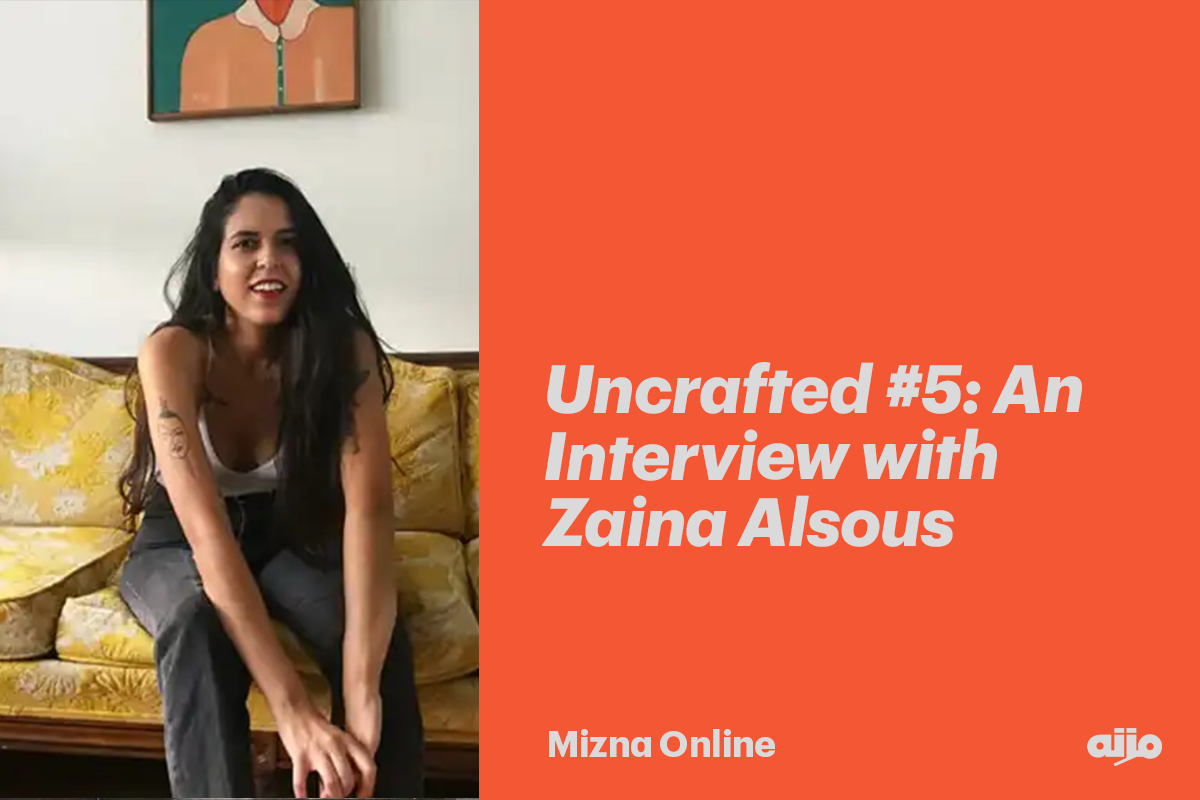
Uncrafted #5: An Interview with Zaina Alsous
The work of poet and organizer Zaina Alsous exemplifies what a labor-aligned poetics looks and sounds like. In her astounding debut, A Theory of Birds (University of Arkansas Press, 2019), she charts a speculative, but materially grounded, path towards the liberation of Palestine, which is framed as the liberation of the worker, which is framed as the liberation of the earth. In a literary environment where the empty signifier “leftist” so often washes away concrete histories, theories, and tools of struggle, her writing re-orients the reader towards a socialist horizon; not simply a rejection of the wretched present, but a will to build a better collectivized future.
– Hazem Fahmy, Uncrafted Column Editor
HAZEM FAHMY
I like to start these off by asking the writer about their relationship with the term “craft.” What does it evoke for you? What is its relevance?
ZAINA ALSOUS
The closest analog I associate with craft is “tradition” in that neither term is politically neutral. Both terms are rooted in a particular practice and application in the service of the loyalties of its wielder. Craft is honed or realized through repetition: we are what we do, among and again, in writing and in life. Craft is relevant insofar as it advances the political and philosophical traditions we are rooted in, ideally of the people against those who seek to extract, exploit, and dominate. We ought to be good at what we do and to be good takes intention and practice—dignity lives in attempt. The “craft” of writing poetry exists somewhere in that horrible murky expanse amid what is certain and uncertain, and locating the right amount of tension to trigger desire and recognition—the mimetic nonsense and miracle of our shared humanity—without overindulging or lecturing or rushing the reader out. “Craft” is also used as a tool of discipline, educating writers in the image of the Western explorer or administrator or, as Fargo Tbakhi succinctly puts it in his essay, “Notes on Craft”, it is “a counterrevolutionary machine.” So, in that regard, the most important thing to remember about craft in the U.S. context is that it is often wielded to help teach people how to be as boring and politically ambivalent as possible. As is true with much of the U.S. cultural tradition for those who dissent, we take what is useful and we leave the rest.
HF
The book you selected for our conversation, Bhanu Kapil’s Ban En Banlieue, is a work that puts failure, quite boldly, very front and center. What work do you think that sort of honest and vulnerability does in the book, and how do you think about failure within your own practice?
ZA
What I love about this text is that even as it asserts itself explicitly as a failed project—“a novel never written”—“failure” expands as a term in the text, unfurling and shapeshifting as the text does with multiple interpretations for what makes language or art “fail.” One interpretation of failure that Kapil uses in Ban en Banlieue is as synonymous with the unending and impossible task of honoring the dead, a welcomed haunting, which partly defines the significance and parameters of our own lives. The other use of failure in the text is to signify the distance between language and the material violences that persist. The book offers a dedication to a teacher, Blair Peach, who was murdered in 1979 while protesting the fascist National Front in a majority immigrant suburb of West London. The book is also haunted by Jyoti Singh Pandey, a young woman who was gang raped and murdered in Delhi in 2012 , and the author Theresa Hak Kyung Cha’s “dead tongue” which opens the text. Cha was raped and murdered in 1982, shortly after the release of her collection Dictee, another “hybrid” text that has reappeared in my life many times and whose presence is deeply felt in Kapil’s Ban en Banlieue. Language fails as memory fails, as the aspiration to honor the dead by telling the full truth of every violence, of every humiliation, of every defiant and kind gestur—to honor the contributions of all the people who intersect a life—is always an impossible task. In a recent interview, Arundhati Roy reflected, “I’m celebrated as a successful writer but actually I’m a deep failure . . . I want these battles to be won.” She emphasizes this acknowledgment should not be debilitating because there is value in the shifting the understanding—what language can and does do—even as political battles are lost and we continue to imperfectly grieve those stolen from us and recall them in disfigured grasps. In this sense I think about failure in my own practice as inevitable, and it allows a certain kind of freedom. I, too, want these battles to be won, and I’m very clear on what poetry and literature are capable of and what they are not. I also believe in writing and reading as transformative modes of being, but only if you are constantly prepared to be moved by and in awe of other people. Failure can soften and put us in deeper touch with our humanity in a way that makes space for courage and love, a combination that is necessary for all social shifts and advancements.
HF
In being about failure, this is also a work that is very attuned to the political economy of writing—the ways in which our practices are shaped by larger institutional and industrial concerns. What work is there for poets to do in the political economy of poetry?
ZA
I posed a very similar question years ago to Mark Nowak. I had just moved to Miami to study poetry and previously had worked for years as a labor organizer and this question of the role of writing and writers in economic disruption and material solidarities weighed heavily on me. I ended up interviewing Mark alongside some of his collaborators in the Union of Radical Workers and Writers and the Worker Writers School, a popular education and writing workshop for rank and file members of trade unions and local labor organizations. What I liked about their responses was the directness and simplicity: “I’m not sure I’d separate poets or writers from everyone else. If we really want to ‘actually shut shit down’—that’s a massive project. We need poets and writers, sure, but we need workers and students and everyone.” Which is to say that the work of poets and writers in the political economy is the work of all working-class people: to resist extraction, displacement, and domination and to collectively and strategically withhold our participation as much as is possible from institutions that anchor this extraction and domination of our communities and beyond them. This can look like organizing with your neighbors, building or joining a union at your workplace, or just volunteering to contribute your skills and time in the service of collective resistance. There have been a number of recent boycott efforts, especially in the wake of the genocide in Gaza; I’m thinking for example of the effort led by Writers Against the War on Gaza in now securing hundreds of signatories who refuse to write or collaborate with the New York Times for their shamefully one-sided coverage of the genocide. I’m grateful for this wave of encouraging those who write to relinquish a notion of prestige or success abstracted from our accountability or commitments to one another and what is made possible after these refusals.
HF
The use of “Ban” as a character allows for some really playful subversion of what a lot of contemporary readers have come to expect of the speaker in a poem. How do you conceptualize the speaker in your work?
ZA
The deadliest and most horrific historical shifts coincide with language use and meaning shaped to reify one group of people over another. That delusional self obsession and entitlement pervades every aspect of our daily life in the U.S and it requires active, daily attempts to undermine the lie foundational to the nation-state we participate in. More than anything, the speaker in my work is trying to locate where this delusion appears both at the level of the interior self and in our social practices or systems, and to insist, as an act of hope (perhaps a counter delusion), that there is simply nothing special about any of us. Our only case for being remarkable exists in the we and what we do together.
HF
The book presents a powerful relationship between its concern with performance, both in terms of the poems’ narrative and in the ways in which many of them may function as performance scripts, and the speaker’s encounters with/reflections on racial and gendered violence. How do you see the relationship between text and performance in your work? What can performance, as its own kind of craft, teach us about this particular moment of violence?
RA
In an interview with The Paris Review published in 2017, Elias Khoury, the giant of Arab literature who we lost last year, was asked about Jean Genet writing that there was something “theatrical” about the Palestinian resistance fighters living in the camps in Prisoner of Love. Khoury responds:
I now think this ability to divide oneself in two, which all actors have, is also a condition for writing and even for living. The roles you play end up being the story of your life. But that doesn’t take anything away from the political and existential importance of those moments. My experience with the fedayeen was a kind of training for life, and for death. It required the utmost ethical commitment and the ability to see things critically, even at times ironically. I think this experience—you can call it theatrical if you like—is common to most people who are caught up in trying to make a revolution.
There is a way in which all aspects of our life can be interpreted as a kind of performance: the attempt at being who we aspire to be and how we want to be received by others which, like writing, is rooted in our own agendas and interests. In political work or in the day to day life of people who are committed to a political project, this duality can take on higher levels of tension because the stakes are higher, we cannot win unless we convince others (and profoundly convince ourselves) to join in whatever it is we are trying to do. Performance as an art form similarly thrives in creating high levels of tension in the division of the self because it is not and cannot be about the precise reporting of violences, it is about simulating the emotional content to approximate a witnessing of violences that imprints itself and stays. There is a kind of totalizing earnestness required of political organizing and performance if either is to be effective and to step into that level of earnestness can be terrifying—but when it lands, when we supercede the baggage of the pretense of performance to arrive at mutual recognition, there’s simply nothing in this life better, more powerful, or more satisfying.

Zaina Alsous is the author of the poetry collection A Theory of Birds (University of Arkansas Press, 2019), winner of the Norma Farber First Book Award and the Etel Adnan Poetry Prize, and the chapbook Lemon Effigies (Anhinga Press, 2017), winner of the Rick Campbell Chapbook Prize. Her poetry, reviews, and essays have been published in Poetry magazine, Kenyon Review, the New Inquiry, Adroit, and elsewhere. She edits for Scalawag Magazine, a publication dedicated to unsettling dominant narratives of the southern United States.

Hazem Fahmy is a writer and critic from Cairo. A PhD student in Middle Eastern Studies at Columbia University, he is the author of three chapbooks: Red//Jild//Prayer (2017) from Diode Editions, Waiting for Frank Ocean in Cairo (2022) from Half-Mystic Press, and At the Gates (2023) from Akashik Books’ New-Generation African Poets series. He is a Watering Hole Fellow, and his writing has appeared, or is forthcoming in The Boston Review, Prairie Schooner, Mubi Notebook, Reverse Shot, and Mizna.
Related
The Bringers of Violence
1 Poem: 10 November 2023
2023 Pushcart Prize Nominations
‘You Have to Treat an Image Like it Never Existed’: Jocelyne Saab’s Beirut Trilogy


