



January 9, 2026
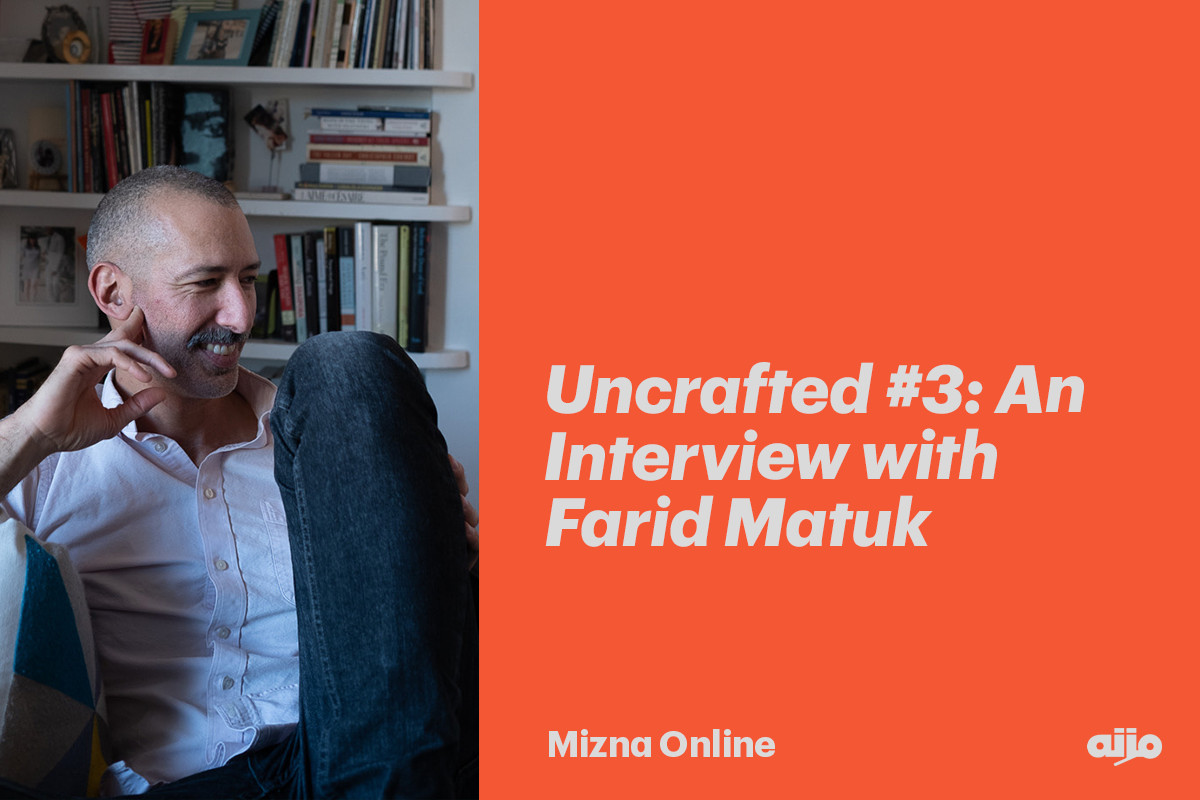
Uncrafted #3: An Interview with Farid Matuk
In a literary landscape where institutional hegemony is rarely challenged, it is easy to forget that poetry as a practice and tradition cannot be encapsulated by the university writing program or the prestigious journal. It is easy to forget that publishing itself is but one avenue with which to engage with and produce literature, and that a literary practice in service of collective liberation will need to go beyond the limited bounds of a literary economy. In our conversation on the complicated legacy of Paul Celan, Farid Matuk reminded me of the political, spiritual, and existential stakes of poetic craft. As importantly, he reminded me that questions of craft and form are inevitably questions of self, belonging, and commitment.
– Hazem Fahmy, Uncrafted Column Editor
HAZEM FAHMY
I usually start these interviews by asking guests broadly about their relationship to the term craft; especially in its institutionalized context. But I want to go straight to something you said in an interview with poets.org. In recounting your educational history, you said: “the MFA nearly stomped out my desire to write.” Can you please share more of that experience?
FARID MATUK
My peers and I were not having the same conversation. And in order to have the same conversation, we would have needed to educate each other just so that we could share terms. That would have taken a long time.
To be more specific, I came out of an undergraduate experience that was really just a mishmash of critical theory and cultural studies. Those are kind of maligned terms now, but it was a really empowering experience for me. I learned as an undergraduate that everything could be denaturalized and questioned. And if you could denaturalize something, you could start to chip away at structures of power. That was really exciting to me.
Later, I started to see that poetry could hold subjective experience and feeling alongside critique and a self-aware play with language. I learned to respect poetry, but I didn’t have an education in canonical, experimental, or any kind of poetry. Before the MFA, I wrote a dozen poems, ten of which went into the application, and that was the totality of my writing output.
I decided to apply after I came back from a Fulbright in Chile. I took one poetry workshop, wrote a couple of poems, and the instructor told me to apply to MFAs. So I went into the Mojave, rented a little adobe shack that was part of an old motel, wrote for three days, and applied to MFAs. I hadn’t read very much in any kind of style. Craft to me then was metaphor and simile. That was all I could think about, so my peers and I were having different conversations.
But I think what I really meant to say in that previous interview was that the careerism that was centered in my MFA program was what stomped away a lot of my desire to write. That program, at the time, was very focused on the achievements of its graduates. The things people paid attention to were prizes, publications, and prestigious fellowships you were expected to get immediately after graduation. I don’t want to posture as if I had a pure relationship to poetry. I don’t think I did then or now. I have ambitions like anyone else. But there was some instinct in me that understood that the stakes could be quite high in this art form. They could be about survival in some way. That notion was not a good match for a culture that tried to teach you how to win an award. It ended up being a positive experience in the sense that, since then, I’ve been suspicious of the ways that the poetry world honors its own. It’s a healthy suspicion that has kept me somewhat sane over the years.
I eventually began to think of craft as a multifarious thing that could be connected to one’s entire sense of existence, their cosmology. But in the MFA, craft only came up as a series of techniques—though that certainly can also be a fairly complex conversation to have. A lot of times, we think about institutionalized craft as musicality and versification, stresses and rhymes, but really, some of the least musical and most politically engaged work that calls itself poetry is exercising the craft of rhetoric.
There are so many planks to the notion of craft. One of the best things I ever heard about craft came from Marie Howe, who visited my MFA program when I was a student. She said it’s like a chord. You have at least five notes—image, rhetoric, narrative, thematics, and musicality—and at any given moment in the poem, you might be striking three of them. It was incredibly helpful of her to say that. Suddenly, the richness of technique became apparent.
As for what I meant about cosmology, many years later, I heard Alice Notley say—I’m paraphrasing, of course—that obviously poetry is the highest art form because it is the art that we are. She was working with a cosmology where semantics, breath, and the body all came together in some relationship with existence. That was a compelling and seductive idea to me. It raised the stakes of why a poet might want to give a fuck about their materials. Craft doesn’t have to be about domesticating experience to achieve legibility. It can be about answering the question: what do you think you are, and how does whatever you are need to articulate?
I’m trying to say that craft can be highly personal and that idiosyncracy can open outward. Poetry is older than the academic discipline of literature, than technologies of print, and therefore, older than genealogies of influence and canons or anything like that. Because I take that seriously, poetry for me has an aspiration to connect to something that is decidedly neither Western nor domesticated through academic disciplines.
HF
That reminds me of something you said in that aforementioned interview about how you resist the singular lyric “I” in order to write through dislocation, accepting the impossibility of a singular forum in which to address your people.
FM
I lack a sense of positioning within a cultural tradition. I’m estranged from my ancestors’ habits, so, I’m trying to humbly account for that, to work with what I have. I also understand that my positioning is really, really close to a kind of Western postmodernity where I could just float around free of the claims of community. But it’s not bad to have community claim you, to ask and expect things of you. There’s a grief and sadness for me in not being claimed by a community.
HF
On the subject of your time in Chile, you’d mentioned in the poets.org interview that one of the things that struck you was the extent to which Pablo Neruda’s commitment to communism has been swept under the rug in most discourse surrounding him, his legacy depoliticized. Do you feel like something similar has befallen Paul Celan?
FM
I don’t know enough about the way that Celan is talked about. I’m very much a novice to Celan scholarship. I’ve mainly read up on how his study of astronomy, geology, and the Kabbalah were three discourses that informed his cosmology and fed his metaphors. But I’m very curious about Celan’s own conception of his politicization. He was dismayed by the way that post-war German critics celebrated his musicality, depoliticizing or ignoring his grief over the Shoah. That’s partly what leads him to a different set of craft choices in his later work. I’m also haunted and troubled by the historical coincidence that is his living in Paris during the 1961 massacre of Algerians by the French National Police. During the Algerian revolution, France freed a lot of its fascist collaborators who had been in jail since the Vichy era, and put them into the police force and the colonial army. We know that the Paris division of the National Police responded to an anti-colonial demonstration by killing demonstrators and dumping their bodies into the Seine, but to this day, no one knows how many. Just a few years later, Celan throws himself into that same river.
There’s always a collective grief in Celan’s work. I have no right to ask anything of him, let alone that he should expand his circle of grieving beyond the specific catastrophe of the Shoah. But I can challenge my own sense of grieving. Maybe that’s the responsibility or possibility of claiming one’s dislocation. Being estranged from a single community might offer something like simultaneity. It’s not that your pain ripples out to touch others. It’s that your body is falling precisely where other bodies have been thrown away, are being thrown away. In some ultimate sense, the distance between us is a lie. People say that Celan’s later work turned language inside out. I think they’re referring to the torqued syntax and compound words. If it’s true that his later poetics turned lyric speech inside out, it also collapsed the distance between self and other, speaker and addressee. It’s not about losing specificity to claim something universal. That would be kind of a classic depoliticizing reading. But maybe the very specific (almost impossible) intensity of Celan’s task led him to a poetics that tried to witness the singularity of the Shoah in a language that simultaneously held space for the way that holocausts iterate, are iterating. Sometimes our craft doesn’t exactly line up with our intentions, or with the communities we hope to address, or with the ones that would claim us.
HF
We’ve talked a lot about contradiction: holding and navigating it. I know that’s very important in your own poetic work. I’m curious how your relationship with this term has been informed or shaped by Celan’s own extremely complex relationship with his native language, German, in terms of it being both his mother tongue and the language of his mother’s killers.
FM
That’s an important question for me, but it concerns more what I’m moving toward in my work rather than what has already happened. I was really thrilled to read Chase Berggrun’s piece on Celan in Poetry because she brought a couple of nuances to the discussion of Celan that are really important to me. Namely, she highlights how, in his later work, Celan is giving up musicality in favor of music. He sacrifices musicality as decorative accompaniment, as a softening element, as something that’s seductive; pleasure for pleasure’s sake. He sacrifices that to engage more intensely with what music is. But it’s neither purely conceptual nor a language that could only be rhetoric. I think Chase makes clear that the question Celan was essentially trying to answer was: how do I lean more into music without any preconceived notions of what music should be? When he got rid of the commonplace and conventional sense of musicality, he became free to invent weird and idiosyncratic syntax and neologisms, but also just really truncated little poems. I appreciate how Chase was able to pinpoint that the political edge sometimes lies in the way you are able to denaturalize something.
And you can denaturalize in multiple ways. If we go back to Marie Howe’s notion of the five notes that can strike a chord—the five notes of craft, if you will—one could just as effectively stick to conventional musicality and use rhetoric, for example, to denaturalize and destabilize expectations of what a poem could be and to what extent a reader should feel comfortable in the space of that poem. I feel more than ever the impulse to just do the late Celan thing and turn inward to turn outward. Much of my newer writing has shifted as a reaction to tech surveillance and the state of online life in this moment. A lot of this is coming from one particular day last year when I turned on Instagram and all the content about Palestine was just suppressed on my feed. It was like somebody had turned off a switch, and it occasioned this retreat from social media. I just shut down accounts and got out of it because it felt like a really polluted space in which to try to speak. It felt very much like I was in someone else’s house.
On that note, I also like how Chase described Celan’s commitment to translating the German language into his own German, trying to make a home in a language that is polluted through and through. It’s too easy, though, to talk about Celan being hermetic. By all accounts, he resisted that label. I think the only way to understand his denaturalizing of German is that it was a turning away from an existing public as an opening—an invitation for other people to follow him into a freer German, a German that could hold the history of that violence while also refusing to make itself legible or familiar to the German public. In that way, I think it held out the possibility of a new public.
In the past, I’ve had a queer relationship to English in the sense that, although I knew it as a colonial language that had sucked up other languages to be the default language of capital, I wanted to play in it anyway; a little piggy in the slop of English. Sometimes that meant making it a little weird, sometimes I wanted to make it really beautiful according to my own sense of what is pleasurable. But now I do want to turn away from English something like how Celan turned away from German.
HF
Pierre Jorris, the translator of Breathturn into Timestead, has a very beautiful introductory essay in the book where he discusses at length how, as much as Celan’s inventiveness was very directly political, and particularly in response to the Holocaust as you’ve mentioned, it also had a lot to do with the fact that he came from the periphery of the German-speaking world. So even before the calamity of the war and the genocide, he already had a very different relationship with the language than the German of the center.
FM
I read that it was his mother who really wanted him to learn High German. I find this relatable in a sense. For people who are in diaspora, your ancestral language—if you have any of it—is often frozen in time. In my case, I have the Spanish of women in their late 30s from 1977; the Spanish of my mother and her sisters, who raised me. When you’re in diaspora, you’re not in that forward momentum of people who are in the center of the culture and the language, and who are changing it as they go. In diaspora we can sometimes get frozen in a nostalgic amber. So I get why in certain poems anachronisms and self-consciously formal constructions would have been seductive to Celan, because it could have been really intimate and aligned with his mother’s values, what she wanted him to learn. But again, it also helps denaturalize and call attention to that diasporic positioning.
HF
We’ve been talking a lot about inventiveness, and I was wondering to what extent your formal experimentation has been shaped by Celan’s penchant for word-making.
FM
It hasn’t yet. That’s one of those things I want to move towards in the next book. What strikes me in terms of artifice in his work is that when he strips away musicality, narrative, and scene, he uses a ton of metaphor. He renders interior landscapes of existence through metaphors of physical landscapes. He’s not talking about the physical world, but in its artifice, it is very real. It’s a great counterpoint to the objectivism of US poetics, where there’s still a strong strain of “no ideas but in [familiar] things.”
I think Celan still very much wanted a reader, no matter how disjointed or compressed or tweaked or obtuse the poems’ angles of sense and syntax. The poems all feel like invitations. The poems want to be read, to co-create with someone willing to use the very austere and spare terms that Celan is laying out. You see this in his use of scope. If in a given poem, he goes from something geological and vast to something incredibly intimate, like an eyelash, that’s a whiplash in scope. He’s not gently walking you down the mountain to the eyelash. He’s not a tourguide. Your reading imagination must quickly grasp the shifts in his poem. Maybe he was a deeply lonely humanist who still believed that poetry could be inviting, but the intensity of the isolation and grief collapsed the invitation into inhabitation – reader and poet occupying one outline, one voice, one simultaneity, and getting that close that fast can feel unnatural in the best way. I think that’s the power of poetic artifice. I create a shape in language, and maybe a reader chooses to enter it with me. We are distinct but simultaneous, susceptible along a double edge of body and breath. Like Prince said, “animals strike curious poses.” Maybe our shared shape is our truer shape, and there we’re both free.

Farid Matuk is the author of the poetry collections This Isa Nice Neighborhood (Letter Machine Editions, 2010), The Real Horse (University of Arizona Press, 2018), and Moon Mirrored Indivisible (University of Chicago Press, 2025). With artist Nancy Friedemann-Sánchez, Matuk created the book-arts project Redolent, recipient of the 2023 Rabinowitz Prize from the Poetry Society of America. Matuk is also the translator of Tilsa Otta’s selected poems, The Hormone of Darkness (Graywolf Press, 2024). Matuk’s work has been supported by the Headlands Center for the Arts, a Holloway Lectureship in the Practice of Poetry at UC Berkeley, and a 2024 USA Fellowship.

Hazem Fahmy is a writer and critic from Cairo. A PhD student in Middle Eastern Studies at Columbia University, he is the author of three chapbooks: Red//Jild//Prayer (2017) from Diode Editions, Waiting for Frank Ocean in Cairo (2022) from Half-Mystic Press, and At the Gates (2023) from Akashik Books’ New-Generation African Poets series. He is a Watering Hole Fellow, and his writing has appeared, or is forthcoming in The Boston Review, Prairie Schooner, Mubi Notebook, Reverse Shot, and Mizna.
Related
The Bringers of Violence
Sunbird
A Box of Dates on the Kitchen Table
ARTIST TALK—Wael Morcos: Graphic Design in Multi-Cultural Contexts


